

Government partners with Meta to boost consumer awareness through AI
By Doruvu Paul Jagan Babu: Assistant Chief Editor

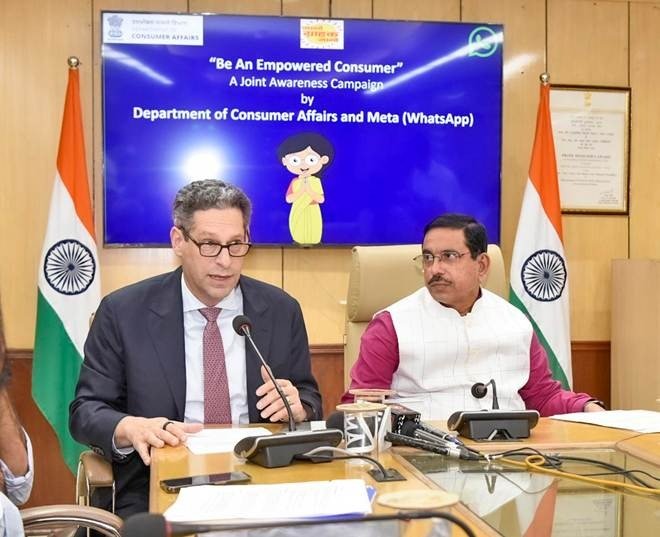
New Delhi: Union Minister for Consumer Affairs, Food and Public Distribution and New and Renewable Energy, Pralhad Joshi, along with Meta’s Chief Global Affairs Officer, Joel Kaplan, announced a new collaboration titled ‘Be an Empowered Consumer.’ The initiative aims to enhance digital literacy under the government’s flagship consumer awareness campaign, ‘Jago Grahak Jago.’
Speaking at the launch, Joshi emphasized that the partnership will equip citizens with tools to navigate the digital landscape and safeguard themselves online. “Consumer awareness is key to a secure digital experience, and this campaign will reinforce our commitment to empowering Indian consumers,” he said. He further highlighted that this initiative will help extend consumer protection efforts to remote areas of the country.
Educating consumers on online safety
The ‘Be an Empowered Consumer’ campaign seeks to educate individuals on recognizing online threats, adopting secure digital habits, and reporting suspicious activities. The campaign stresses the importance of strong passwords, verifying online information, and avoiding digital fraud. Discussions regarding this initiative took place prior to its launch.


AI-powered consumer grievance redressal tool
During the meeting, Joshi was briefed on a joint project commissioned with IIT Bombay, in collaboration with the National Law School of India University, Bangalore, and supported by Meta. The project explores the feasibility of leveraging Llama 2, Meta’s open large language model, to create a consumer-centric chatbot named GrahakNyay. This AI-powered chatbot is designed to enhance access to consumer rights information and streamline grievance redressal processes. It is currently undergoing closed-group beta testing and will be integrated into the Department of Consumer Affairs (DoCA) website upon completion.
Nidhi Khare, Secretary, Department of Consumer Affairs, reaffirmed the government’s commitment to consumer rights and emphasized the importance of digital literacy in countering unethical business practices. She noted that GrahakNyay will enable seamless complaint filing and efficient resolution of consumer grievances.

Meta’s commitment to digital consumer protection
Kaplan highlighted Meta’s role in consumer protection efforts, stating, “With rapid technological advancements, staying updated on online safety measures is crucial. By making AI more accessible, we aim to enhance consumer awareness, improve redressal mechanisms, and empower individuals to make informed choices online.”
Strengthening consumer rights through policy and technology
The Department of Consumer Affairs continues to drive consumer protection through legislative advancements and technology-driven initiatives. The rise of digital commerce has exposed consumers to new forms of unfair trade practices, including misleading advertisements and unethical e-commerce strategies. To counter this, the Central Consumer Protection Authority (CCPA) was established under the Consumer Protection Act, 2019, to regulate consumer rights violations and unfair trade practices.
Under Section 18 of the Act, the CCPA is empowered to prevent deceptive advertising and issue safety alerts regarding hazardous goods or services. Sections 20 and 21 enable the authority to impose penalties of up to ₹50 lakh for violations.
Recent consumer protection measures
In recent years, the CCPA has issued advisories and taken action against illegal sales of wireless jammers, prescription drugs, and car seat belt alarm stoppers. The Consumer Protection (E-commerce) Rules, 2020, and the Guidelines for Prevention of Misleading Advertisements (2022) have been implemented to ensure accountability in online commerce. Additional efforts incl…