



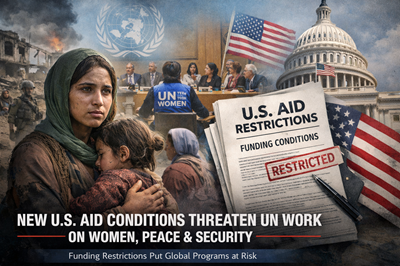
SPECIAL-REPORT : The global agenda for women, peace, and security—a cornerstone of international efforts to build sustainable peace and protect vulnerable communities—faces a new challenge as recent conditions attached to United States foreign assistance raise concerns among diplomats, humanitarian agencies, and civil society groups. Observers warn that new policy restrictions tied to U.S. funding may disrupt programs designed to empower women, prevent conflict-related violence, and strengthen inclusive governance in fragile regions.
At the center of the controversy is the potential impact of these conditions on United Nations initiatives that depend heavily on American funding and political support. Experts fear that new requirements could undermine decades of progress made under the international framework established by United Nations policies and resolutions that recognize women as key actors in peacebuilding and conflict prevention.
The Women, Peace and Security Agenda
The international framework known as the Women, Peace and Security (WPS) agenda began with the adoption of United Nations Security Council Resolution 1325 in 2000 by the United Nations Security Council. The resolution marked a historic shift in how the international community understood the relationship between gender equality and global security.
Resolution 1325 called for the increased participation of women at all levels of decision-making in peace processes, greater protection of women and girls during armed conflict, and the integration of gender perspectives into peacekeeping missions and humanitarian responses. Over the past two decades, the resolution has been supported by additional UN measures and adopted by governments worldwide as a guiding principle for building durable peace.
Programs inspired by the WPS agenda focus on several key areas:

-
Supporting women’s leadership in peace negotiations
-
Protecting women and girls from conflict-related sexual violence
-
Ensuring humanitarian responses meet gender-specific needs
-
Promoting gender equality in post-conflict governance
The United States has historically been one of the strongest financial supporters of these initiatives, providing funding through international aid programs and diplomatic backing in multilateral forums.
U.S. Aid and Its Global Influence
The United States remains the largest single contributor to many international humanitarian and development programs. Through agencies such as the United States Agency for International Development, American assistance supports projects ranging from conflict prevention to health care and education.
Because of this influence, any change in U.S. foreign aid policy often has ripple effects across the global humanitarian landscape. When Washington modifies the terms of its financial contributions, international organizations—including UN agencies—must adapt quickly to comply with new conditions.
Recent adjustments to aid rules, however, have sparked alarm among advocacy groups working on gender equality and conflict prevention. These groups argue that the restrictions could limit the ability of UN programs to cooperate with local organizations or carry out activities aimed at empowering women in fragile environments.
New Conditions and Their Potential Impact
According to policy analysts, the new conditions attached to U.S. funding require stricter compliance with certain domestic policy priorities. These requirements may include limitations on partnerships, reporting obligations, and oversight provisions that could complicate collaboration between UN agencies and grassroots organizations.
While the exact scope of the restrictions varies depending on the funding channel, critics say the measures risk disrupting ongoing projects that rely on flexible cooperation with civil society groups. Many of these organizations play crucial roles in reaching communities affected by conflict, especially women’s networks that operate at the local level.
Officials working within UN programs fear that administrative constraints could slow down program implementation or discourage partnerships with organizations that cannot meet the new regulatory requirements.
For initiatives designed to support women’s participation in peace negotiations or address gender-based violence, such disruptions could significantly reduce their effectiveness.
Concerns From Civil Society
Women’s rights groups and humanitarian organizations have voiced concern that the new funding conditions may unintentionally weaken the global movement to include women in peacebuilding.
Advocates argue that women’s organizations—especially those operating in conflict zones—often rely on UN support to continue their work. If funding restrictions limit the UN’s ability to collaborate with these groups, the consequences could be severe.
Civil society leaders point out that many grassroots organizations lack the resources to comply with complex donor regulations. Without access to international support networks, their ability to influence peace processes could diminish.
Some activists also worry that the new requirements could discourage UN agencies from funding smaller organizations altogether, favoring larger institutions that have the administrative capacity to navigate complicated compliance procedures.
Importance of Women in Peacebuilding
Research conducted by international institutions consistently shows that peace agreements are more likely to succeed when women participate in negotiations and political decision-making.
Studies have demonstrated that peace deals involving women are significantly more durable and inclusive. Women often advocate for issues such as education, community development, and social reconciliation—factors that contribute to long-term stability.
In conflict zones ranging from Africa to the Middle East, women’s networks have helped mediate disputes, rebuild trust between communities, and support survivors of violence.
The WPS agenda therefore emphasizes not only protecting women but also recognizing them as essential leaders in the peacebuilding process.
UN Agencies and Field Operations
Several UN agencies play key roles in implementing the women, peace and security agenda. Among them is UN Women, which focuses specifically on gender equality and women’s empowerment.
UN Women works closely with peacekeeping missions, humanitarian organizations, and local partners to integrate gender perspectives into conflict prevention and recovery programs. The agency also supports training initiatives aimed at increasing women’s participation in politics and security institutions.
Other UN bodies—including peacekeeping missions and development programs—rely on similar partnerships with local organizations to implement gender-sensitive initiatives.
If funding conditions complicate these partnerships, agencies could face delays or reductions in program scope.
Diplomatic and Political Debate
The issue has sparked debate among policymakers and diplomats. Supporters of the new conditions argue that stronger oversight of foreign aid ensures accountability and aligns international programs with national policy priorities.
They maintain that transparency and regulatory compliance are essential when public funds are used to support international organizations.
Critics, however, warn that overly restrictive rules could undermine multilateral cooperation and weaken programs designed to address complex global challenges.
Diplomats from several countries have reportedly raised concerns in international forums, emphasizing that the success of the WPS agenda depends on flexible collaboration between governments, international organizations, and civil society.
Regional Implications
The potential impact of the new funding conditions may be particularly significant in regions affected by ongoing conflict or political instability.
In areas where women’s participation in politics remains limited, international support is often crucial for creating opportunities for leadership and representation.
For example, women’s groups in post-conflict societies frequently rely on UN-backed programs to advocate for legal reforms, promote education, and support survivors of violence.
If these initiatives lose funding or face administrative obstacles, the progress achieved over the past two decades could slow considerably.
Long-Term Consequences
Experts caution that the effects of funding changes may not be immediately visible but could emerge gradually over time.
Programs designed to strengthen women’s participation in governance and peace processes often require sustained support over many years. Interruptions in funding can weaken local networks and erode trust between communities and international partners.
Furthermore, setbacks in the WPS agenda could have broader implications for global stability. When women are excluded from peace processes, the resulting agreements may fail to address the needs of entire communities, increasing the risk of renewed conflict.
Maintaining consistent support for gender-inclusive initiatives therefore remains a critical priority for many international policymakers.
Calls for Dialogue and Cooperation
In response to the growing concerns, many analysts have called for dialogue between U.S. policymakers, UN officials, and civil society organizations.
They argue that constructive engagement could help clarify the new funding rules and ensure that essential programs continue without disruption.
Some experts suggest that flexible implementation mechanisms or targeted exemptions could allow UN agencies to maintain partnerships with grassroots organizations while still meeting donor requirements.
Such solutions could help balance the need for accountability with the practical realities of working in fragile and conflict-affected environments.
The Future of the Women, Peace and Security Agenda
Despite the uncertainty created by the new aid conditions, supporters of the WPS agenda remain determined to continue advancing gender equality in peacebuilding.
International organizations, governments, and advocacy groups have spent more than two decades building a global consensus around the importance of women’s participation in security and governance.
The coming months may determine whether new funding policies will reshape the landscape of international assistance—or whether adjustments can be made to preserve the progress already achieved.
For millions of women living in conflict-affected regions, the outcome of this debate could influence not only the success of peace initiatives but also the prospects for safer, more inclusive societies.
The evolving debate over U.S. foreign aid conditions highlights the delicate balance between national policy priorities and international cooperation. As the world continues to confront complex conflicts and humanitarian crises, programs that empower women and promote inclusive peacebuilding remain vital.
The challenge for policymakers will be ensuring that regulatory changes do not unintentionally weaken the very initiatives designed to prevent violence and build lasting peace.
For the global community and organizations such as the United Nations, preserving the momentum of the women, peace and security agenda will require sustained collaboration, political commitment, and a shared understanding that gender equality is inseparable from global stability.