


Social Media: 5 Critical Facts About How Virality Beats Truth
By Doruvu Paul Jagan Babu: Assistant Chief Editor

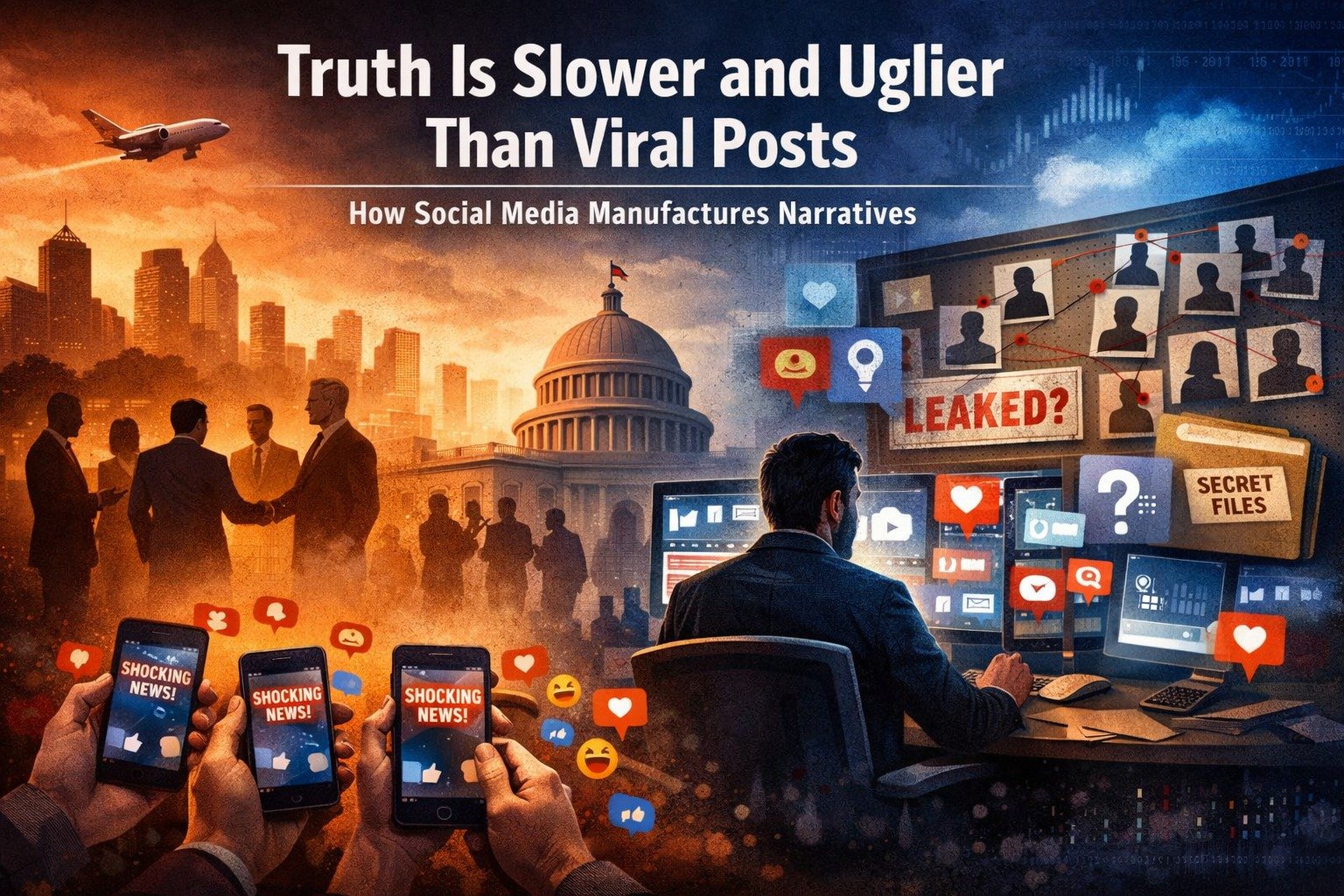
There was a time when news travelled slowly, but facts travelled far. Today, news travels instantly, while facts struggle to keep up. In the age of social media, virality has replaced verification, outrage has replaced understanding, and narratives are manufactured faster than truth can surface. What we are witnessing is not merely a change in how information spreads, but a transformation in how people believe.
According to widely available information on the internet, social media platforms are designed to reward engagement—likes, shares, comments—not accuracy. This structural reality explains why emotionally charged content, especially involving power, crime, secrecy, and morality, spreads far quicker than sober, evidence-based reporting.

As one old journalistic saying goes: “A lie can travel halfway around the world while the truth is still putting on its shoes.” In today’s digital ecosystem, that lie doesn’t just travel—it trends.
Manufacturing narratives: How It really works
Narratives on social media are rarely accidental. They are built through repetition, selective emphasis, and omission. A complex legal or investigative issue is broken down into:

A shocking claim
A vague villain (often described as elites, corporates, or political circles)
A moral conclusion delivered before facts are examined
According to media studies and digital behaviour research available online, algorithms amplify content that triggers anger, fear, or moral superiority. Nuance does not perform well; certainty does—even when that certainty is false or premature.
This is how a case becomes a story, and a story becomes a belief system.

The illusion of hidden truths and secret lists
One recurring feature of viral narratives is the promise of a “hidden truth” or a “secret list.” Psychologists explain this as the illusion of exclusive knowledge—the feeling that one possesses information others are trying to hide.
Historically, rumours of secret cabals have existed in every era. In earlier times, they spread through word of mouth. Today, they spread through forwarded messages, edited videos, and screenshots stripped of context.
Available court documents, investigative reports, and verified journalism on the internet consistently show that legal processes are slow, evidence-based, and often disappointing to those seeking instant moral closure. This gap between public expectation and legal reality is where misinformation thrives.
Safe outrage and distant villains
One reason such narratives gain traction in India is that they offer safe outrage. The villains are distant—foreign systems, unnamed global elites, abstract corporate or political circles. Anger can be expressed without demanding accountability in one’s immediate surroundings.
Sociologists often note that societies under economic stress, inequality, or political uncertainty are more receptive to simplified moral stories. When daily realities are complex and exhausting, a clear villain provides emotional relief.
But this relief comes at a cost: attention is diverted from structural problems closer home.
When virality replaces journalism
According to available data on media consumption, a large section of the public now encounters news first through social media rather than newspapers or verified portals. The problem is not access—it is context.
Traditional journalism asks:
Who is the source?
What is the evidence?
What is legally proven?
What remains allegation?
Social Media asks only one question:
Will this spread?
An anecdote often shared in newsrooms captures this reality: “If the headline shocks you, the article probably won’t.” On social media, many never read beyond the headline—or worse, beyond the caption.
The middle ground that goes missing
Fact-based reporting available on the internet repeatedly shows that reality usually lies between two extremes:
Total innocence
Total conspiracy
But social media dislikes the middle ground. It prefers absolutes—heroes and villains, victims and monsters. In this process, uncertainty is portrayed as weakness and caution as complicity.
Legal systems, however, operate on evidence, timelines, and due process. They are slow not because they are hiding the truth, but because truth itself is complicated.
What the data tells us—and what it doesn’t
Publicly accessible information shows that:
Association is not proof
Allegation is not conviction
Mention in documents is not establishment of guilt
Yet viral narratives collapse these distinctions. This does not mean that power structures are innocent or that systems do not fail. It means that criticism must be grounded in facts, not forwarded assumptions.
As another old saying reminds us: “Facts are stubborn things.”* They do not bend to hashtags.
Choosing to be informed, not influenced
The real danger of manufactured narratives is not that they deceive everyone—it is that they exhaust people. Constant outrage creates fatigue, cynicism, and eventual disengagement.
An informed reader today must slow down deliberately:
Cross-check sources
Read beyond viral posts
Distinguish opinion from evidence
Accept that some questions take time to answer
Truth, as history repeatedly shows, emerges quietly—often long after the noise has faded.
Slowing down is a civic act
In an era where virality defines visibility, choosing patience is an act of resistance. Truth is rarely cinematic. It does not arrive with dramatic music or explosive revelations. It comes through documents, testimonies, timelines, and uncomfortable complexities.
Social media manufactures narratives at the speed of emotion. Truth, however, moves at the speed of verification.