

US–Israel Strikes Target Iran’s Internal Security Forces as Conflict Intensifies 2026
By Samir Singh 'Bharat': Editor In Chief

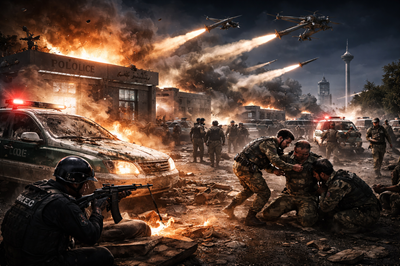
WAR-REPORT : A coordinated military campaign by United States and Israel has intensified in recent days, with new strikes focusing on key components of Iran’s internal security apparatus. The latest operations, carried out on March 12 and March 13, appear aimed not only at degrading Iran’s military capabilities but also at weakening the domestic institutions responsible for maintaining regime control.
According to military officials, the campaign has targeted units within Iran’s security structure that play a central role in suppressing protests and enforcing government authority. Analysts say the strategy reflects a broader effort to destabilize the Iranian regime by undermining both its external military strength and its internal mechanisms of control.

Strikes Target Iranian Law Enforcement Infrastructure
On March 13, the combined US–Israeli force conducted precision strikes against facilities belonging to the Law Enforcement Command in Gharchak. These sites were reportedly associated with specialized police units responsible for traffic enforcement and economic security operations.
The targeted facilities are believed to support internal security operations throughout Tehran Province, the political and administrative heart of the country. While traffic police may appear unrelated to military operations, officials say these units form part of a larger domestic security framework that the government relies on to maintain order during periods of unrest.
Military planners involved in the campaign argue that weakening such institutions can disrupt the regime’s ability to coordinate internal security responses during crises.

Separate Israeli Strikes Hit Basij Checkpoints
In addition to the joint strikes, the Israel Defense Forces launched independent operations targeting checkpoints operated by the Basij in Tehran Province.
The attacks took place on March 12 and March 13, hitting at least two checkpoints located in northeastern and southeastern parts of the province. The Basij, which operates under the authority of the Islamic Revolutionary Guard Corps, is widely known for its role in enforcing ideological loyalty and suppressing anti-government demonstrations.
For decades, Basij units have been deployed throughout urban areas to monitor public activity, control crowds, and respond to political unrest. Their presence at checkpoints and public facilities has made them a visible symbol of the regime’s internal security apparatus.

By targeting Basij positions, Israeli forces appear to be focusing on institutions directly associated with regime stability rather than solely on conventional military assets.

Iranian Security Forces Disperse to Avoid Detection
In response to the strikes, Iranian security personnel have reportedly altered their deployment patterns. According to field reports, members of the Basij, the Law Enforcement Command, and other security units have abandoned many fixed checkpoints across major urban areas.
Instead, these personnel have moved to temporary shelters and concealed positions to reduce their vulnerability to surveillance drones and follow-on airstrikes.
Witnesses and local sources reported that security forces have taken cover beneath highway overpasses, bridges, and other structures in cities including Rasht and multiple districts within Tehran.
Military analysts believe this shift reflects growing concern among Iranian personnel about the precision targeting capabilities of modern drone surveillance and strike systems.
Strategy Focused on Internal Security Institutions
The latest attacks are part of a broader pattern in which US and Israeli forces have repeatedly targeted elements of Iran’s internal security network.
Among the organizations reportedly struck during the campaign are:
-
The Law Enforcement Command
-
The Basij
-
Units of the Islamic Revolutionary Guard Corps
These institutions form the backbone of the Iranian regime’s domestic control system. They are responsible for monitoring political dissent, suppressing demonstrations, and maintaining order during crises.
By targeting these organizations, the combined force appears to be pursuing a strategy aimed at weakening the regime’s ability to maintain internal stability.
Netanyahu Signals Support for Regime Change
The campaign’s broader political objectives were highlighted by comments from Benjamin Netanyahu during a press conference on March 12.
Speaking publicly for the first time since the conflict began, Netanyahu said Israel’s actions are intended to create conditions that could eventually lead to the collapse of Iran’s ruling system.
“We are creating the optimal conditions for toppling the regime,” Netanyahu stated.
He emphasized that meaningful political change in Iran would ultimately have to come from within the country itself. However, he suggested that Israeli military operations could help facilitate that outcome.
“A regime needs to be toppled from the inside,” Netanyahu said. “But we can definitely help—and we are helping.”
The remarks represent one of the clearest public statements linking Israel’s military operations to the prospect of political transformation inside Iran.
New Wave of Strikes Hits Command Centers
The Israel Defense Forces reported that additional strikes were carried out on March 13 targeting command elements associated with several Iranian security organizations.
These operations focused on command structures linked to:
-
The Islamic Revolutionary Guard Corps
-
The Law Enforcement Command
-
The Basij
Military officials say the attacks were designed to disrupt coordination between different branches of Iran’s security forces.
Destroying command centers can have significant operational effects because it interferes with communication, intelligence sharing, and decision-making processes within the targeted organizations.
Iran’s Missile and Drone Capabilities Severely Damaged
Beyond the strikes on internal security institutions, Western officials say the campaign has inflicted heavy damage on Iran’s missile and drone forces.
A senior official from the Israel Defense Forces reported that Israeli forces have destroyed between 160 and 190 missile launchers while disabling another 200 launch systems.
These losses have significantly reduced Iran’s ability to conduct retaliatory strikes against regional targets.
The official also noted that Iranian missile crews have become increasingly reluctant to deploy their equipment due to fears of being targeted by surveillance drones and precision strikes.
Western Estimates of Military Damage
According to reporting by Bloomberg, Western governments estimate that the combined US–Israeli operations have destroyed approximately 80 percent of Iran’s offensive military capabilities.
While the exact figures remain difficult to verify independently, analysts agree that the campaign has inflicted substantial damage on Iran’s strategic weapons infrastructure.
The scale of destruction suggests that the strikes have targeted not only launchers but also storage facilities, maintenance centers, and logistical networks associated with Iran’s missile and drone programs.
Signs of Strain Within Iranian Security Forces
The ongoing conflict appears to be placing significant pressure on Iran’s security institutions.
The senior Israel Defense Forces official stated that Iranian forces have suffered at least 10,000 casualties since the beginning of the campaign.
In addition to battlefield losses, reports indicate growing morale problems among Iranian personnel.
The official noted that some soldiers and missile operators have deserted their positions or refused to carry out orders.
Separate reports from anti-government media outlets suggest that the Islamic Revolutionary Guard Corps attempted to mobilize reserve forces earlier in the week. However, several individuals reportedly failed to report to designated military centers.
If confirmed, these developments could indicate a weakening of discipline within parts of Iran’s military structure.
Limited Maritime Traffic Through the Strait of Hormuz
While the conflict continues on land and in the air, developments at sea suggest that Iran is selectively allowing some maritime traffic to pass through the strategically vital Strait of Hormuz.
Sources familiar with the situation told Reuters on March 13 that two Indian-flagged liquefied petroleum gas carriers were recently permitted to transit the strait.
Another vessel carrying Saudi Arabia crude oil is expected to arrive in India on March 14 after passing through the strait earlier this month.
These movements indicate that Iran may be allowing certain shipments to continue despite the broader disruption caused by the conflict.
Turkey and Iraq Also Granted Passage
Officials from Turkey confirmed that an Iranian authority allowed a Turkish-owned ship to navigate through the strait.Israeli
According to statements reported by the Iranian outlet Fars News Agency, the vessel received permission because it was operating in connection with an Iranian port.
Meanwhile, Mohammad Kazem al Sadegh stated that oil tankers from Iraq can also pass through the strait under certain conditions.Israeli
He explained that ships must provide identification details and certify that they are not owned by companies linked to the United States or Israel.
Maritime Traffic Drops Dramatically
Despite these limited exceptions, maritime activity in the Strait of Hormuz has fallen sharply since the start of the conflict.
Data released by the United Nations indicates that overall shipping traffic through the waterway has dropped by 97 percent.
The dramatic decline highlights the broader economic impact of the war, particularly on global energy markets.
The Strait of Hormuz is one of the world’s most important oil transit routes, carrying a significant portion of global petroleum exports. Any disruption to shipping in this region can have far-reaching consequences for international trade and energy prices.
The ongoing campaign by United States and Israel against Iran represents one of the most significant military confrontations in the Middle East in recent years.
By targeting both Iran’s strategic weapons infrastructure and its internal security institutions, the combined force appears to be pursuing a dual strategy aimed at weakening the regime’s military capabilities and its ability to maintain domestic control.
At the same time, selective maritime access through the Strait of Hormuz suggests that Iran is attempting to manage the economic consequences of the conflict while maintaining leverage over global shipping routes.
As the conflict continues to unfold, the balance between military operations, internal stability, and international economic pressures will likely shape the next phase of the crisis.