

Decisive Escalation: US–Israel Air Campaign 2026 Gains Air Superiority Over Tehran
By Samir Singh 'Bharat': Editor In Chief

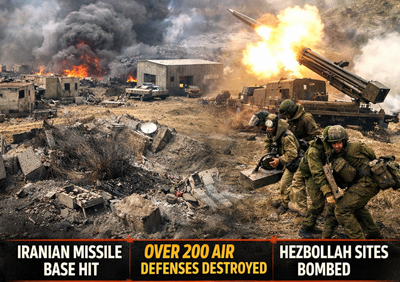
WAR-REPORT : The combined United States and Israeli military campaign against Iran entered a decisive new phase this week, as officials from both countries confirmed that sustained air operations have significantly degraded Iranian air defense systems, enabling what American commanders described as “local air superiority” over western Iran and the capital, Tehran.
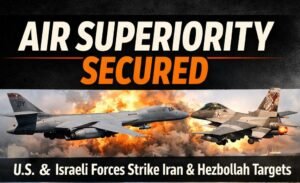
On March 2, Chairman of the US Joint Chiefs of Staff, General Dan Caine, announced that coalition forces had established localized dominance in Iranian airspace following several days of intensive strikes. The statement marked a critical milestone in the rapidly evolving conflict, which began on February 28 and has since expanded across multiple theaters, including Iran, Lebanon, and parts of the eastern Mediterranean.

The Israel Defense Forces (IDF) stated that more than 200 Iranian air defense systems have been targeted since hostilities commenced. According to Israeli military officials, the systematic dismantling of radar arrays, missile batteries, and command-and-control nodes has opened strategic corridors in Iranian airspace, reducing the operational risks previously posed to coalition aircraft.
Israeli Defense Minister Israel Katz disclosed on March 1 that Israeli aircraft have begun deploying “stand-in” munitions directly over Tehran—an operational shift made possible by the suppression of Iranian surface-to-air missile (SAM) capabilities. Traditionally, Israeli jets relied on stand-off weapons launched from significant distances to avoid air defense threats. The ability to conduct close-in precision strikes suggests a marked erosion of Iran’s defensive shield around its capital.
Military analysts view the transition to stand-in munitions as a clear signal that Iran’s integrated air defense network has been fragmented. Aircraft flying directly over high-value targets implies diminished radar tracking, weakened missile response, and compromised coordination among Iranian defense units. The operational shift also broadens the range of aircraft platforms that can be deployed, including older or less stealth-oriented models.

In a parallel development, United States Central Command (CENTCOM) confirmed that US B-1 bombers conducted precision strikes on March 1 aimed at degrading Iran’s ballistic missile capabilities. The use of B-1 aircraft—long-range, heavy bombers capable of delivering substantial payloads—demonstrates Washington’s growing confidence in the permissiveness of Iranian airspace.
While the B-1 is not a stealth aircraft like the B-2 Spirit, its deployment indicates that coalition planners assess the remaining Iranian air defenses as sufficiently weakened to mitigate the risks traditionally associated with such platforms. Defense experts argue that this operational choice underscores the cumulative impact of days of suppression strikes.

Systematic Targeting of Missile Infrastructure
Beyond air defense suppression, coalition operations have increasingly focused on Iran’s ballistic missile infrastructure—seen as a central pillar of Tehran’s deterrence posture. Satellite imagery circulating among defense analysts shows significant bunker-buster bomb impacts at the Islamic Revolutionary Guards Corps Aerospace Force Imam Ali Missile Base in Khorramabad, Lorestan Province.
The base, operated by the Islamic Revolutionary Guard Corps (IRGC), houses the al Hadid 7th Missile Brigade and the al Tawhid 23rd Missile Brigade. Intelligence assessments indicate that the facility stores Shahab-3 ballistic missiles, which have an operational range estimated between 800 and 1,300 kilometers—placing Israel and US regional installations well within reach.
The Shahab-3 system has long formed the backbone of Iran’s medium-range ballistic missile arsenal. By targeting storage bunkers and support infrastructure at Imam Ali, coalition forces appear intent on disrupting Iran’s capacity to launch coordinated missile barrages.
Further strikes on March 2 targeted the Bid Ganeh ballistic missile facility in Tehran Province. Missile experts believe Bid Ganeh serves as a key storage and production site for medium-range ballistic missiles. Notably, Israel had previously targeted the same facility during the June 2025 Israel-Iran confrontation, underscoring its strategic importance.
Analysts suggest that the destruction of missile depots and command facilities may complicate Iran’s ability to execute synchronized, large-scale retaliatory attacks. By focusing on both missile stockpiles and logistical infrastructure, coalition planners are attempting to undermine not only Iran’s immediate launch capacity but also its replenishment and coordination mechanisms.
Strategic Implications of Air Dominance
Establishing air superiority carries both tactical and strategic implications. Tactically, it allows coalition aircraft to operate with reduced risk, conduct sustained surveillance missions, and strike dynamic targets with greater precision. Strategically, it exerts psychological pressure on Iran’s leadership and military command structure.
The ability of Israeli and American aircraft to operate over Tehran without significant interference signals a profound vulnerability within Iran’s defensive architecture. Military strategists note that such dominance can shift the conflict’s tempo, enabling rapid targeting cycles and flexible force deployment.
Moreover, air superiority enhances intelligence, surveillance, and reconnaissance (ISR) capabilities. With Iranian radar networks degraded, coalition drones and reconnaissance aircraft can more effectively map remaining targets, monitor troop movements, and assess battle damage in near real-time.
However, defense experts caution that localized air superiority does not equate to total control across Iran’s vast geography. Iran retains dispersed missile units, mobile launchers, and hardened underground facilities that may continue to pose challenges.
Expanding Operations in Lebanon
The conflict has not been confined to Iranian territory. On March 2, the IDF expanded air operations in Lebanon, targeting sites associated with Hezbollah in an effort to preempt retaliatory attacks against Israel.
According to Israeli military statements, more than 70 Hezbollah weapons depots, launch sites, and launchers in southern Lebanon were struck in a single day. The campaign appears aimed at degrading Hezbollah’s capacity to launch rockets or precision-guided munitions into northern Israel.
In addition to military infrastructure, Israeli forces targeted branches of al Qard al Hassan across Lebanon. Al Qard al Hassan functions as Hezbollah’s principal financial institution, operating approximately 30 branches nationwide. Israeli officials allege that the institution channels funds used to finance military operations, pay fighters, and procure weapons.
The IDF has previously targeted al Qard al Hassan during and after the Fall 2024 Israel-Hezbollah conflict, viewing it as a critical financial artery sustaining Hezbollah’s operational capabilities. By striking both kinetic and financial nodes, Israel appears to be applying a comprehensive pressure strategy.
Hezbollah’s Southern Presence
Notably, Israeli airstrikes have concentrated largely in southern Lebanon. This geographic focus is significant because the IDF had earlier assessed that Hezbollah had relocated much of its heavy weaponry and combat units north of the Litani River to mitigate vulnerability.
The continued targeting of southern sites suggests that Hezbollah retains smaller, decentralized units capable of mounting limited cross-border attacks. Such units may rely on concealed rocket launchers and mobile platforms designed to evade detection.
Security analysts argue that Hezbollah’s operational model—emphasizing dispersion and redundancy—allows it to sustain limited retaliatory capabilities even after sustained air campaigns. While large-scale coordinated barrages may be disrupted, sporadic attacks remain plausible.
Regional and International Reactions
The escalation has drawn international attention, with regional governments expressing concern over the widening scope of hostilities. Diplomatic channels remain active, though prospects for immediate de-escalation appear uncertain.
Military observers note that the coalition’s emphasis on degrading missile capabilities may reflect a desire to prevent a broader regional conflagration. By limiting Iran’s ability to project force via ballistic missiles, the United States and Israel may be attempting to contain escalation.
At the same time, analysts warn that continued strikes on high-profile Iranian military facilities could provoke asymmetric responses. Iran’s regional network of allied militias, including Hezbollah, remains a variable factor in the conflict’s trajectory.
The Road Ahead
As the conflict progresses, several key questions loom. Can Iran regenerate its air defense and missile capabilities in the short term? Will Hezbollah escalate beyond limited retaliatory actions? And how long can coalition forces sustain high-tempo operations without broader regional spillover?
The coming days will likely test the durability of coalition air dominance and Iran’s capacity for adaptation. Military campaigns of this scale often evolve unpredictably, particularly when multiple theaters are involved.
For now, coalition commanders project confidence. The declaration of localized air superiority, the deployment of B-1 bombers, and the sustained targeting of missile infrastructure collectively indicate a deliberate strategy aimed at reshaping the strategic balance.
Yet history suggests that air campaigns alone rarely determine long-term outcomes. While the degradation of air defenses and missile stockpiles represents a tangible operational success, the broader political and strategic consequences remain uncertain.
The conflict has entered a phase defined by rapid strikes, shifting tactical advantages, and mounting regional stakes. Whether air superiority translates into lasting strategic leverage will depend on developments in Tehran, Beirut, and beyond.
As coalition aircraft continue to patrol contested skies and missile facilities smolder under the weight of precision strikes, the Middle East stands at a pivotal juncture—one where military calculations intersect with geopolitical realities, and where the next move could shape the region’s security landscape for years to come.