

Will Trump Escalate in Iran? Dangerous Crisis Could Trigger Global Disaster
By Samir Singh 'Bharat': Editor In Chief

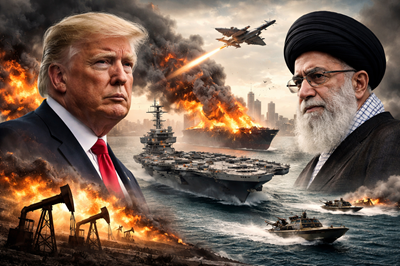
WAR-REPORT : The ongoing confrontation between the United States and Iran has rapidly evolved from a limited military engagement into one of the most dangerous geopolitical crises of the 21st century. What began as a campaign intended to pressure Tehran into submission has instead produced a volatile and unpredictable standoff, with consequences reverberating across global energy markets, diplomatic alliances, and domestic politics.
At the center of this unfolding crisis stands Donald Trump, whose decisions in the coming weeks may determine whether the conflict stabilizes or spirals into a far more destructive phase. The question now confronting policymakers, analysts, and citizens worldwide is stark: will the situation deteriorate further, transforming an already troubling war into a disastrous one?

This article examines the strategic, political, and economic dynamics shaping the conflict, exploring whether escalation is inevitable—or avoidable.
Table of Contents
ToggleA War That Defied Expectations
When the United States initiated military operations against Iran, expectations in Washington were clear. The campaign was supposed to be swift, decisive, and limited in scope. Early assumptions suggested that overwhelming American military superiority would quickly degrade Iran’s capabilities and force it back to the negotiating table.
Instead, the conflict has stretched into weeks, exposing the limitations of military power in achieving complex political objectives. Iran has demonstrated resilience, adapting its strategy and leveraging asymmetric tactics to counter a technologically superior adversary.

Rather than collapsing under pressure, Tehran has responded with calculated defiance—targeting regional interests, sustaining missile operations, and exploiting vulnerabilities in global energy infrastructure. The result is a conflict that has not only endured but intensified, challenging initial assumptions of a quick victory.
Analysts increasingly warn that the United States may have underestimated both Iran’s capacity to absorb damage and its willingness to escalate.
The Escalation Trap
One of the most dangerous dynamics now at play is what experts describe as an “escalation trap.” This occurs when initial military actions fail to achieve their objectives, prompting decision-makers to intensify operations in the hope of securing a decisive outcome.

In the current scenario, each round of escalation risks provoking a stronger or more unconventional response from Iran. Military strikes intended to weaken Tehran’s capabilities have instead encouraged broader retaliation, including disruptions to maritime trade and regional instability.
The strategic dilemma is clear:
- De-escalation may be perceived as weakness, undermining credibility.
- Escalation risks widening the conflict beyond control.
This paradox places the United States in an increasingly precarious position. Reports suggest that even within the administration, there is growing debate over whether intensifying the campaign would produce results—or deepen the crisis.
The Strait of Hormuz: A Global Pressure Point
At the heart of the crisis lies one of the world’s most critical chokepoints: the Strait of Hormuz. This narrow waterway is essential for global oil shipments, and its disruption has already triggered severe economic consequences.
Iran’s ability to threaten or restrict access to the strait has given it a powerful strategic lever. By targeting shipping routes and energy infrastructure, Tehran has effectively internationalized the conflict, ensuring that its consequences extend far beyond the battlefield.
The resulting energy shock has driven up fuel prices, strained supply chains, and heightened economic anxiety worldwide.
For the United States, securing the strait is both a military and political imperative. However, doing so without triggering broader regional escalation remains a formidable challenge.
Domestic Pressure and Political Calculations
As the conflict drags on, its domestic impact within the United States is becoming increasingly significant. Rising fuel prices and economic uncertainty have eroded public support for the war, placing additional pressure on the administration.
Polling data indicates a decline in approval ratings, reflecting growing dissatisfaction with both the economic and strategic handling of the crisis.
This domestic dimension complicates decision-making. Escalation may be intended to demonstrate strength, but it also carries the risk of further economic disruption and political backlash. Conversely, de-escalation could be framed as a retreat, potentially weakening political standing.
The administration’s messaging has reflected this tension, oscillating between threats of intensified military action and signals of openness to negotiation.
Strained Alliances and International Isolation
Another critical factor shaping the trajectory of the conflict is the response of international allies. Traditionally, the United States has relied on a network of alliances to support its military and diplomatic initiatives.
However, the current conflict has exposed significant divisions. European nations have been reluctant to participate directly in military operations, emphasizing diplomacy over confrontation.
This reluctance has frustrated Washington, contributing to tensions within alliances such as NATO. The perception of limited support has further complicated the administration’s strategic calculations, raising questions about burden-sharing and international legitimacy.
The lack of unified backing not only weakens the effectiveness of military operations but also limits diplomatic options, making escalation both more tempting and more risky.
Military Options: From Airstrikes to Ground War
The range of potential escalation scenarios remains broad. Initial operations have focused on airstrikes, targeting military infrastructure, missile systems, and strategic facilities.
However, discussions have reportedly extended to more aggressive options, including expanded bombing campaigns and even the possibility of deploying ground forces.
Such measures would represent a significant escalation, dramatically increasing both the scale and risk of the conflict. A ground invasion, in particular, would likely encounter fierce resistance and could draw the United States into a prolonged and costly war.
Historical precedents—from Iraq to Afghanistan—serve as cautionary examples of how quickly limited interventions can evolve into extended conflicts with uncertain outcomes.
Iran’s Strategy: Resilience and Retaliation
Iran’s approach to the conflict has been characterized by adaptability and strategic patience. Rather than seeking direct confrontation, Tehran has focused on leveraging its strengths, including regional networks, missile capabilities, and economic leverage.
By dispersing military assets and decentralizing command structures, Iran has reduced its vulnerability to conventional strikes. At the same time, it has maintained the ability to retaliate in ways that impose costs on its adversaries.
This strategy complicates efforts to achieve decisive results through military means. Even significant tactical successes may fail to translate into strategic victory, prolonging the conflict and increasing the likelihood of escalation.
Economic Fallout: A Crisis Beyond the Battlefield
The economic consequences of the conflict are already severe and could worsen dramatically if escalation continues. The disruption of energy supplies has triggered one of the most significant global shocks in recent history, affecting everything from transportation costs to industrial production.
For many countries, particularly those heavily dependent on imported energy, the impact is immediate and profound. Inflationary pressures are rising, and economic growth is slowing, raising concerns about a broader global downturn.
These economic dynamics create additional incentives for de-escalation, as the costs of continued conflict become increasingly unsustainable.
Diplomatic Pathways: Narrow and Uncertain
Despite the intensity of the conflict, diplomatic efforts have not entirely ceased. Backchannel communications and proposals for negotiation continue, reflecting recognition on both sides that a purely military solution may be unattainable.
However, significant obstacles remain. Deep mistrust, conflicting objectives, and domestic political pressures all complicate the prospects for meaningful dialogue.
Previous attempts at negotiation have been undermined by ongoing hostilities, reinforcing skepticism about the viability of diplomatic solutions.
The Risk of Miscalculation
Perhaps the greatest danger in the current situation is the risk of miscalculation. In a highly charged environment, where both sides are operating under pressure and uncertainty, even minor incidents can trigger disproportionate responses.
History provides numerous examples of conflicts that escalated unintentionally, driven by misinterpretation, miscommunication, or simple error.
In the context of the U.S.-Iran confrontation, such risks are amplified by the complexity of the regional environment and the involvement of multiple actors.
From Bad to Disastrous: What Lies Ahead
The trajectory of the conflict remains uncertain, but the stakes are undeniably high. Several scenarios are possible:
- Managed De-escalation
Through diplomacy and restraint, the conflict stabilizes, avoiding further escalation. - Prolonged Stalemate
The war continues at a lower intensity, with periodic flare-ups and ongoing economic disruption. - Major Escalation
Expanded military operations lead to a broader regional war, with potentially catastrophic consequences.
Current indicators suggest that the risk of escalation remains significant. The combination of strategic uncertainty, political pressure, and economic strain creates a volatile environment in which decisions may be driven as much by necessity as by strategy.
Our Media Opinion: A Defining Moment
The confrontation with Iran represents a defining moment in contemporary geopolitics. It is a test not only of military capability but of strategic judgment, diplomatic skill, and political leadership.
For Donald Trump, the choices made in the coming days and weeks will have far-reaching implications. Escalation may promise short-term gains, but it carries profound risks. De-escalation may offer stability, but it requires navigating complex political and strategic challenges.
The path forward is neither simple nor certain. What is clear, however, is that the margin for error is rapidly shrinking. The difference between a difficult situation and a disastrous one may ultimately depend on decisions made under pressure, in a moment when the world is watching—and waiting.