

Strait of Hormuz Crisis Deepens as U.S. and Iran Clash Over Maritime Control
By Samir Singh 'Bharat': Editor In Chief

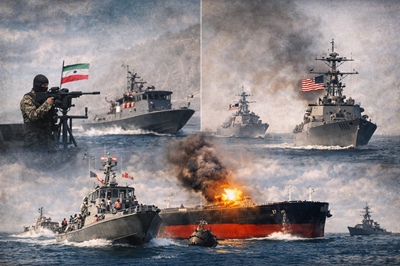
WAR-REPORT : The confrontation between the United States and Iran has entered a dangerous new phase as both nations escalate their competing efforts to control maritime access through the strategically vital Strait of Hormuz. With naval deployments intensifying and diplomatic negotiations collapsing, the region now stands on the brink of a prolonged crisis that could reshape global energy flows and international security.
At the center of the unfolding standoff is a stark and unprecedented reality: nearly all maritime traffic through the Strait of Hormuz has effectively been halted, except for vessels approved by Iran. This development marks a dramatic escalation in Tehran’s efforts to assert control over one of the world’s most critical energy corridors, through which a significant portion of global oil shipments typically pass.

Competing Blockades and Maritime Control
The United States Navy has initiated measures aimed at preventing Iranian and Iran-approved vessels from freely transiting the strait, while Iran has simultaneously imposed its own restrictions on all other maritime traffic. The result is a de facto dual blockade, where each side seeks to enforce its authority over the narrow waterway.
Currently, the only vessels navigating the strait are those sanctioned by Iran, effectively operating under Tehran’s protection framework. These ships are reportedly adhering to a unilateral traffic separation system imposed by Iran, which compels vessels to pass through Iranian territorial waters. This system has raised serious concerns among international observers, who view it as an attempt to legitimize Iranian control over international shipping lanes.
The sharp decline in maritime activity underscores the severity of the situation. On April 12, only a single vessel reportedly transited the strait without complying with Iranian directives, choosing instead to skirt the southern edge of a declared hazardous zone. This rare passage highlights both the risks involved and the near-total effectiveness of Iran’s restrictions.

Iran’s “Hazardous Area” Strategy
Iran has employed a combination of military threats and limited naval mining operations to enforce its control over the Strait of Hormuz. By declaring a broad “hazardous area” that covers nearly the entire waterway—except for its own territorial waters—Tehran has effectively deterred non-compliant vessels from entering the region.
Within this framework, Iran has established a system in which ships must seek approval and, in some cases, pay fees to ensure safe passage. Critics have described this arrangement as a form of coercion, while Iranian officials argue that it is a necessary measure to ensure security amid ongoing tensions.
The use of naval mines, though limited, has further heightened the risk for commercial shipping. Even the perception of danger has been enough to significantly reduce traffic, as shipping companies weigh the potential costs of disruption against the risks of navigating contested waters.

U.S. Military Response and Mine-Clearing Operations
In response to Iran’s actions, the United States has ramped up its naval presence in the region. The United States Navy has deployed multiple vessels with the stated objective of clearing naval mines and restoring freedom of navigation through the strait.
Two U.S. Navy destroyers transited the Strait of Hormuz on April 11, marking a significant show of force intended to establish conditions for mine-clearing operations. These movements were closely monitored by the naval wing of the Islamic Revolutionary Guard Corps, which issued warnings but ultimately refrained from direct engagement.
The IRGC Navy has publicly declared that any foreign military presence in the strait will face a “decisive response,” signaling a readiness to escalate if provoked. Despite these threats, the United States appears determined to proceed with its operations, emphasizing the importance of maintaining open sea lanes for global التجارة and energy supplies.
Support for these efforts has reportedly come from several Gulf nations, which have a direct stake in ensuring the continued flow of oil exports. While details remain limited, cooperation in mine-clearing operations suggests a growing regional alignment against Iran’s maritime restrictions.
Trump’s Warning and Escalation Risks
Adding to the tension, Donald Trump made a forceful statement on April 12, declaring that the United States would “interdict every vessel” that has paid Iran for passage through the strait. This announcement signals a potential expansion of U.S. enforcement measures, effectively targeting not only Iranian actions but also third-party compliance with Tehran’s system.
Such a policy could significantly escalate the situation, as it places commercial shipping companies in a difficult position. Vessels that comply with Iranian requirements risk interception by U.S. forces, while those that do not face potential threats from Iran.
This dynamic creates a high-risk environment in which miscalculation or accidental confrontation could quickly spiral into broader conflict.
Diplomatic Breakdown in Islamabad
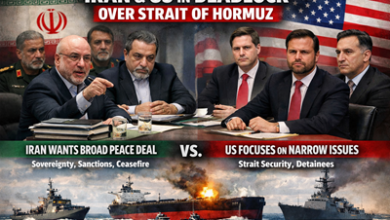
Amid rising military tensions, diplomatic efforts to resolve the crisis have faltered. Talks held in Islamabad on April 11 and 12 failed to produce any meaningful agreement between the United States and Iran.
According to Iranian officials speaking to the The New York Times, the negotiations collapsed over several key issues. These included Iran’s stockpile of highly enriched uranium, its insistence on maintaining control over the Strait of Hormuz, and demands for the release of approximately $27 billion in frozen oil revenues.
The United States reportedly demanded the immediate reopening of the strait to international shipping, a condition that Iran rejected. Tehran countered that unrestricted access would only be granted as part of a comprehensive peace agreement, reflecting its broader negotiating strategy.
Nuclear Disputes and Economic Demands
The issue of Iran’s nuclear program remains a central point of contention. U.S. negotiators are said to have demanded that Iran either surrender or sell its entire stockpile of highly enriched uranium, a proposal that Iran did not accept.
Instead, Iranian officials reportedly offered an unspecified counterproposal, which failed to satisfy U.S. concerns. This impasse highlights the enduring challenges of addressing nuclear proliferation issues within the broader context of geopolitical conflict.
Economic considerations have also played a significant role in the negotiations. Iran has sought access to frozen assets held in various countries, arguing that these funds are essential for economic recovery and post-war reconstruction.
The United States, however, has resisted these demands, particularly calls for war reparations funded through frozen oil revenues. This disagreement further underscores the gap between the two sides’ expectations and priorities.
Ceasefire Ambiguities and Enforcement Challenges
The absence of a clearly defined and mutually agreed-upon ceasefire framework has added another layer of complexity to the situation. While a temporary ceasefire was reportedly in place, the lack of detailed provisions has made it difficult to assess compliance or enforce its terms.
U.S. officials have indicated that reopening the Strait of Hormuz was a key requirement of the ceasefire, but Iran disputes this interpretation. This ambiguity has allowed both sides to accuse each other of violations, further eroding trust.
Political Reactions and Blame
Following the collapse of the talks, both sides have sought to assign responsibility for the failure. Mohammad Bagher Ghalibaf, who led the Iranian delegation, criticized the United States and argued that Washington must “earn” Iran’s trust before any meaningful progress can be made.
Meanwhile, Donald Trump emphasized that Iran had refused to make concessions on its nuclear program but expressed optimism that negotiations could resume in the future. This cautious optimism contrasts with the increasingly confrontational tone of U.S. military actions.
Global Implications
The escalating crisis in the Strait of Hormuz carries significant implications for the global economy. As one of the world’s most important transit routes, any disruption to shipping through the strait can have immediate effects on energy prices and supply chains.
The current situation, characterized by restricted access and heightened risk, has already begun to impact shipping patterns and market stability. Prolonged disruption could lead to sustained increases in oil prices, affecting economies worldwide.
A Region on Edge
As military and diplomatic tensions continue to rise, the risk of open conflict between the United States and Iran cannot be ignored. The combination of naval deployments, economic pressure, and failed negotiations creates a volatile environment in which even minor incidents could trigger a larger confrontation.
The involvement of regional actors and the strategic importance of the Strait of Hormuz further complicate the situation, making it one of the most closely watched geopolitical crises in the world today.
Our Media Opinion
The ongoing standoff between the United States and Iran represents a critical moment in international relations. With both sides entrenched in their positions and unwilling to make significant concessions, the path to resolution remains uncertain.
The dual blockade of the Strait of Hormuz, coupled with the collapse of diplomatic talks, has created a dangerous impasse with far-reaching consequences. Whether through renewed negotiations or escalating confrontation, the decisions made in the coming days and weeks will likely shape the future of the region—and potentially the global order—for years to come.