

U.S. and Iran Agree to Two-Week Ceasefire as Diplomatic Breakthrough
By Samir Singh 'Bharat': Editor In Chief

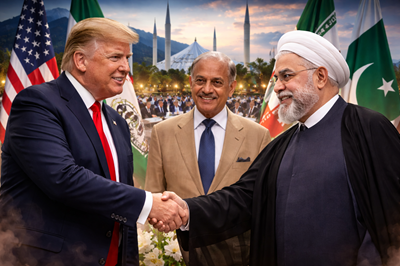
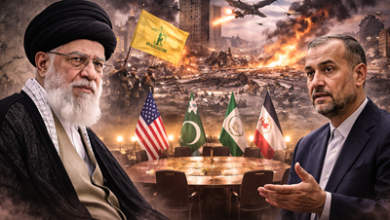
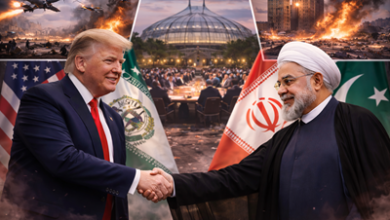
WAR-REPORT : In a significant development that has temporarily eased escalating tensions in the Middle East, the United States and Iran have agreed to a two-week ceasefire brokered by Pakistan. The agreement, announced on April 7, represents a rare moment of diplomatic convergence between two long-standing adversaries and has opened the door for structured negotiations scheduled to begin in Islamabad on April 11. While the ceasefire is limited in duration, its implications are far-reaching, particularly in the context of regional stability, global energy security, and the future trajectory of the conflict.
The ceasefire agreement emerged after intense diplomatic efforts led by Pakistan, with Prime Minister Shehbaz Sharif playing a central mediating role. In the hours leading up to the announcement, Sharif had publicly stated that negotiations between Washington and Tehran were “progressing steadily, strongly, and powerfully.” His statement reflected growing optimism among diplomatic circles that a breakthrough was imminent, even as hostilities continued in various theaters across the region.

The formal confirmation of the ceasefire came from both sides in quick succession. U.S. President Donald Trump announced that Washington had agreed to the arrangement, emphasizing that Iran had committed to reopening the Strait of Hormuz as a key condition. Approximately three hours later, Iran’s Supreme National Security Council issued its own statement confirming acceptance of the ceasefire, signaling a coordinated acknowledgment of the agreement.
Iranian Foreign Minister Abbas Araghchi provided further clarity on Tehran’s position, stating that Iran would allow the “safe passage” of vessels through the Strait of Hormuz during the ceasefire period. However, he noted that this arrangement would be implemented “via coordination with Iran’s armed forces and with due consideration of technical limitations.” This phrasing suggests that while Iran is willing to facilitate maritime traffic, it intends to retain a degree of operational control over the process.
The reopening of the Strait of Hormuz is a central component of the ceasefire agreement. As one of the world’s most critical maritime chokepoints, the strait serves as a vital artery for global energy supplies. Disruptions to shipping in this region have immediate and profound effects on international markets, making its stability a priority for both regional and global stakeholders. By agreeing to reopen the strait, Iran has taken a step that not only supports the ceasefire but also addresses broader concerns about economic stability.

At the same time, the agreement reflects a degree of pragmatism on both sides. For the United States, securing the reopening of the Strait of Hormuz represents a tangible outcome that aligns with its strategic and economic interests. For Iran, the ceasefire provides an opportunity to engage in negotiations while preserving its leverage and advancing its broader objectives.
Central to the upcoming negotiations is Iran’s 10-point counterproposal, which it initially submitted to the United States on April 5. President Trump described this proposal as “a workable basis on which to negotiate,” indicating that while differences remain, there is sufficient overlap to justify further discussions. The proposal outlines a comprehensive set of demands that reflect Iran’s long-standing grievances and strategic priorities.
Among the most significant elements of Iran’s proposal is its demand for a permanent end to the conflict, accompanied by guarantees that neither the United States nor Israel will initiate future attacks against Iran. This condition underscores Tehran’s desire for long-term security assurances, which it views as essential to any sustainable resolution. The inclusion of Israel in this demand highlights the interconnected nature of regional conflicts and the importance of addressing multiple fronts simultaneously.

Iran has also called for the lifting of all primary and secondary sanctions imposed by the United States, as well as the termination of resolutions passed by the United Nations Security Council and the International Atomic Energy Agency (IAEA) Board of Governors. These measures have had a significant impact on Iran’s economy, and their removal is seen by Tehran as a prerequisite for meaningful progress in negotiations.
In addition to sanctions relief, Iran’s proposal includes demands for financial reparations to compensate for damages incurred during the conflict. This aspect of the proposal is likely to be particularly contentious, as it raises complex questions about accountability and the scope of any potential settlement.
Another key demand is the withdrawal of U.S. forces from the region, reflecting Iran’s broader objective of reducing American military presence in the Middle East. This issue has been a longstanding point of contention between the two countries and is likely to be a central topic in the upcoming negotiations.
Iran has also called for a cessation of hostilities across all fronts, including Israeli operations against Hezbollah in Lebanon. This demand aligns with Iran’s regional strategy and its support for allied groups, often referred to as the “Axis of Resistance.” By linking the ceasefire to broader regional dynamics, Iran is seeking to ensure that any agreement addresses the full scope of the conflict.
One of the more controversial elements of Iran’s proposal is its plan to impose fees on vessels transiting the Strait of Hormuz. According to reports, Iran intends to charge up to $2 million per vessel, with the revenue to be shared with Oman and used for post-war reconstruction efforts. This proposal highlights Iran’s attempt to leverage its geographic position for economic gain, while also raising questions about the legality and feasibility of such a system under international maritime law.
The inclusion of Oman in this arrangement reflects the country’s traditional role as a mediator and facilitator in regional diplomacy. Oman’s involvement could provide a degree of legitimacy and balance to the proposed mechanism, although its practical implementation would require extensive coordination and agreement among multiple stakeholders.
The ceasefire agreement has also had implications for other actors in the region. Reports indicate that Israel has agreed in principle to halt operations against Iran and Hezbollah, contingent on Iran ceasing its activities in the Strait of Hormuz. While this understanding has not been officially confirmed by Israeli authorities, it suggests a broader alignment of interests aimed at de-escalation.
Prime Minister Shehbaz Sharif’s statement on April 7 further indicated that Iran’s allies and the United States’ partners have agreed to observe a ceasefire “everywhere, including in Lebanon and elsewhere.” This suggests that the agreement extends beyond bilateral arrangements and encompasses a wider network of actors involved in the conflict. However, at the time of writing, neither Israel nor members of Iran’s Axis of Resistance have publicly commented on the ceasefire, leaving some uncertainty about its scope and durability.
The success of the ceasefire will depend on the ability of all parties to adhere to its terms and to engage constructively in the upcoming negotiations. The two-week timeframe provides a limited window for progress, but it also creates a sense of urgency that could facilitate meaningful dialogue.
The choice of Islamabad as the venue for negotiations underscores Pakistan’s role as a neutral intermediary and its commitment to promoting regional stability. Hosting the talks places Pakistan at the center of a high-stakes diplomatic effort and reflects its growing influence in international affairs.
From a broader perspective, the ceasefire represents a rare opportunity to shift the trajectory of the conflict. While the underlying issues remain complex and deeply entrenched, the agreement provides a framework for dialogue and a chance to explore potential solutions. The willingness of both sides to engage in negotiations suggests that there is recognition of the costs associated with continued escalation.
At the same time, significant challenges remain. The differences between the U.S. and Iranian positions are substantial, particularly on issues such as sanctions, security guarantees, and regional dynamics. Bridging these gaps will require careful diplomacy, compromise, and sustained engagement.
The role of external actors will also be critical. Countries with interests in the region, including European states, Gulf nations, and international organizations, may seek to support the negotiation process and ensure its success. Their involvement could help to build confidence and provide additional avenues for progress.
Our Media Opinion, the agreement between the United States and Iran to implement a two-week ceasefire marks an important step toward de-escalation and dialogue. While the road ahead is uncertain, the upcoming negotiations in Islamabad offer a chance to address longstanding issues and to explore the possibility of a more stable and secure regional order. The outcome of these talks will have significant implications not only for the parties directly involved but also for the broader international community.