

US Destroys 16 Iranian Minelayers Near Strait of Hormuz in Shocking Naval Confrontation
By Samir Singh 'Bharat': Editor In Chief

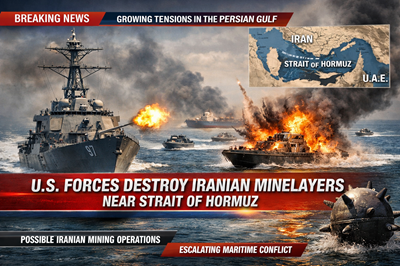
WAR-REPORT : Tensions in the Persian Gulf have escalated sharply after the United States Central Command (CENTCOM) announced that American forces destroyed 16 Iranian minelaying vessels operating near the strategically vital Strait of Hormuz. The incident, reported on March 10, marks one of the most serious confrontations in the region in recent years and highlights the growing risk of disruption to global maritime trade.
According to U.S. officials, the Iranian vessels were allegedly preparing to deploy naval mines in the narrow waterway that serves as one of the most important energy corridors in the world. The development comes amid an already tense security environment following repeated Iranian attacks on vessels in the Persian Gulf earlier in March.

The situation has drawn strong reactions from the United States government, including a warning from U.S. President Donald Trump that Iran must immediately remove any mines from the Strait or face unprecedented military consequences. The confrontation reflects a wider strategic struggle between Iran, the United States, and regional powers over control, influence, and security in the Middle East.
Strategic Importance of the Strait of Hormuz
The Strait of Hormuz is widely considered one of the most critical chokepoints in the global energy supply chain. Located between Iran and the Arabian Peninsula, the narrow passage connects the Persian Gulf to the Gulf of Oman and the Arabian Sea.
Roughly one-fifth of the world’s oil supply passes through this strait every day. Oil tankers transporting crude from Saudi Arabia, Iraq, Kuwait, the United Arab Emirates, and other Gulf producers rely heavily on this route to reach international markets.

Any disruption in the Strait of Hormuz can have immediate and far-reaching consequences for global energy prices, international shipping, and geopolitical stability. Even limited military activity in the region tends to send shockwaves through global markets.
Because of its importance, the strait has long been the focal point of tensions between Iran and Western powers, particularly the United States.
U.S. Military Action Against Iranian Minelayers
According to CENTCOM, U.S. naval and aerial forces intercepted and destroyed 16 Iranian vessels that were believed to be preparing to deploy naval mines near the Strait of Hormuz. American officials stated that the vessels were small craft capable of carrying multiple naval mines.

Intelligence assessments suggested that each vessel could carry up to three mines, making them a serious threat to commercial shipping. Naval mines are particularly dangerous because they can remain hidden beneath the water’s surface and detonate upon contact with ships.
Military analysts say even a small number of mines could significantly disrupt shipping traffic and force commercial vessels to reroute, leading to delays and higher transportation costs.
The destruction of the vessels appears to be part of a broader effort by the United States and its regional allies to maintain freedom of navigation in the Persian Gulf.
Reports of Iranian Mining Preparations
Reports that Iran may be preparing to mine the Strait of Hormuz were first cited by U.S. intelligence officials and later reported by American media outlets. According to these reports, Iran had begun using small boats capable of discreetly transporting and deploying naval mines.
Such tactics are consistent with Iran’s long-standing naval strategy, which relies heavily on asymmetric warfare. Instead of matching the United States Navy ship for ship, Iran has invested in smaller, faster vessels, underwater mines, and coastal missile systems designed to challenge larger naval forces.
Experts note that mining operations can be carried out relatively quickly and quietly, making them a preferred method for disrupting maritime traffic.
The possibility of Iranian mines in the Strait immediately raised alarm among international shipping companies and regional governments.
Strong Warning from Washington
The U.S. government responded swiftly to the reports. President Donald Trump issued a statement on social media warning Iran to remove any mines that may have been deployed in the Strait of Hormuz.
In his statement, Trump emphasized that the United States had no confirmed evidence that mines had already been laid but demanded immediate action if any had been placed. He also warned that failure to comply could result in military consequences “at a level never seen before.”
The warning reflects Washington’s determination to prevent Iran from threatening international shipping lanes. Maintaining open sea routes in the Persian Gulf has been a central objective of U.S. policy in the region for decades.
American naval forces maintain a constant presence in the area precisely to deter actions that could disrupt maritime traffic.
Historical Precedent: The Iran–Iraq War
Iran’s potential use of naval mines in the Strait of Hormuz has historical precedent. During the Iran–Iraq War in the 1980s, Iran used similar tactics to target international shipping and pressure its adversaries.
In that conflict, Iranian forces laid numerous mines in the Persian Gulf in an attempt to disrupt the oil exports of Iraq and its allies. The strategy led to a series of naval confrontations with Western forces.
One of the most significant incidents occurred when an Iranian mine severely damaged the USS Samuel B. Roberts, a U.S. Navy guided missile frigate, in April 1988.
In response, the United States launched a major retaliatory operation against Iranian military targets.
The American operation destroyed several Iranian naval vessels and offshore oil platforms used for military purposes. The confrontation remains one of the largest naval engagements involving the United States since World War II.
Recent Attacks in the Persian Gulf
The current crisis comes shortly after a series of attacks on vessels in the Persian Gulf earlier in March.
Reports indicate that Iran targeted at least three ships each day between March 1 and March 4. These incidents raised concerns among shipping companies and governments about the safety of maritime operations in the region.
The attacks appeared to be part of Iran’s broader strategy to pressure regional rivals and Western countries amid an ongoing military confrontation.
However, the frequency of attacks appears to have decreased in recent days.
The last confirmed incidents reportedly occurred on March 7.
Impact of U.S. and Israeli Military Campaign
Analysts believe that Iran’s ability to carry out large-scale retaliatory strikes has been significantly reduced by ongoing U.S. and Israeli military operations.
These operations have reportedly targeted Iranian missile launch sites, drone infrastructure, and naval capabilities.
According to U.S. Defense Secretary Pete Hegseth, recent American strikes have severely weakened Iran’s naval forces.
He stated on March 5 that the Iranian navy had become “combat ineffective” due to sustained attacks on its assets and infrastructure.
Hegseth also noted on March 10 that Iran had fired its lowest number of missiles since the conflict began during the previous 24 hours.
This decline suggests that Iran may be struggling to maintain the pace of its earlier retaliatory operations.
Economic Consequences for Iran
Ironically, attempts by Iran to mine the Strait of Hormuz could also damage its own economic interests.
Iran relies heavily on oil exports to sustain its economy, and most of those exports pass through the same waterway.
Any disruption to maritime traffic could complicate Iran’s ability to ship oil to international markets.
China remains the largest importer of Iranian crude oil, and stable shipping routes are essential for maintaining this trade relationship.
Recent maritime tracking data suggests that Iranian oil shipments have already declined significantly.
Decline in Iranian Oil Tanker Traffic
Commercial maritime data indicates a sharp drop in the number of Iranian oil tankers passing through the Strait of Hormuz.
Only three vessels linked to Iran’s so-called “ghost fleet” have crossed the strait since March 2.
This represents a dramatic decline compared with the previous week.
Between February 22 and March 1, approximately 24 Iranian tankers reportedly passed through the waterway.
The reduction suggests that the security situation in the region is already affecting Iran’s ability to export oil.
Some analysts believe shipping companies are increasingly cautious about operating in the area due to the risk of military confrontation.
Global Economic Implications
Any sustained disruption in the Strait of Hormuz could have major implications for global energy markets.
Oil prices tend to react quickly to geopolitical developments in the Persian Gulf. Even the perception of risk in the region can lead to price spikes.
Countries heavily dependent on imported energy, including many in Asia and Europe, would likely be among the first to feel the effects of any major disruption.
Energy analysts warn that a prolonged conflict in the region could push global oil prices significantly higher.
Such developments could also impact inflation and economic growth worldwide.
Regional Reactions
Countries across the Middle East are closely monitoring the situation.
Gulf Arab states, including Saudi Arabia and the United Arab Emirates, have long expressed concern about Iranian activities in the Strait of Hormuz.
These nations depend heavily on the safe export of oil through the strait.
Any attempt by Iran to block or disrupt shipping lanes could directly threaten their economic stability.
As a result, regional governments have historically supported international efforts to maintain maritime security in the Persian Gulf.
Future Outlook
The situation in the Strait of Hormuz remains volatile and unpredictable.
While the destruction of Iranian minelaying vessels may temporarily reduce the immediate threat, the underlying tensions between Iran and the United States remain unresolved.
Military analysts warn that further confrontations could occur if Iran continues attempts to disrupt shipping lanes or if U.S. forces intensify their operations in the region.
Diplomatic efforts may also play a role in preventing the crisis from escalating into a broader regional conflict.
However, given the strategic importance of the Strait of Hormuz, any incident in the area is likely to draw rapid international attention.
The destruction of 16 Iranian minelayers by U.S. forces marks a significant development in the ongoing confrontation in the Persian Gulf. Reports that Iran may be preparing to deploy naval mines in the Strait of Hormuz have heightened concerns about the safety of global shipping and the stability of international energy markets.
While the United States has taken decisive military action to prevent potential disruptions, the situation remains fragile. Iran’s economic interests, regional rivalries, and broader geopolitical tensions all intersect in the narrow waters of the Strait of Hormuz.
As global powers continue to monitor developments closely, the events unfolding in this critical maritime corridor could shape the future of security and energy stability in the Middle East for years to come.