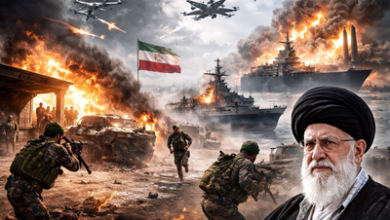



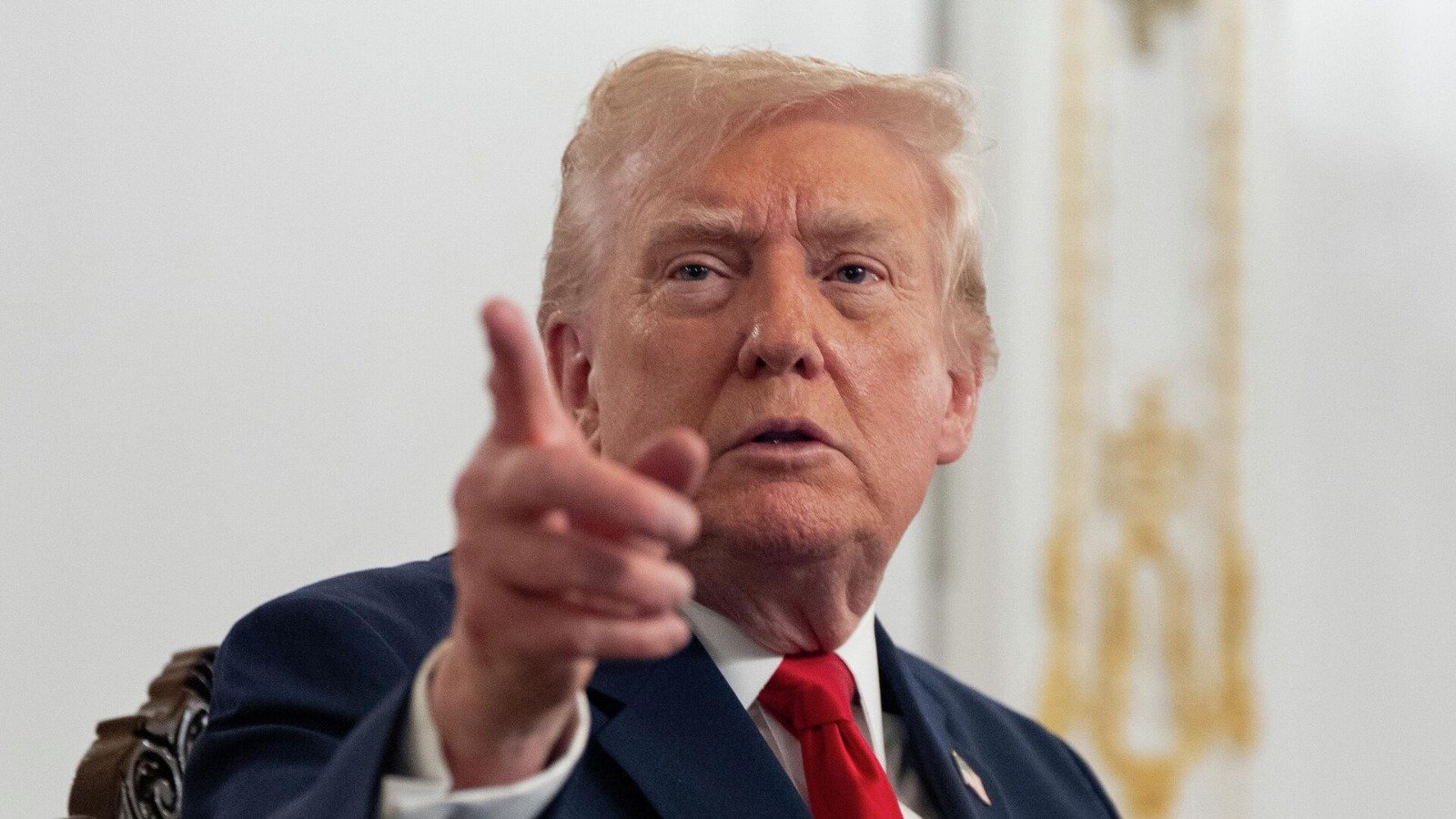
The geopolitical landscape of West Asia has entered a dangerously volatile phase, as conflicting narratives, military signaling, and economic tremors converge into what may become one of the defining crises of the decade. On March 23, 2026, U.S. President Donald Trump announced what appeared, on the surface, to be a temporary de-escalation: a five-day postponement of planned military strikes against Iranian energy infrastructure. However, beneath this announcement lies a far more complex and unstable reality—one shaped by contradictory statements, strategic mistrust, and mounting global consequences.
A Pause, Not Peace
President Trump’s statement framed the delay as a result of “good and productive conversations” with Iran. The wording suggests diplomacy, but the context suggests something else entirely: pressure, uncertainty, and strategic recalibration.

This is not a ceasefire. It is not even a negotiation framework. It is a tactical pause.
The United States has not withdrawn its military intent. It has merely delayed action. That distinction matters. A postponement signals hesitation, not resolution. It reflects the administration’s awareness of the potential consequences of escalation—particularly on global energy markets and domestic political stability.
At the same time, Iran has categorically denied the existence of any negotiations. Through its state-linked Tasnim News Agency, Iranian officials dismissed the U.S. narrative, asserting that no talks are underway and warning that the Strait of Hormuz will not return to pre-war conditions.

This contradiction is critical. It exposes a communication gap—or deliberate messaging divergence—that makes miscalculation far more likely.
The Strait of Hormuz: The World’s Pressure Point
The Strait of Hormuz is not just a regional chokepoint. It is the artery through which nearly a fifth of the world’s oil supply flows. Any disruption here is not a regional issue—it is a global economic shock.
Iran’s statement that the strait “will not return to pre-war conditions” is not just rhetoric. It is a signal of long-term disruption. Even without a full blockade, uncertainty alone is enough to destabilize markets. Insurance premiums for shipping rise. Freight slows. Prices spike.

This is already happening.
Energy markets are reacting not to actual shortages, but to anticipated risk. And in energy economics, perception often moves faster than reality.
A Crisis Bigger Than the 1970s?
The head of the International Energy Agency, Fatih Birol, issued a stark warning: the global economy faces a “major, major threat” if the conflict continues to escalate. His comparison is telling. He stated that the combined impact of the current crisis could surpass the oil shocks of the 1970s and even the disruptions caused by the Russia-Ukraine war.
That’s not casual language. That’s escalation language.
The oil shocks of the 1970s reshaped global economics, triggered inflation spirals, and forced structural changes in energy policy. If today’s crisis is indeed worse, the implications are massive:
- Sustained high fuel prices
- Supply chain disruptions
- Inflationary pressure across economies
- Slower global growth
And unlike the 1970s, today’s world is far more interconnected and dependent on stable energy flows.
Domestic Pressure on Washington
Trump’s decision to delay military action is not happening in a vacuum. It is happening under pressure—specifically, rising fuel prices within the United States.
Higher gasoline prices are politically toxic. They hit consumers directly, immediately, and visibly. Unlike abstract geopolitical concerns, fuel costs are felt daily by voters.
This creates a dilemma for the administration:
- Escalate militarily and risk further price spikes
- De-escalate and risk appearing weak
The five-day delay is an attempt to balance both. It buys time without committing to either path. But it also signals uncertainty—and uncertainty is rarely interpreted as strength in geopolitics.
Israel Expands the Battlefield
While the U.S. signals hesitation, Israel appears to be moving in the opposite direction—toward escalation.
Recent actions indicate preparation for a ground campaign into Lebanon, targeting Hezbollah, the Iran-backed militant group. The destruction of a key bridge is not symbolic—it is logistical. It suggests preparation for troop movement, supply routes, and sustained operations.
This changes the equation entirely.
If Israel opens a full ground front in Lebanon, the conflict stops being a contained confrontation and becomes a multi-front war involving:
- Israel
- Hezbollah
- Iran (indirectly or directly)
- Potentially Syria
And once multiple actors are actively engaged, controlling escalation becomes exponentially harder.
Iran’s Strategic Position
Iran is playing a calculated game. It is avoiding direct large-scale confrontation with the United States while maximizing pressure through indirect means.
Its strategy appears to include:
- Disrupting energy flows
- Supporting regional proxies like Hezbollah
- Maintaining ambiguity around escalation
By denying negotiations, Iran reinforces its position of resistance. By destabilizing the Strait of Hormuz, it leverages its strongest economic weapon.
This is asymmetric warfare at a geopolitical scale.
Iran does not need to defeat the United States militarily. It only needs to make the cost of conflict too high.
Energy Markets: Controlled Chaos
The phrase “energy markets will remain unsettled” is doing a lot of work here. It’s not just a prediction—it’s a strategy.
Volatility benefits certain actors. It creates leverage.
For oil-exporting nations, higher prices can mean higher revenue. For geopolitical players, instability creates negotiating power.
But for the global economy, it’s a nightmare.
Unstable energy prices:
- Increase production costs
- Raise transportation expenses
- Feed inflation
- Reduce consumer spending
This ripple effect spreads across industries—from manufacturing to agriculture to technology.
No country is insulated.
The Illusion of Control
One of the biggest misconceptions in crises like this is the idea that major powers are fully in control.
They’re not.
What we’re seeing is a chain reaction:
- Israel escalates against Hezbollah
- Iran responds indirectly
- The U.S. reacts to both
- Markets respond to all of it
Each actor is making decisions based on limited information, political pressure, and strategic assumptions. That’s a dangerous mix.
The five-day delay by the U.S. is not a sign of control. It’s a sign of recalibration in an environment where outcomes are increasingly unpredictable.
The Risk of Miscalculation
The biggest threat right now is not deliberate escalation—it’s miscalculation.
Consider this:
- The U.S. believes it is engaging in “productive conversations”
- Iran says no negotiations exist
- Israel is preparing for ground operations
These are three completely different narratives operating simultaneously.
All it takes is one misread signal:
- A military movement interpreted as an attack
- A defensive action seen as aggression
- A delay perceived as weakness
And the situation can spiral rapidly.
Economic Fallout Beyond Oil
While oil is the most visible impact, the crisis extends far beyond it.
Natural gas markets are also under pressure. Shipping routes are at risk. Insurance costs are rising. Investor confidence is weakening.
This leads to:
- Currency fluctuations
- Stock market volatility
- Reduced global trade
The comparison to the Russia-Ukraine war is relevant, but incomplete. That conflict primarily affected Europe and energy flows from Russia. This crisis affects a far more critical global chokepoint.
A Multipolar Crisis
This is not just a U.S.–Iran issue. It is a multipolar crisis involving:
- The United States (military and economic power)
- Iran (regional influence and energy leverage)
- Israel (military escalation and strategic objectives)
- Global markets (economic consequences)
Each player has different goals:
- The U.S. wants deterrence without economic fallout
- Iran wants leverage without full-scale war
- Israel wants to neutralize threats decisively
These goals are not aligned. That’s the problem.
The Five-Day Window
The five-day postponement is being framed as an opportunity. But for what?
If there are no real negotiations, then what changes in five days?
Realistically:
- Military positions won’t shift significantly
- Strategic objectives won’t change
- Political pressures will remain
What can change is the level of tension.
This window could either:
- Allow backchannel diplomacy to emerge
- Or increase uncertainty and speculation
Right now, it looks more like the latter.
What Happens Next?
There are three likely scenarios:
1. Controlled De-escalation
Diplomatic channels open quietly. Military actions are reduced. Energy markets stabilize.
This is the best-case scenario—but currently the least supported by evidence.
2. Limited Escalation
Strikes occur but remain targeted. Conflict expands slightly but stays regionally contained.
This is the most probable path.
3. Full-Scale Regional Conflict
Israel launches a ground campaign. Iran escalates indirectly or directly. The U.S. becomes more involved.
This is the worst-case scenario—and it’s not as unlikely as it should be.
Final Reality Check
Strip away the political language, and the situation looks like this:
- There is no confirmed diplomacy
- There is active military preparation
- There is economic disruption already underway
The five-day delay is not a solution. It’s a pause in a system that is still moving toward confrontation.
The global economy is already reacting. Energy markets are already unstable. Strategic trust between actors is already broken.
And once trust collapses, conflict becomes easier—not harder.