

Russia Accused of Deporting Ukrainian Children for Propaganda 2026
By Samir Singh 'Bharat': Editor In Chief

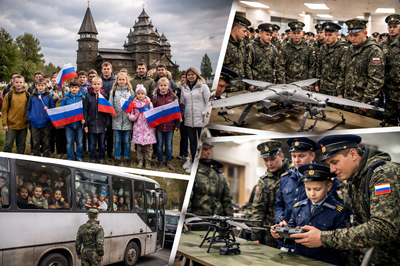
WAR-REPORT : In a development that has drawn renewed international concern, Russian authorities have reportedly transported groups of Ukrainian children from frontline areas of occupied Zaporizhia Oblast to the Republic of Karelia under what officials describe as a cultural and educational initiative. However, analysts and human rights observers argue that such programs may serve broader strategic purposes, including propaganda dissemination and the systematic integration of Ukrainian youth into Russian political and military structures.
At the same time, parallel efforts are underway in other occupied regions of Ukraine to expand military-oriented education among children and adolescents. Of particular note is the growing role of the Russian Ministry of Defense–run Nakhimov Naval School system, which is increasingly positioning itself as a key institution for training youth in advanced military technologies, including the development and operation of combat drones.
Together, these initiatives highlight a broader pattern of activity that raises significant questions about the treatment of children in conflict zones, the militarization of education, and the long-term implications for identity, sovereignty, and international law.
Transfer of Children from Zaporizhia to Karelia
On March 23, Yevgeny Balitsky, the Russian-installed head of occupied Zaporizhia Oblast, announced that a group of children from frontline districts had been sent to the Republic of Karelia. The children reportedly originated from the Vasylivka and Kamianka-Dniprovska raions—areas that have experienced sustained military activity and instability.
According to Balitsky, the initiative was carried out with the support of Maria Lvova-Belova, the Kremlin-appointed Commissioner on Children’s Rights, as well as regional authorities in Karelia. He stated that the purpose of the trip was to expose the children to Russia’s “natural wealth and cultural diversity” and to provide them with an understanding of Russian history and traditions.

While these official explanations frame the program as a humanitarian and educational effort, critics argue that such transfers are deeply problematic. Observers note that relocating children from conflict-affected areas to distant regions within Russia can serve as a mechanism for ideological influence, particularly when the content of educational programming is closely aligned with state narratives.
Patronage Networks and Systematic Transfers
The Republic of Karelia has been designated as a “patron region” for parts of occupied Zaporizhia Oblast, specifically the Vasylivka Raion. Under this system, Russian regions establish administrative and logistical ties with occupied Ukrainian territories, ostensibly to support reconstruction and governance efforts.
However, analysts have pointed out that these patronage relationships also facilitate the movement of civilians—especially children—between occupied areas and Russia proper. Previous reports have documented how such arrangements are used to send Ukrainian children to camps, educational programs, and temporary stays in Russian regions.
These transfers often occur under conditions that limit parental oversight and independent monitoring, raising concerns about consent, transparency, and the potential for long-term separation. In some cases, children have reportedly remained in Russia for extended periods, with limited communication with their families.
Human rights organizations have repeatedly warned that the relocation of children from occupied territories, particularly without clear legal safeguards, may violate international humanitarian law. The concern is heightened by the possibility that such programs are designed not only to provide temporary relief but also to reshape the cultural and national identity of the children involved.
Narratives of Culture and Identity
The emphasis on exposing Ukrainian children to Russian culture, history, and geography is a central component of these initiatives. By framing the transfers as opportunities for enrichment and education, Russian authorities present the programs as benevolent.
However, critics argue that this narrative masks a deeper objective: the assimilation of Ukrainian youth into a Russian national framework. Educational activities during these trips often include lessons, excursions, and cultural programming that emphasize Russian historical narratives and identity markers.
For children from conflict zones—many of whom have experienced displacement, trauma, and disruption—such exposure can have a lasting impact. The introduction of new narratives in a controlled environment may influence their perceptions of history, belonging, and national identity.
This dynamic is particularly sensitive given the broader geopolitical context, in which questions of sovereignty and cultural autonomy are central to the conflict between Russia and Ukraine.
Expansion of Military-Oriented Education
In parallel with these relocation programs, Russia is intensifying efforts to integrate military training into educational institutions in occupied Ukraine. A key example is the Nakhimov Naval School system, which operates under the Russian Ministry of Defense.
On March 23, Gurgen Malkhasyan, the Minister of Industry and Trade for the self-proclaimed Donetsk People’s Republic (DNR), stated that the Mariupol branch of the Nakhimov Naval School had engaged in discussions about the development of unmanned systems and related technologies. He emphasized the need to establish a structured training program for youth in occupied Donetsk Oblast focused on drone development and operation.
According to Malkhasyan, such programs are intended to address a “personnel shortage” in the field of unmanned systems—a domain that has become increasingly central to modern warfare.
The Role of the Nakhimov Naval School
The Nakhimov Naval School system has long been a cornerstone of Russia’s military education infrastructure. Designed to prepare young students for future service in the armed forces, these schools combine academic instruction with military training and discipline.
The Mariupol branch of the Nakhimov Naval School was ordered by Russian President Vladimir Putin in March 2023 and officially opened in 2024. Since then, it has enrolled hundreds of children and adolescents, many of whom are from occupied territories.
The institution is equipped with advanced educational facilities, including technical labs and training centers, which enable it to deliver specialized programs in areas such as engineering, navigation, and now unmanned systems.
By introducing drone-related curricula, the school is aligning itself with broader trends within the Russian military, which has increasingly emphasized the importance of unmanned technologies in both offensive and defensive operations.
Militarization of Youth
The incorporation of drone training into youth education represents a significant shift in the nature of military preparation. Unlike traditional forms of training, which often focus on physical conditioning and basic tactics, drone programs require technical expertise, including programming, electronics, and remote operation.
This shift reflects the evolving nature of warfare, where technological proficiency is as critical as physical capability. However, it also raises ethical and legal questions about the involvement of minors in activities that are directly related with military operations.
Critics argue that introducing such training at an early age effectively normalizes participation in conflict and blurs the line between education and military service. For children in occupied territories, who may have limited access to alternative educational pathways, enrollment in such programs may not be entirely voluntary.
Broader Strategic Objectives
The dual approach of cultural programming and military training suggests a comprehensive strategy aimed at shaping the next generation in occupied regions. On one hand, relocation programs emphasize cultural assimilation and ideological alignment. On the other hand, educational initiatives like those at the Nakhimov Naval School focus on developing practical skills that can be integrated into military structures.
Together, these efforts may serve to strengthen Russia’s long-term presence in occupied territories by fostering a population that is both culturally aligned and technically equipped to support its strategic objectives.
Analysts note that this approach is consistent with broader patterns observed in other conflict zones, where control over education and youth development is used as a means of consolidating influence.
International Reactions and Legal Implications
The reported deportation of Ukrainian children and the militarization of education in occupied territories have drawn criticism from international organizations and governments. Concerns center on potential violations of international law, including provisions related to the protection of civilians and the rights of children in armed conflict.
Under international humanitarian law, the transfer of children from occupied territories is subject to strict regulations, particularly when it involves movement across international borders. The absence of transparent procedures and independent oversight in these cases has raised alarms among legal experts.
Similarly, the involvement of minors in military-related training programs may conflict with international norms that seek to prevent the recruitment and use of child soldiers.
While Russian authorities maintain that their actions are lawful and beneficial, the lack of access for independent observers makes it difficult to verify these claims or assess the full impact of the programs.
Our Media Opinion
The recent reports of Ukrainian children being transported to Karelia and the expansion of military training programs in occupied territories underscore a complex and deeply concerning aspect of the ongoing conflict.
These initiatives, framed by Russian authorities as humanitarian and educational, are viewed by many observers as part of a broader strategy to reshape identity, loyalty, and capability among the younger generation in occupied regions.
As the conflict continues, the treatment of children and the role of education will remain critical issues, not only for the immediate well-being of those affected but also for the long-term of the region. The intersection of culture, education, and military strategy in this context highlights the multifaceted nature of modern warfare and the profound challenges it poses to international norms and human rights.