

Israel Plans Major Ground Offensive in Lebanon as U.S. Backs Effort to Push Hezbollah 2026
By Samir Singh 'Bharat': Editor In Chief
 war-times.com
Send an email
15 March 2026
war-times.com
Send an email
15 March 2026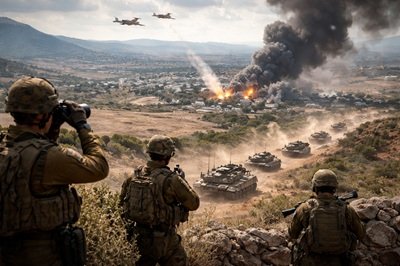
WAR-REPORT: Tensions along the Israel–Lebanon border are rising sharply as Israeli leaders prepare for what could become the largest ground campaign in southern Lebanon in years. According to reports from American and Israeli officials, Israel is planning a significant expansion of its military operations aimed at dismantling the infrastructure of the militant group Hezbollah south of the Litani River.
The proposed operation, which could begin within days, represents a major escalation in the conflict and reflects Israel’s determination to push Hezbollah fighters away from its northern border while eliminating the group’s military capabilities in southern Lebanon. The United States has reportedly expressed support for the operation, though Washington has also urged Israel to avoid strikes on sensitive Lebanese state infrastructure, particularly Beirut Rafic Hariri International Airport.
This unfolding situation highlights the fragile security environment in the Middle East and raises concerns that a wider regional conflict could erupt if diplomatic efforts fail.
Israel’s Strategic Objective in Southern Lebanon
Israeli officials say the planned campaign is intended to fundamentally alter the security landscape along Israel’s northern frontier. For years, Hezbollah has maintained extensive military infrastructure across southern Lebanon, including underground bunkers, missile storage sites, command centers, and fortified positions within civilian villages.
A senior Israeli official explained that the primary goals of the operation are to seize territory in southern Lebanon, push Hezbollah forces northward away from the Israeli border, and dismantle the group’s weapons depots and military positions.


Israel reportedly aims to control the entire area south of the Litani River, a region that has long been viewed as strategically critical. The Litani River lies roughly 30 kilometers north of the Israeli border and has historically been considered a natural buffer zone separating Hezbollah’s main strongholds from Israel.
Israeli military planners believe that controlling this area would significantly reduce Hezbollah’s ability to launch rocket attacks and cross-border raids into northern Israel.

Officials in both Washington and Tel Aviv have indicated that the United States supports the broader goal of disarming Hezbollah in southern Lebanon. However, American officials have also emphasized the importance of avoiding unnecessary escalation that could damage Lebanese state institutions or civilian infrastructure.
U.S. Support with Strategic Constraints
The United States has reportedly been closely coordinating with Israel as the military operation takes shape. According to officials familiar with the discussions, Washington supports Israel’s efforts to degrade Hezbollah’s military capabilities but has urged restraint in targeting Lebanese infrastructure.
American officials have specifically asked Israel not to strike Beirut’s main international airport, fearing such an attack could severely disrupt humanitarian aid deliveries and commercial travel while further destabilizing the Lebanese economy.
Israeli officials have agreed to these conditions and reportedly committed to consulting with the United States before targeting any major Lebanese state infrastructure.
This arrangement reflects the delicate balancing act facing Washington: supporting Israel’s security objectives while trying to prevent the conflict from spiraling into a broader war that could destabilize Lebanon and the wider region.
Military Preparations Along the Northern Border
As diplomatic discussions continue, the Israel Defense Forces have begun preparing for a large-scale ground maneuver in Lebanon.
Military officials announced that the Israel Defense Forces Northern Command will receive substantial reinforcements in the coming days. The move is part of a broader strategy to prepare for an expanded military campaign against Hezbollah positions across southern Lebanon.
According to Eyal Zamir, the reinforcements will include a full military division, two brigades, and several engineering battalions. These units will support the three Israeli divisions that have already been deployed along the Israel–Lebanon border since the beginning of the current conflict.
Engineering battalions are expected to play a crucial role in the operation. Their tasks may include clearing minefields, destroying underground tunnels, breaching fortified positions, and constructing defensive positions to secure captured territory.
Israeli media outlets have reported that armored vehicles, tank transporters, and armored personnel carriers have already been seen moving toward the northern frontier. These movements are widely interpreted as preparations for a large-scale ground offensive that could unfold in multiple phases.
Hezbollah’s Presence in Southern Lebanon
Hezbollah has long maintained a significant military presence in southern Lebanon. The organization, which is both a political party and an armed militant group, was originally formed in the early 1980s during Israel’s occupation of southern Lebanon.
Over the decades, Hezbollah has developed into one of the most powerful non-state armed groups in the world. The group possesses tens of thousands of rockets and missiles, as well as advanced anti-tank weapons, drones, and sophisticated surveillance capabilities.
Much of Hezbollah’s military infrastructure is embedded within civilian areas, including villages and towns across southern Lebanon. Israeli officials argue that this tactic allows Hezbollah to shield its weapons and fighters from airstrikes while increasing the risk of civilian casualties.
The planned Israeli campaign aims to dismantle these networks by physically capturing the territory where they are located.
However, analysts warn that such operations could be extremely difficult and costly. Hezbollah fighters are highly experienced in guerrilla warfare and have spent years building defensive fortifications across southern Lebanon.
Potential Duration of the Conflict
Israeli officials have indicated that the upcoming operation could last for months, even if tensions with Iran—Hezbollah’s primary patron—subside in the near future.
Military planners believe that eliminating Hezbollah’s infrastructure across southern Lebanon will require a sustained campaign involving ground forces, air support, and engineering operations.
Previous conflicts between Israel and Hezbollah have shown that fighting in southern Lebanon can be intense and prolonged. The rugged terrain, dense vegetation, and complex network of villages make military operations particularly challenging.
Israeli commanders are reportedly preparing for a long campaign that may involve multiple stages, including territorial seizure, systematic demolition of weapons depots, and long-term security operations to prevent Hezbollah from reestablishing its presence.
Diplomatic Efforts to De-Escalate
Despite the growing military preparations, diplomatic efforts to reduce tensions are also underway.
Reports indicate that Israeli and Lebanese officials are preparing to hold direct negotiations in the coming days, possibly in Paris or Cyprus. The talks are expected to be mediated by the United States and could focus on de-escalation measures along the border.
Israeli Prime Minister Benjamin Netanyahu has reportedly assigned Ron Dermer to oversee negotiations with the Lebanese government.
On the Lebanese side, officials are reportedly forming a diplomatic delegation to participate in the talks. Interestingly, the delegation will not include representatives from Hezbollah or the Amal Movement.
According to Lebanese sources, the decision was supported by Nabih Berri, who agreed that the delegation should consist only of official government diplomats.
This arrangement suggests that Lebanon’s government is attempting to present the negotiations as a state-to-state dialogue rather than a discussion involving armed militant groups.
Ceasefire Agreement and Negotiation Demands
Lebanese officials have emphasized that they want both sides to reimplement the ceasefire agreement that was reached in November 2024 before engaging in broader negotiations.
That agreement was intended to reduce cross-border hostilities and establish mechanisms for preventing further escalation. However, repeated clashes and mutual accusations of violations have undermined the ceasefire’s effectiveness.
Israel has reportedly insisted that the Lebanese Armed Forces take immediate action against Hezbollah in southern Lebanon.
From Israel’s perspective, the Lebanese military should enforce the terms of United Nations resolutions requiring armed groups to withdraw north of the Litani River.
However, Lebanon’s government has historically struggled to confront Hezbollah directly. The group holds significant political influence within Lebanon and maintains a powerful independent military structure.
U.S. Mediation Role
The United States is expected to play a central role in mediating upcoming negotiations between Israel and Lebanon.
Possible American mediators include Massad Boulos and Jared Kushner.
U.S. officials hope that diplomatic engagement could prevent a broader regional conflict while still addressing Israel’s security concerns.
Some reports indicate that Lebanese officials have already proposed immediate direct negotiations with Israel under American sponsorship to reach a comprehensive peace arrangement.
If such talks succeed, they could potentially transform the long-standing conflict between Israel and Hezbollah.
Regional and Global Implications
The prospect of a large Israeli ground offensive in southern Lebanon has significant implications for the Middle East and beyond.
A major escalation could draw in other regional actors, including Iran and allied militant groups operating in Syria, Iraq, and Yemen.
Additionally, instability in Lebanon could worsen the country’s already severe economic crisis. Lebanon has faced years of financial collapse, political paralysis, and infrastructure deterioration.
Large-scale military operations could further damage the country’s fragile institutions and increase humanitarian challenges.
For the international community, the situation represents a critical test of diplomacy. If negotiations fail and a full-scale ground war begins, the consequences could extend far beyond the Israel–Lebanon border.
Our Media Opinion
Israel’s planned expansion of its ground campaign in southern Lebanon marks a pivotal moment in the ongoing confrontation with Hezbollah. With troops mobilizing, armored vehicles moving toward the border, and diplomatic negotiations unfolding simultaneously, the region is entering a period of heightened uncertainty.
While Israel seeks to push Hezbollah north of the Litani River and dismantle its military infrastructure, the success of the operation—and its potential consequences—remain uncertain.
Diplomatic efforts led by the United States may still provide a pathway to de-escalation. However, with military preparations accelerating and tensions running high, the coming weeks could determine whether the region moves toward conflict or a fragile peace.
war-times.com
Send an email
15 March 2026