



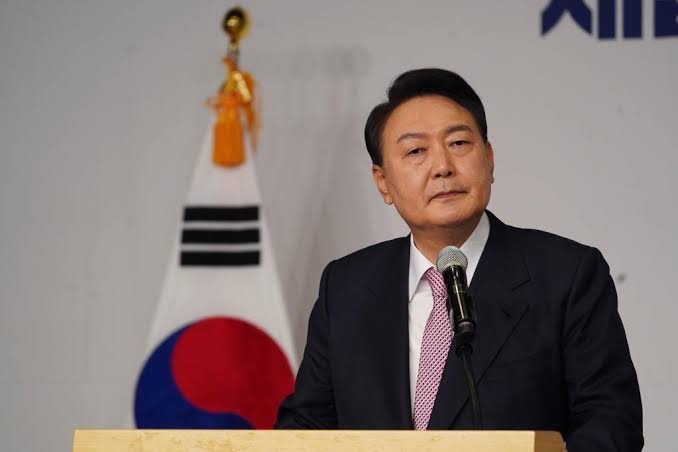
Seoul, South Korea — In a historic and dramatic turn of events, South Korean President Yoon Suk Yeol was impeached today by the National Assembly, following revelations surrounding his alleged order to impose martial law in response to recent nationwide protests.
The impeachment motion, passed with a significant majority in the 300-seat legislature, marks a watershed moment in South Korean politics. Yoon becomes the second president in the nation’s history to face impeachment after former President Park Geun-hye, who was ousted in 2017 over corruption charges.

The Martial Law Allegation
The controversy erupted earlier this month when leaked government documents suggested that President Yoon had directed top military officials to prepare a contingency plan to impose martial law as a means to quell escalating public unrest. The protests, which began as demonstrations against labor reforms and economic policies, had swelled into broader demands for political accountability.
Critics argue that Yoon’s alleged actions were an unconstitutional overreach of executive power, reminiscent of South Korea’s authoritarian past. Opposition lawmakers described the plan as a direct assault on the country’s hard-won democratic freedoms.

“The president’s move to invoke martial law undermines the very fabric of our democracy. This is unacceptable in a modern, free South Korea,” said Lee Jae-myung, leader of the Democratic Party, which led the impeachment effort.

Rising Tensions and Calls for Accountability

Public outcry against the president’s handling of the protests had already placed his administration under intense scrutiny. Demonstrations grew more heated as opposition leaders called for transparency and an independent investigation into the martial law documents.
Yoon, who took office in May 2022, has denied the allegations, insisting that the documents were misinterpreted and merely represented a worst-case scenario planning exercise. In a televised statement prior to the impeachment vote, he accused his opponents of “political maneuvering” aimed at destabilizing his government.
“This is a betrayal of the people’s trust and a distortion of the truth,” Yoon said. “I have always acted in the best interests of national security and the well-being of our citizens.”
Despite his protests, Yoon’s approval ratings had plummeted in recent weeks, with a majority of South Koreans expressing dissatisfaction with his leadership in recent polls.
The Road Ahead
Following the impeachment, Yoon’s presidential powers have been suspended, with Prime Minister Han Duck-soo assuming the role of acting president. The case now moves to the Constitutional Court, which has 180 days to rule on whether to uphold the impeachment. If the court affirms the decision, Yoon will be removed from office, and a snap presidential election will be held within 60 days.
The impeachment comes at a time of heightened political and economic uncertainty for South Korea. The nation faces challenges ranging from rising inflation and a slowing economy to growing security concerns over North Korea’s missile program.
Political Reactions
Reactions from international and domestic leaders have been swift. U.S. officials expressed concern about the political turmoil but reaffirmed their commitment to maintaining strong bilateral ties with South Korea.
Domestically, opposition parties have hailed the impeachment as a victory for democracy. “This is a reminder that no leader is above the law,” said Sim Sang-jung, a prominent member of the Justice Party.
Meanwhile, supporters of Yoon have staged counter-protests, calling the impeachment a “political witch hunt” and demanding that the Constitutional Court reject the motion.
As the court deliberates, South Korea braces for a period of uncertainty and reflection. For many, the impeachment serves as a test of the country’s democratic institutions and their ability to navigate a constitutional crisis without compromising the rule of law.