

Russian Forces Launch Major Spring–Summer Offensive Against Ukraine’s Fortres
By Samir Singh 'Bharat': Editor In Chief

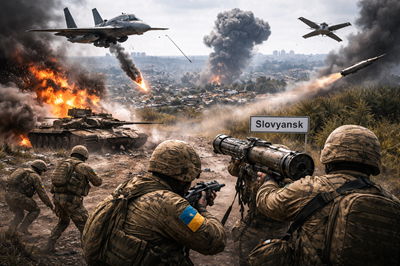
WAR-REPORT : Russian forces have likely begun their long-anticipated Spring–Summer 2026 offensive against Ukraine’s heavily fortified defensive network, widely referred to as the “Fortress Belt,” in Donetsk Oblast. This development signals a major escalation in the ongoing conflict, as Moscow intensifies its efforts to achieve a breakthrough after months of largely attritional warfare.
At the center of this new offensive is the strategically significant town of Lyman, which has once again become a focal point of intense military activity. Russian forces have increased the scale, coordination, and intensity of their ground operations in this direction, indicating a broader objective of advancing toward Slovyansk, a critical Ukrainian stronghold and the northern anchor of the Fortress Belt.

Lyman: A Strategic Gateway
Lyman occupies a vital position in eastern Ukraine’s defensive architecture. Located northeast of Slovyansk, it serves as a key gateway for any force attempting to penetrate Ukraine’s layered defensive lines in the Donbas region.
According to Ukrainian military sources, including the 3rd Army Corps and the Joint Forces Task Force, Russian forces conducted a large-scale assault in the Lyman direction on March 19. The operation reportedly involved elements of the 1st Guards Tank Army and the 20th Guards Combined Arms Army, both of which are among Russia’s most significant and capable formations.
The scale of the assault was notable. Ukrainian officials reported that the attack included more than 500 infantry troops, supported by dozens of armored vehicles and over 100 motorcycles, buggies, and all-terrain vehicles. This level of force is considerably larger than the smaller, company-sized assaults that have characterized much of the fighting in recent months.

The attack was conducted along seven separate axes, suggesting a coordinated effort to stretch Ukrainian defenses and exploit vulnerabilities. A reinforced assault near Shandryholove, northwest of Lyman, was likely part of this broader operation.
The Importance of Slovyansk and Kramatorsk
The intensified focus on Lyman is closely tied to Russia’s broader objective of capturing Slovyansk and Kramatorsk. These two cities are central to Ukraine’s defensive network in Donetsk Oblast and serve as major logistical, command, and administrative hubs.
A spokesperson for a Ukrainian mechanized brigade operating in the Lyman direction emphasized that Lyman is a critical strongpoint on the route to Slovyansk. Control of Lyman would allow Russian forces to establish a forward base for further offensive operations targeting both Slovyansk and Kramatorsk.

The capture of these cities would represent a significant strategic victory for Russia. It would not only weaken Ukraine’s defensive posture in the east but also potentially allow Russian forces to expand their control deeper into Ukrainian territory.
Evolving Russian Tactics
One of the most significant aspects of the current offensive is the apparent evolution in Russian battlefield tactics. Ukrainian officials report that Russian forces are increasingly moving away from traditional mechanized columns and adopting more dispersed and flexible assault formations.
Rather than advancing in tightly grouped armored units, Russian forces are now spreading their vehicles and infantry across multiple axes of advance. This approach reduces their vulnerability to concentrated Ukrainian firepower, particularly from artillery and drone strikes.
The use of multiple simultaneous attack directions also complicates Ukrainian defensive planning. By forcing defenders to respond to threats from several directions at once, Russian forces aim to create confusion and identify weak points in the defensive line.
This shift in tactics is likely a response to lessons learned over the course of the conflict, particularly regarding the effectiveness of Ukrainian drone operations. By dispersing their forces, Russian units can reduce the risk of being targeted and destroyed by precision-guided munitions.
Integration of Airpower and Drone Warfare
In addition to ground operations, Russian forces have intensified their use of airpower and unmanned systems in the Lyman direction. Ukrainian sources report an increase in the deployment of heavy guided glide bombs, such as the KAB-3000, as well as loitering munitions like the Lancet drone.
Russian forces are also using fixed-wing drones, including the Molniya system, for reconnaissance and strike missions. These platforms are being used to target Ukrainian supply lines, command centers, and defensive positions.
Reports also indicate that Russian forces may have conducted guided bomb strikes on Slovyansk itself, suggesting an expansion of their targeting scope. While such claims have not been independently verified, they align with broader patterns of Russian air operations.
These actions are consistent with a battlefield air interdiction strategy, which aims to disrupt enemy logistics and degrade defensive capabilities before and during ground assaults. By targeting supply routes and infrastructure, Russian forces seek to weaken Ukrainian resistance and facilitate more rapid advances.
Mounting Pressure on Ukrainian Defenses
The intensified Russian offensive is placing significant pressure on Ukrainian forces in the region. Ukrainian commanders report an increase in both the frequency and scale of attacks, with Russian units maintaining a high operational tempo.
The use of large numbers of infantry, often supported by light vehicles such as motorcycles and all-terrain vehicles, allows Russian forces to sustain constant pressure on Ukrainian positions. This approach also enables them to conserve heavier armored assets while maintaining offensive momentum.
At the same time, the increased use of drones and airstrikes is complicating Ukrainian logistics. Supply routes are under constant threat, making it more difficult to deliver ammunition, reinforcements, and other critical resources to frontline units.
Despite these challenges, Ukrainian forces continue to hold their defensive positions. They are leveraging fortified structures, terrain advantages, and advanced surveillance systems to counter Russian advances. However, the situation remains highly dynamic, and the outcome of the current offensive remains uncertain.
A Critical Phase of the War
The launch of Russia’s Spring–Summer offensive represents a critical phase in the conflict. After months of relative stalemate, both sides appear to be preparing for a period of intensified combat that could significantly alter the battlefield.
For Russia, success in breaching the Fortress Belt would represent a major strategic achievement. It would allow Moscow to consolidate control over much of Donetsk Oblast and potentially shift the momentum of the war in its favor.
For Ukraine, the stakes are equally high. Maintaining control of Lyman, Slovyansk, and Kramatorsk is essential to preserving its defensive integrity in the east. A breakthrough by Russian forces in this sector could force Ukrainian units to withdraw and establish new defensive lines further west.
Humanitarian and Civilian Impact
As military operations intensify, the humanitarian situation in eastern Ukraine continues to deteriorate. Civilians in the conflict zone face increasing risks from artillery fire, airstrikes, and drone attacks.
Damage to infrastructure is widespread, affecting homes, hospitals, and essential services. Displacement is increasing, with many residents forced to flee their homes in search of safety.
Access to basic necessities, including food, water, and medical care, is becoming more difficult in affected areas. Humanitarian organizations continue to operate under challenging conditions, attempting to provide assistance to those in need.
The human cost of the conflict underscores the urgency of finding a resolution, even as military operations continue.
Decisive Months Ahead
The coming months are likely to be decisive in shaping the trajectory of the war in eastern Ukraine. The battle for Lyman, and the broader struggle for control of the Fortress Belt, will play a central role in determining the outcome of this phase of the conflict.
Russia’s evolving tactics, combined with increased use of airpower and larger-scale assaults, indicate a determined effort to achieve a breakthrough. At the same time, Ukraine’s defensive resilience and adaptability continue to present significant challenges to advancing forces.
As the Spring–Summer offensive unfolds, the situation on the ground will remain fluid and unpredictable. The outcome will depend on a complex interplay of military strategy, logistical capacity, and the ability of each side to adapt to changing sitution.
What remains clear is that this phase of the conflict will have far-reaching implications, not only for Ukraine and Russia but for the broader international community as well.