


Russia Maintains Expansive Territorial Ambitions in Ukraine 2026
By Samir Singh 'Bharat': Editor In Chief

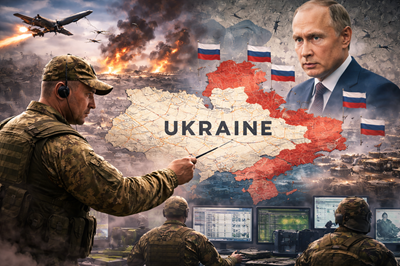
WAR-REPORT : Russia continues to pursue far-reaching territorial objectives in Ukraine that extend well beyond its publicly stated demands, even as battlefield realities increasingly constrain its ability to achieve those goals. Recent statements by Ukrainian officials, coupled with observable trends on the ground, indicate that while Moscow retains ambitious long-term plans, it currently lacks the operational capacity to execute them effectively. At the same time, Ukraine’s evolving technological capabilities—particularly in drone warfare—are reshaping the dynamics of the conflict and imposing mounting costs on Russian forces.
Ukraine’s Growing Drone Warfare Advantage
According to Ukrainian Presidential Office Deputy Head Colonel Pavlo Palisa, Russian military planning for 2026 and beyond reflects a broad and aggressive strategic vision. Speaking on April 8, Palisa outlined a series of objectives that go far beyond the immediate focus on Donetsk Oblast. While Russia has consistently emphasized its goal of securing control over the Donbas region, its longer-term ambitions encompass large portions of southern and eastern Ukraine, as well as the establishment of buffer zones along key border areas.

Palisa reported that Russian forces are expected to prioritize the complete seizure of the remaining parts of the Donbas region, particularly in Donetsk Oblast, while simultaneously intensifying operations in the Dnipropetrovsk–Zaporizhia border area. These efforts are likely to form the core of Russia’s operational focus in the near term. However, beyond these immediate objectives, Moscow’s plans extend to significantly broader territorial ambitions.
Among these ambitions is the creation of buffer zones along Ukraine’s northern border, specifically in Kharkiv, Sumy, and Chernihiv oblasts. Such buffer zones would serve both defensive and offensive purposes, potentially allowing Russian forces to reduce perceived threats from Ukrainian counterattacks while also positioning themselves for future advances. Additionally, Russian planners reportedly aim to set conditions for the eventual seizure of the entirety of Zaporizhia and Kherson oblasts—regions that hold both strategic and economic significance.
Looking further ahead, Palisa indicated that Russia’s long-term objectives include capturing Mykolaiv and Odesa oblasts, which would effectively give Moscow control over Ukraine’s southern coastline and significantly limit Kyiv’s access to the Black Sea. This would represent a major strategic shift, altering the balance of power in the region and impacting global trade routes.

One of the more notable aspects of Russia’s reported plans is its intention to establish a buffer zone in southwestern Ukraine, specifically in Vinnytsia Oblast, using the territory of Transnistria—a pro-Russian separatist region in Moldova. This would mark the first time Russia has attempted to project influence into this area from that direction, highlighting the breadth of its strategic thinking. However, such an operation would require a level of coordination and capability that Russian forces currently do not appear to possess.
Despite the scope of these ambitions, Palisa emphasized that Russian forces presently lack the offensive capacity needed to achieve them. This assessment is supported by the failure of Russian forces to meet earlier operational objectives. In June 2025, Palisa had outlined a series of targets that Russia aimed to accomplish within specific timelines, including the capture of a significant portion of Donetsk Oblast by September 2025 and broader territorial gains by the end of 2026. As of April 2026, none of these objectives have been fully realized.
A key factor limiting Russia’s progress is its inability to restore operational maneuver on the battlefield. Modern large-scale offensives require coordinated, mobile operations capable of exploiting breakthroughs and sustaining momentum. Without this capability, advances tend to be slow, costly, and limited in scope. The current state of the conflict suggests that Russian forces are largely confined to incremental gains rather than decisive breakthroughs.

At the same time, Ukrainian forces have been adapting rapidly to the evolving nature of warfare, particularly through the use of advanced drone technologies. These innovations have provided Ukraine with both tactical and operational advantages, enabling it to counter Russian advances more effectively while also targeting key infrastructure and logistics.
Palisa reported that Russian forces have incurred significant casualties relative to the territory they have gained. In the first quarter of 2026 alone, Russian forces reportedly suffered approximately 316 casualties per square kilometer of advance in Donetsk Oblast. This represents a substantial increase compared to 2025, when the average was around 120 casualties per square kilometer across the broader theater, and approximately 160 in specific high-intensity areas such as the Pokrovsk direction.
These figures highlight the growing cost of Russian operations and suggest that their current approach may be unsustainable over the long term. High casualty rates not only affect morale and combat effectiveness but also place additional strain on recruitment and logistics systems.
In contrast, Ukraine has made notable progress in achieving numerical and qualitative advantages in drone warfare. According to Palisa, Ukrainian forces now maintain a ratio of approximately 1.3 strike drones for every Russian strike drone on the front line. This represents a significant shift in the balance of capabilities, particularly given the central role that drones play in modern combat operations.
Ukraine has also invested heavily in developing drones that are resistant to electronic warfare (EW) systems. Approximately 32 percent of Ukrainian drones are equipped with fiber-optic guidance systems that make them less vulnerable to jamming, compared to around 24 percent of Russian drones. This technological edge enhances Ukraine’s ability to conduct reliable and precise strikes even in contested electronic environments.
In addition to front-line operations, Ukraine has expanded its mid-range strike campaign against Russian drone infrastructure. These strikes have targeted launch sites, communication nodes, and support facilities, including locations in occupied Donetsk City and Crimea. By disrupting these networks, Ukraine has limited Russia’s ability to coordinate large-scale drone operations.
Palisa noted that these efforts have prevented Russian forces from launching up to 1,000 drones simultaneously, forcing them instead to stagger their launches throughout the day. This reduction in operational intensity diminishes the overall effectiveness of Russian drone campaigns and provides Ukrainian forces with greater opportunities to intercept and counter incoming threats.
The cumulative impact of these developments is significant. Ukraine’s defensive successes, combined with its technological innovations and targeted strikes, are creating compounding effects that degrade both Russian front-line capabilities and long-range strike potential. These effects extend beyond immediate battlefield outcomes, influencing broader strategic dynamics.
Recent Ukrainian advances in southern Ukraine since late January 2026 have further complicated the situation for Russian forces. These gains have created cascading operational pressures, forcing Russia to make difficult decisions about resource allocation. In some cases, Russian units must choose between reinforcing vulnerable positions against Ukrainian counterattacks or continuing offensive operations in other sectors.
This dynamic undermines the narrative promoted by Russian officials that Ukrainian defenses are on the verge of collapse. Instead, the evidence suggests a more complex and contested battlefield, in which Ukraine retains the capacity to adapt, resist, and even regain the initiative in certain areas.
Beyond the battlefield, the Kremlin has also intensified its information operations, particularly in the nuclear domain. On April 8, Russia’s Foreign Intelligence Service (SVR) claimed that European Union leaders are allegedly discussing the development of independent nuclear weapons capabilities. These claims were presented as a warning to the United States, with Russia urging Washington to intervene to prevent such developments.
However, these allegations appear to lack credible evidence and are widely interpreted as part of a broader strategy to create divisions between the United States and the European Union. By portraying the EU as acting in ways that could undermine U.S. nuclear interests, Russia may be attempting to weaken transatlantic cohesion and complicate coordinated responses to the conflict.
This approach is consistent with previous efforts by the Kremlin to use nuclear rhetoric as a tool of influence. Russian officials have repeatedly made unsubstantiated claims about nuclear threats involving Ukraine and its allies, including allegations earlier in 2026 that the United Kingdom and France were attempting to transfer nuclear materials to Ukraine. Such claims are often designed to disrupt discussions about security guarantees and to create uncertainty among Western partners.
The use of nuclear-related narratives in information operations underscores the multifaceted nature of the conflict, which extends beyond physical combat to include psychological and political dimensions. Managing these dynamics will be critical for maintaining unity among Ukraine’s supporters and countering efforts to exploit perceived divisions.
In conclusion, Russia’s expansive territorial ambitions in Ukraine remain evident, but its ability to achieve these objectives is increasingly constrained by operational limitations and mounting costs. At the same time, Ukraine’s technological adaptations and strategic initiatives are reshaping the battlefield, providing it with new tools to counter Russian advances and impose significant losses.
The interplay between military developments and information operations further complicates the situation, highlighting the need for a comprehensive approach to understanding and addressing the conflict. As the war continues, the balance between ambition and capability, innovation and adaptation, will play a निर्णक role in determining its ultimate outcome.