

The PRC’s Calibrated Support to Iran and Its Broader Strategic
By Samir Singh 'Bharat': Editor In Chief

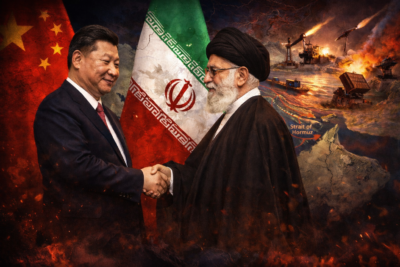
WAR-REPORT : The evolving geopolitical landscape surrounding tensions between People’s Republic of China (PRC), Iran, and the United States continues to reveal a complex pattern of restrained yet consequential engagement. Recent developments suggest that while the PRC has avoided overt and large-scale support for Iran during its confrontation with the United States, it has nonetheless provided limited and carefully calibrated assistance. This approach reflects a broader strategic balancing act: supporting a key regional partner without triggering direct retaliation from Washington or alienating critical economic partners in the Gulf.
Table of Contents
ToggleLimited Material Support with Strategic Implications
Reports emerging in early April indicate that the PRC has facilitated the transfer of sensitive materials to Iran that could significantly impact Tehran’s military capabilities. According to credible sources, multiple shipments of sodium perchlorate—a critical precursor in the production of solid missile propellant—were delivered from the PRC to Iran. Sodium perchlorate plays an essential role in the manufacturing of solid-fuel ballistic missiles, enabling greater storage stability, rapid deployment, and improved strike readiness.

The arrival of at least five such shipments suggests a deliberate effort to assist Iran in partially rebuilding or sustaining its missile production infrastructure. This development is particularly significant in the aftermath of the June 2025 conflict—often referred to as the Twelve-Day War—during which Iran’s missile capabilities were reportedly degraded. The PRC had previously supplied similar materials following that conflict, indicating a pattern of post-conflict support aimed at helping Iran recover strategically important capabilities.
While the scale of this assistance appears limited, its implications are far-reaching. Even incremental improvements in Iran’s missile program could enhance its deterrence posture and increase the risks faced by US forces and allied assets across the Middle East.
The Role of Commercial Technology and Satellite Intelligence
Beyond material support, another dimension of PRC-linked assistance has emerged in the domain of intelligence and targeting capabilities. Reports citing officials from the US Defense Intelligence Agency indicate that Iran may have leveraged satellite imagery provided by a PRC-based company, MizarVision, to improve the precision of its military operations.

MizarVision has reportedly published high-resolution satellite imagery of US military installations in the Middle East, enhanced with artificial intelligence-assisted tagging. These images identify specific military assets, infrastructure layouts, and operational zones with notable clarity. The availability of such data—especially if accessible at little or no cost—would provide a significant advantage to any actor seeking to conduct targeted strikes.
Iran, which does not possess a fully developed independent satellite constellation, likely relies on a combination of domestic intelligence, allied support, and open-source data. The integration of commercially available satellite imagery into its targeting processes could markedly improve the accuracy of its missile and drone strikes.
Notably, the PRC government is believed to hold a minority stake in MizarVision, raising questions about the extent of state involvement or oversight. While there is no definitive public evidence that Beijing directly instructed the company to release such data, the timing and accessibility of the imagery suggest at least tacit approval. Reports indicate that the imagery was made freely available for several weeks, coinciding with a period of heightened US military activity in the region.

Strategic Restraint and Calculated Ambiguity
Despite these developments, assessments from analytical organizations such as ISW-CDOT suggest that the PRC has intentionally limited its support to Iran. This restraint appears driven by several strategic considerations.
First, the PRC maintains significant economic and political ties with Gulf states, including Saudi Arabia and the United Arab Emirates. Openly backing Iran in a military confrontation could jeopardize these relationships, which are vital for China’s energy security and broader economic interests.
Second, overt military support for Iran could provoke direct retaliation from the United States, potentially escalating tensions into a wider conflict. By keeping its assistance below a certain threshold—providing dual-use materials and enabling access to open-source intelligence—the PRC can support Iran without crossing lines that might trigger a forceful US response.
This approach reflects a broader pattern in PRC foreign policy: leveraging ambiguity and indirect means to advance strategic objectives while minimizing risk. By operating in the gray zone between neutrality and alignment, Beijing can influence outcomes without becoming a direct participant in the conflict.
Implications for Regional Stability
The PRC’s actions suggest a continued interest in preserving the stability of the Iranian regime. Iran serves as a key partner in China’s Belt and Road Initiative and plays a strategic role in counterbalancing US influence in the Middle East. Ensuring that Iran retains a credible deterrent capability aligns with Beijing’s broader objective of maintaining a multipolar regional order.
However, this strategy carries inherent risks. Even limited support could embolden Iran to adopt more assertive military postures, potentially increasing the likelihood of miscalculation or escalation. Additionally, the use of commercially available satellite imagery for military targeting raises broader concerns about the militarization of private-sector technologies.
Cross-Strait Dynamics: A Parallel Diplomatic Track
While the PRC navigates its role in the Middle East, it is simultaneously advancing its political objectives in East Asia—particularly in relation to Taiwan. A recent high-profile meeting between Xi Jinping, General Secretary of the Chinese Communist Party, and Cheng Li-wun, Chairwoman of Taiwan’s Kuomintang (KMT), underscores Beijing’s efforts to shape cross-strait dynamics through political engagement.
The meeting, held on April 10 during Cheng’s six-day visit to the PRC, marked a significant moment in cross-strait relations. Cheng is the first sitting KMT chairperson to visit the mainland since former chairman Eric Chu did so in 2015. Her visit included stops in Jiangsu, Shanghai, and Beijing, reflecting a carefully orchestrated diplomatic itinerary.
During the meeting, both sides reiterated their commitment to the so-called “1992 Consensus,” a framework that acknowledges a shared understanding of “one China” while allowing for differing interpretations. They also expressed opposition to Taiwanese independence, aligning with longstanding PRC policy.
Political Messaging and Domestic Implications
Cheng’s visit carries significant implications not only for cross-strait relations but also for Taiwan’s domestic political landscape. Since assuming leadership of the KMT in November 2025, she has emphasized the importance of re-establishing dialogue with Beijing. She has criticized what she describes as the “provocative” policies of the ruling Democratic Progressive Party (DPP) and Taiwan’s president, William Lai Ching-te.
By positioning herself as a proponent of dialogue and stability, Cheng aims to differentiate the KMT from the DPP, which has adopted a more cautious and sovereignty-focused approach toward the PRC. Her characterization of herself as a “bridge for peace” reflects a broader strategy of leveraging cross-strait engagement to bolster the KMT’s political standing.
This strategy is particularly relevant in the context of Taiwan’s upcoming 2026 local elections. By demonstrating its ability to maintain communication channels with Beijing, the KMT may seek to appeal to voters concerned about rising tensions and the potential for conflict.
Historical Context and Ongoing Tensions
Relations between the PRC and Taiwan have remained strained since the election of former President Tsai Ing-wen in 2016, after which Beijing suspended official communication channels. In the absence of formal dialogue, non-governmental and party-to-party exchanges—often facilitated by the KMT—have become an important avenue for interaction.
The PRC has consistently sought to isolate the DPP-led government while engaging with opposition figures who are perceived as more amenable to its positions. This dual-track approach allows Beijing to exert influence within Taiwan’s political system while maintaining pressure on the ruling administration.
Converging Strategies Across Regions
Taken together, the PRC’s actions in the Middle East and East Asia reveal a coherent strategic approach characterized by indirect influence, selective engagement, and risk management. In both contexts, Beijing seeks to advance its interests without triggering direct confrontation.
In the Middle East, this involves providing limited support to Iran while maintaining plausible deniability. In East Asia, it entails engaging with sympathetic political actors in Taiwan to shape the trajectory of cross-strait relations.
These strategies are underpinned by a broader objective: the gradual reshaping of the international order in a manner that enhances China’s influence while constraining that of the United States.
Our Media Opinion
The PRC’s recent activities highlight the complexity of modern geopolitical competition, where influence is often exerted through subtle and multifaceted means. By providing limited material support and enabling access to advanced technologies, Beijing has contributed to Iran’s ability to sustain and potentially enhance its military capabilities.
At the same time, its engagement with Taiwan’s opposition underscores a parallel effort to shape political dynamics in East Asia. In both cases, the PRC has demonstrated a preference for strategies that operate below the threshold of direct confrontation, allowing it to pursue its objectives while managing risk.
As these dynamics continue to unfold, they will have significant implications for regional stability, global security, and the evolving balance of power in the international system.