

India’s “Right to Reject” Debate: Why NOTA Exists but Still Falls Short of Real Electoral Power 2026
By Samir Singh 'Bharat': Editor In Chief

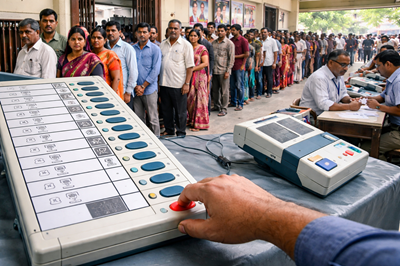
New Delhi : India, the world’s largest democracy, prides itself on giving citizens the right to choose their representatives through free and fair elections. Over the years, however, a growing section of voters has expressed dissatisfaction not just with individual candidates but with the overall quality of political choices available to them. This sentiment gave rise to the demand for a “Right to Reject,” ultimately leading to the introduction of NOTA—“None of the Above”—on ballot papers. While NOTA was hailed as a progressive step toward empowering voters, its practical limitations have sparked an ongoing debate about whether it truly delivers meaningful electoral accountability.
Debate on Strengthening NOTA Powers
The concept of NOTA was formally introduced in India following a landmark 2013 judgment by the Supreme Court, which directed the Election Commission to provide voters with the option to reject all candidates if they found none suitable. This decision was widely celebrated as a move toward enhancing democratic participation, protecting voter anonymity, and allowing citizens to express dissent within the electoral framework. For the first time, voters who were disillusioned with the political system had a formal mechanism to register their dissatisfaction without abstaining from voting altogether.

Despite its symbolic importance, NOTA’s actual impact on election outcomes remains minimal. Under current rules, even if NOTA secures the highest number of votes in a constituency, the candidate with the next highest number of valid votes is declared the winner. In other words, NOTA does not have the power to invalidate an election or force a re-poll with new candidates. This limitation has led critics to argue that NOTA is more of a symbolic gesture than a tool of genuine democratic reform.
The absence of legal consequences for a high NOTA vote raises important questions about electoral accountability. If a majority of voters reject all candidates, should the election still stand? Should political parties be compelled to field better candidates? These questions lie at the heart of the “Right to Reject” debate in India. Advocates for reform argue that without enforceable consequences, NOTA fails to serve its intended purpose of pressuring political parties to improve the quality of their candidate.
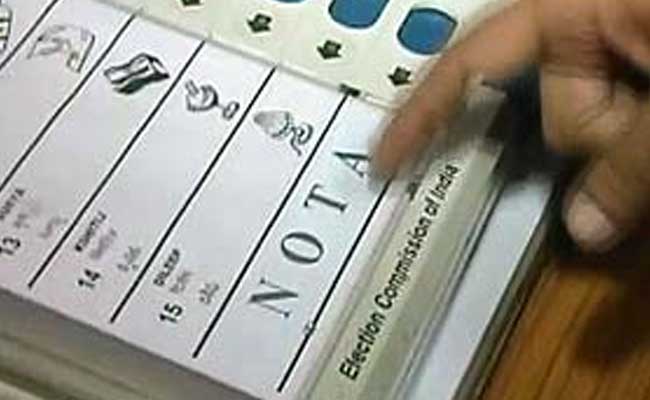

Proponents of a stronger NOTA mechanism suggest several reforms. One commonly proposed idea is that if NOTA receives the highest number of votes in a constituency, the election should be declared null and void, and a fresh election should be conducted with new candidates. Another suggestion is to disqualify candidates who contested in the rejected election from participating in the re-election. Such measures, supporters argue, would create a powerful incentive for political parties to nominate credible and capable individuals.
However, opponents of these reforms caution against potential unintended consequences. Conducting re-elections could lead to increased financial and administrative burdens on the electoral system. India already conducts elections on a massive scale, involving millions of polling officials and extensive logistical planning. Repeated elections in constituencies where NOTA prevails could strain resources and disrupt governance.
There are also concerns about the possibility of misuse. Critics argue that organized groups could deliberately promote NOTA campaigns to force repeated elections, thereby destabilizing the political process. In a country as diverse and complex as India, ensuring that electoral reforms do not inadvertently create opportunities for manipulation is a significant challenge.

Another perspective emphasizes voter responsibility. Some analysts argue that instead of relying on NOTA, citizens should engage more actively in the political process by supporting credible candidates, participating in party activities, and demanding transparency and accountability. From this viewpoint, NOTA is seen as a passive form of protest that does not necessarily contribute to constructive political change.
Nevertheless, the rise in NOTA votes across various elections indicates a growing sense of disillusionment among voters. In several constituencies, NOTA has received a significant share of votes, sometimes even surpassing the margins of victory between leading candidates. While these votes do not alter the election outcome, they send a strong message about voter dissatisfaction. Political parties, at least in theory, are expected to take note of such trends and adjust their candidate selection strategies accordingly.
The psychological and symbolic value of NOTA should not be underestimated. It provides an outlet for voter frustration and helps maintain participation in the electoral process. Without NOTA, disillusioned voters might choose to abstain altogether, leading to lower voter turnout and weakening the legitimacy of election results. By allowing voters to formally register their rejection, NOTA contributes to a more inclusive democratic process.
At the same time, the limitations of NOTA highlight a broader issue within India’s electoral system—the need for deeper structural reforms. Electoral transparency, candidate accountability, campaign finance regulation, and internal democracy within political parties are all critical areas that require attention. Strengthening these aspects could address many of the concerns that lead voters to choose NOTA in the first place.
Comparisons with other democracies reveal that India is not alone in grappling with the concept of a “Right to Reject.” Some countries have experimented with similar mechanisms, though with varying degrees of effectiveness. In certain jurisdictions, provisions exist for recall elections, where voters can remove elected representatives before the end of their term. Others have implemented stricter candidate qualification criteria or stronger anti-defection laws to enhance accountability.
In India, the idea of a recall mechanism has also been discussed, though it has not been implemented at the national or state level. Introducing such a system would require significant legal and constitutional changes, as well as safeguards to prevent misuse. Nonetheless, it represents another dimension of the broader conversation about empowering voters beyond the act of casting a ballot.
The role of the Election Commission is crucial in this context. As the guardian of India’s electoral process, it has the authority to recommend reforms and ensure that elections remain free, fair, and credible. While the introduction of NOTA was a significant step forward, further innovation and policy changes may be necessary to address its shortcomings.
Public awareness and civic education also play a vital role. Many voters may not fully understand the implications of choosing NOTA or the limitations associated with it. Enhancing awareness about electoral rights and responsibilities can help citizens make more informed decisions and engage more effectively with the democratic process.
Political parties, too, must introspect. The persistence of NOTA votes is, in many ways, a reflection of public dissatisfaction with the choices presented to them. By prioritizing merit, integrity, and public service in candidate selection, parties can rebuild trust and reduce the appeal of NOTA as a protest option.
Ultimately, the debate over NOTA and the “Right to Reject” is a reflection of a deeper aspiration among Indian voters—a desire for a more responsive, accountable, and representative political system. While NOTA provides a voice for dissent, it does not yet offer a mechanism for change. Bridging this gap will require thoughtful reforms, careful balancing of competing concerns, and a commitment to strengthening democratic institutions.
As India continues to evolve as a democracy, the question remains: should the “Right to Reject” remain symbolic, or should it be transformed into a tool of real electoral power? The answer will shape not only the future of NOTA but also the broader trajectory of democratic governance in the country.