


North Korea Nuclear Expansion Yongbyon: 7 Critical Risks as US Missile Defense Shifts
By Samir Singh 'Bharat': Editor In Chief

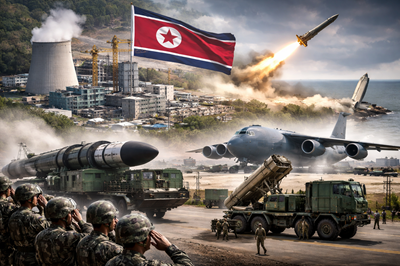
WAR-REPORT : The security landscape of Northeast Asia is once again under intense scrutiny following new indications that North Korea may be expanding its nuclear enrichment infrastructure. Satellite imagery and assessments by the International Atomic Energy Agency suggest that construction activity at a major nuclear complex could significantly enhance the country’s ability to produce nuclear material.
At the same time, reports that the United States has redeployed portions of its advanced missile defense systems from South Korea to the Middle East have sparked concerns among security analysts about potential temporary vulnerabilities in the region’s defensive architecture.

Together, these developments highlight a complex geopolitical moment in which nuclear proliferation concerns intersect with shifting military priorities and evolving regional alliances.
Satellite Evidence Points to Expansion at Yongbyon
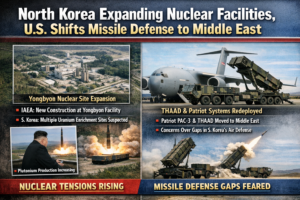
According to a report issued on March 3 by the International Atomic Energy Agency, satellite imagery indicates that North Korea is expanding facilities at the Yongbyon Nuclear Scientific Research Center, long considered the heart of the country’s nuclear program.
The imagery reveals the construction of a new complex believed to be linked to uranium enrichment operations. While analysts are still examining the precise function of the new structures, early assessments suggest that the facility could significantly increase Pyongyang’s capacity to produce fissile material necessary for nuclear weapons.

IAEA Director General Rafael Grossi stated that the new installation appears comparable in size and infrastructure to another suspected enrichment site at Kangson nuclear facility. The comparison is based primarily on similarities in power supply systems and cooling capabilities, both essential elements for operating centrifuge-based uranium enrichment processes.
However, Grossi emphasized that the agency has not yet confirmed whether the newly expanded Yongbyon complex is definitively a uranium enrichment plant. Due to North Korea’s limited cooperation with international inspectors, the IAEA relies largely on satellite imagery and external intelligence sources to monitor developments within the country’s nuclear infrastructure.
Multiple Enrichment Sites Suspected Across North Korea
Additional insights have emerged from officials in South Korea, who believe Pyongyang may be operating several enrichment facilities simultaneously.

South Korean Unification Minister Chung Dong-young stated on March 6 that North Korea likely maintains uranium enrichment sites in three locations:
-
Yongbyon Nuclear Scientific Research Center
-
Guseong
-
Kangson nuclear facility
These facilities, if confirmed, would form the backbone of the country’s expanding nuclear production network.
Chung also claimed that approximately 16 kilograms of plutonium were extracted from the Yongbyon reactor complex during 2025. Plutonium is a critical ingredient in many modern nuclear weapons, particularly those based on implosion-type designs.
Experts note that advanced nuclear warheads typically require between three and five kilograms of plutonium for the fissile core that triggers the explosive chain reaction. Based on these estimates, the amount reportedly produced last year could potentially supply material for several additional nuclear warheads.
If accurate, such production levels would mark a notable acceleration in North Korea’s nuclear weapons program and reinforce concerns that Pyongyang is steadily expanding its arsenal despite international sanctions and diplomatic pressure.
Strategic Implications of Yongbyon Expansion
The Yongbyon nuclear complex has been a focal point of international negotiations and monitoring efforts for decades. Located about 100 kilometers north of Pyongyang, the site includes reactors, reprocessing facilities, and laboratories associated with both plutonium and uranium-based weapons programs.
Historically, the facility has been central to diplomatic initiatives aimed at curbing North Korea’s nuclear ambitions. During earlier negotiations, Pyongyang offered to dismantle parts of Yongbyon in exchange for sanctions relief, but talks ultimately collapsed.
The latest construction activity suggests that rather than scaling back its nuclear program, the country may be actively modernizing and expanding its production capacity.
Analysts believe that establishing multiple enrichment facilities would provide strategic advantages. Dispersing nuclear infrastructure across several locations would make it harder for foreign intelligence agencies to monitor or target the program and could ensure continuity of operations even if one site were disrupted.
Moreover, expanding uranium enrichment capabilities could allow Pyongyang to shift toward highly enriched uranium-based weapons, which can be produced in smaller and more concealed facilities compared with plutonium-based programs.
US Missile Defense Redeployment Raises Concerns
While developments in North Korea’s nuclear program are drawing attention, a separate but related issue has emerged involving the redeployment of US missile defense systems from the Korean Peninsula.
South Korean media outlets reported that several Boeing C-17 Globemaster III and Lockheed C-5 Galaxy cargo planes departed Osan Air Base on March 5 carrying equipment associated with Patriot PAC-3 batteries.
Reports suggest that these interceptors and launch systems were transferred to support ongoing US and allied operations in the Middle East.
Further reporting by The Washington Post on March 10 indicated that elements of the Terminal High Altitude Area Defense deployed in South Korea may also have been relocated to reinforce air defense networks in the Middle East.
Officials from United States Forces Korea and the South Korean Ministry of National Defense declined to confirm the reports publicly, citing operational security.
Middle East Conflict Driving Missile Defense Demand
The redeployment appears to be linked to escalating hostilities involving Iran, which has launched large-scale missile and drone attacks against Israel and allied forces in the region.
To counter these threats, the United States and its partners have relied heavily on layered missile defense systems, including Patriot PAC-3 and Terminal High Altitude Area Defense.
According to reports, US forces used more than 800 Patriot interceptors during just three days of intense combat last week. That figure reportedly exceeds the annual production rate of approximately 600 interceptors manufactured by Lockheed Martin.
The extraordinary rate of interceptor use has likely forced the Pentagon to reallocate missile defense resources globally, including from the Korean Peninsula.
Potential Gaps in South Korea’s Missile Defense
Military experts warn that moving Patriot PAC-3 and parts of the Terminal High Altitude Area Defense could temporarily weaken South Korea’s integrated air and missile defense network.
The Patriot PAC-3 system forms the final defensive layer designed to intercept short- and medium-range ballistic missiles during the terminal phase of flight, when the missile is approaching its target.
Given the short distances involved on the Korean Peninsula, missiles launched by North Korea could reach their targets within minutes, making the terminal defense layer particularly important.
Without sufficient Patriot batteries, the lower tier of the Korean Air and Missile Defense network could be weakened.
South Korea’s Indigenous Missile Defense Efforts
To strengthen its defenses, South Korea has been developing its own missile interception technologies.
Two key components are the M-SAM Block I and the improved M-SAM Block II, which operate in the lower-to-mid interception layer between Patriot systems and high-altitude defenses.
At higher altitudes, the Terminal High Altitude Area Defense remains the only operational system capable of intercepting ballistic missiles at heights ranging from 40 to 150 kilometers.
However, South Korea is also developing the L-SAM missile defense system, which is intended to serve as a domestically produced high-altitude interceptor comparable to THAAD.
The system has not yet been fully operationally deployed, meaning that any reduction in US missile defense assets could temporarily affect the overall strength of the region’s defensive umbrella.
Strategic Calculations in Pyongyang
Despite these developments, analysts believe that North Korea currently has little incentive to conduct direct missile strikes aimed at exploiting potential gaps in the Korean Peninsula’s air defense systems.
Such an action would risk triggering a major military confrontation with both South Korea and the United States.
Instead, Pyongyang may view its nuclear and missile programs primarily as tools for deterrence and leverage in international negotiations.
Nevertheless, temporary gaps in missile defense coverage could affect perceptions of deterrence and readiness. In strategic terms, even short-term vulnerabilities can influence calculations among regional actors.
Broader Implications for Regional Security
The convergence of expanding nuclear infrastructure in North Korea and shifting missile defense deployments underscores the fragile security balance in Northeast Asia.
For policymakers in South Korea, the developments highlight the importance of accelerating indigenous missile defense programs and maintaining close coordination with the United States.
For the international community, the latest findings reinforce longstanding concerns about nuclear proliferation and the limitations of monitoring programs when access to facilities is restricted.
As tensions persist across multiple regions—from the Middle East to the Korean Peninsula—global security planners face increasingly complex challenges in balancing resources, maintaining deterrence, and preventing escalation.
The expansion of nuclear facilities at Yongbyon and the reported redeployment of US missile defense assets represent two interconnected developments shaping the strategic environment in East Asia.
If North Korea succeeds in significantly expanding its fissile material production, it could accelerate the growth of its nuclear arsenal. Meanwhile, temporary adjustments in US military deployments may influence the region’s defensive posture.
Although no immediate crisis appears imminent, the situation highlights the ongoing need for diplomatic engagement, enhanced monitoring, and strengthened defense cooperation to maintain stability in one of the world’s most strategically sensitive regions.