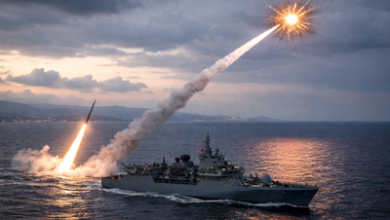


North Korea Advances MIRV Ambitions with High-Thrust ICBM Engine Test
By Samir Singh 'Bharat': Editor In Chief

WAR-REPORT : Recent developments in North Korea’s missile program have raised significant concerns among global security analysts and policymakers. The country’s latest test of a high-thrust solid-fuel intercontinental ballistic missile (ICBM) engine signals a clear effort to advance its strategic capabilities, particularly in the direction of multiple independently targetable re-entry vehicles (MIRVs).
This technological progression represents more than a routine weapons test. It reflects a calculated move to enhance deterrence, complicate missile defense systems, and strengthen North Korea’s position in future geopolitical negotiations. At the same time, Pyongyang is expanding its diplomatic and economic outreach, signaling a broader strategy that combines military advancement with international engagement.

The Engine Test: A Major Technological Advancement
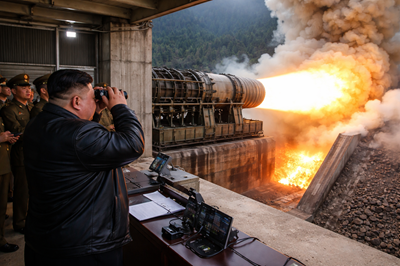
On March 29, North Korean state media reported that Kim Jong Un personally observed a high-thrust solid-fuel engine ejection test. The test involved the use of advanced carbon fiber composite materials, which are known for their strength and lightweight properties.
According to official claims, the engine generates a maximum thrust of approximately 2,500 kilonewtons (kN). This represents a significant increase compared to earlier tests:
- The September 2025 engine produced around 1,971 kN
- That engine was itself a 40 percent improvement over its predecessor
This steady progression indicates a focused effort to improve propulsion efficiency and overall missile performance.

To put this in perspective, the reported thrust of North Korea’s new engine exceeds that of several established systems:
- The Minuteman III produces about 891 kN
- Russia’s Topol-M generates around 913 kN
- The Chinese DF-41 is estimated at 1,100 to 1,400 kN
If accurate, the 2,500 kN figure would represent one of the most powerful ICBM engines currently known.
Why High Thrust Matters
The significance of high engine thrust extends beyond raw performance. In missile technology, thrust directly influences range, payload capacity, and operational flexibility.

A more powerful engine allows a missile to:
- Travel longer distances
- Carry heavier payloads
- Maintain stability even with complex configurations
This becomes particularly important in the context of MIRV technology, where a single missile carries multiple warheads. Each additional warhead increases the overall weight, requiring greater thrust to maintain range and accuracy.
The Role of Carbon Fiber Materials
Another important aspect of the test is the use of carbon fiber composite materials. These materials are lighter than traditional metals while maintaining high strength and durability.
Their advantages include:
- Reduced missile weight
- Increased payload capacity
- Improved fuel efficiency
- Enhanced structural resilience
By incorporating such materials, North Korea is not only improving engine performance but also optimizing overall missile design.
MIRV Capability: A Game-Changer in Strategic Warfare
The development of MIRV technology represents a significant shift in North Korea’s strategic posture. MIRVs allow a single missile to carry multiple warheads, each capable of striking a different target.
This capability offers several advantages:
1. Increased Strike Efficiency
One missile can target multiple locations, maximizing impact.
2. Defense System Saturation
Missile defense systems must intercept multiple warheads simultaneously, increasing the likelihood that some will penetrate.
3. Enhanced Deterrence
The ability to conduct widespread strikes strengthens a country’s second-strike capability, ensuring retaliation even after an initial attack.
North Korea’s pursuit of MIRV technology aligns with its broader goal of establishing a credible deterrent against potential adversaries.
Range and Global Reach
Analysts from the Stimson Center, particularly its 38 North program, have assessed that North Korea’s solid-fuel ICBMs may have a range exceeding 15,000 kilometers.
Such a range would enable the country to reach targets across the continental United States, significantly expanding its strategic reach.
Long-range capability combined with MIRV technology would create a more complex and challenging threat environment for missile defense systems.
Solid-Fuel Technology: Operational Advantages
North Korea’s focus on solid-fuel ICBMs is also noteworthy. Unlike liquid-fuel missiles, solid-fuel systems offer several operational benefits:
- Faster launch readiness
- Reduced vulnerability to preemptive strikes
- Easier storage and transportation
These advantages make solid-fuel missiles more practical for real-world deployment and enhance their survivability in conflict scenarios.
Expanding Diplomatic Engagement
While advancing its military capabilities, North Korea is also actively expanding its international relationships. A notable development is the recent visit of Alexander Lukashenko to Pyongyang.
This visit, which took place on March 25 and 26, marked the first time Lukashenko traveled to North Korea. The two leaders had previously met in Beijing in September 2025 during a major commemorative event hosted by China.
The Treaty of Friendship and Cooperation
During the visit, Kim Jong Un and Alexander Lukashenko signed a Treaty of Friendship and Cooperation. This agreement establishes a legal framework for bilateral collaboration between the two countries.
Although the full details of the treaty have not been disclosed, it is not believed to include mutual defense commitments similar to North Korea’s 2024 agreement with Russia.
Instead, the treaty appears to focus on cooperation in various sectors, including:
- Education
- Culture
- Healthcare
- Agriculture
- Information and media
Such agreements may help North Korea mitigate the effects of international sanctions and strengthen its economic resilience.
Economic and Strategic Implications
The expansion of international partnerships serves multiple purposes for North Korea.
Economic Relief
Cooperation in agriculture and healthcare could address domestic challenges.
Political Leverage
Building relationships with other countries increases diplomatic influence.
Sanctions Resistance
Diversified partnerships reduce reliance on any single external partner.
These factors contribute to a more resilient and adaptable national strategy.
Belarus as a Strategic Partner
Belarus’s involvement is particularly significant. As a country with close ties to Russia, its engagement with North Korea may reflect broader geopolitical alignments.
Lukashenko’s decision to open a Belarusian embassy in Pyongyang further underscores the importance of this relationship. Diplomatic presence facilitates deeper cooperation and signals long-term commitment.
Additionally, Lukashenko reportedly offered to act as an intermediary in discussions with the United States, indicating a potential role in future negotiations.
Implications for Global Security
The combination of advanced missile development and expanding diplomatic ties presents a complex challenge for the international community.
Military Concerns
Enhanced missile capabilities increase the threat level and complicate defense planning.
Diplomatic Challenges
New alliances may shift regional power dynamics and influence negotiation outcomes.
Technological Competition
Advancements in materials and propulsion technology highlight the evolving nature of modern warfare.
Potential Future Developments
Looking ahead, several scenarios may unfold:
1. Continued Missile Development
North Korea may conduct further tests to refine MIRV technology and solid-fuel systems.
2. Expanded Diplomatic Outreach
Additional agreements with other countries could strengthen economic and political ties.
3. Increased Tensions
Advancements in military capability may lead to heightened tensions with the United States and its allies.
4. Negotiation Opportunities
Diplomatic engagement may open pathways for dialogue and potential agreements.
Our Media Opinion: A Dual Strategy of Power and Partnership
North Korea’s recent actions reflect a dual strategy that combines military advancement with diplomatic engagement. The high-thrust ICBM engine test demonstrates a clear commitment to enhancing strategic capabilities, particularly in the realm of MIRV technology.
At the same time, the expansion of international relationships indicates an effort to strengthen economic resilience and increase geopolitical influence.
Together, these developments mark a significant moment in North Korea’s evolution as a strategic actor. They highlight the growing complexity of global security challenges and underscore the need for careful analysis, coordinated responses, and sustained diplomatic efforts.
As the situation continues to evolve, the balance between deterrence, defense, and dialogue will play a critical role in shaping the future of international stability.