



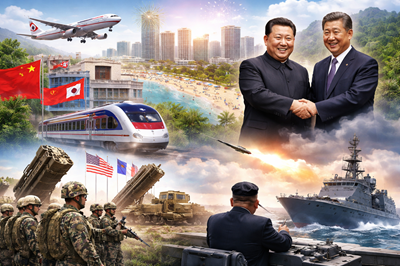
Special Report : In a rapidly evolving geopolitical landscape, North Korea appears to be recalibrating its economic and military strategies, seeking to balance deepening ties with China while sustaining its growing alignment with Russia. Recent developments—including the resumption of cross-border transport, renewed diplomatic signaling, and expanded military activity—highlight Pyongyang’s multifaceted approach to securing economic resilience and reinforcing its deterrence posture.
At the same time, shifting defense priorities by the United States, particularly in the Middle East, are raising concerns about potential vulnerabilities in South Korea’s air defense coverage. Against this backdrop, North Korea’s military modernization efforts—especially in naval capabilities—underscore its intent to project strength and adapt to changing regional dynamics.

Reopening Economic Channels: China-North Korea Engagement Gains Momentum
One of the most significant developments in recent weeks has been the revival of transportation links between Beijing and Pyongyang. After more than three years of pandemic-induced isolation, passenger train services between the two capitals resumed on March 12. These routes had been suspended in January 2020 as North Korea sealed its borders in response to COVID-19, though freight services gradually resumed in 2022.
The restoration of passenger rail connectivity signals more than a logistical adjustment—it represents a deliberate step toward normalizing bilateral exchanges. Complementing this move, Air China has announced the resumption of direct flights between Beijing and Pyongyang starting March 30, marking the first such service in six years.
These developments point to a broader effort by Pyongyang to revive economic activity and reduce its dependence on a narrow set of revenue sources. Tourism, in particular, has emerged as a focal point of North Korea’s economic strategy.

Tourism as a Revenue Engine: A Calculated Economic Shift
Under the leadership of Kim Jong Un, North Korea has increasingly emphasized tourism as a viable pathway to economic diversification. During the 9th Congress of the Workers’ Party of Korea, Kim underscored the importance of developing the country’s tourism infrastructure as part of a broader economic modernization agenda.
Central to this vision is the Wonsan-Kalma Coastal Tourist Area, a flagship development project designed to attract foreign visitors—particularly from China. On February 15, Pyongyang extended an unprecedented invitation to Chinese Ambassador Wang Yajun to visit the newly opened resort, signaling a clear intent to deepen bilateral cooperation in tourism.
The Chinese Embassy in Pyongyang subsequently highlighted the Wonsan-Kalma project in a public post on March 4, suggesting Beijing’s openness to supporting such initiatives. Analysts interpret this as a coordinated effort to revive pre-pandemic tourism flows, which once contributed significantly to North Korea’s foreign currency earnings.

Estimates suggest that if Chinese tourism returns to pre-2020 levels, North Korea could generate over $175 million annually—a substantial boost for a heavily sanctioned economy.
Diplomatic Signaling: A Subtle Shift in Pyongyang’s Tone Toward Beijing
Diplomatic messaging between Pyongyang and Beijing also indicates a warming of relations. On March 10, North Korean state media reported that Kim Jong Un had sent a personal reply to a congratulatory letter from Xi Jinping, General Secretary of the Chinese Communist Party.
This gesture is notable because North Korea had previously omitted Xi’s name from its reporting on New Year’s greetings exchanges earlier in January—a move widely interpreted as a sign of diplomatic distancing.
Kim’s latest response suggests a recalibration, potentially reflecting Pyongyang’s recognition of China’s enduring importance as an economic partner. While North Korea has drawn closer to Russia in recent months—particularly in military and defense cooperation—it appears unwilling to sideline its historically vital relationship with Beijing.
For China, maintaining stable ties with North Korea is equally strategic. Beijing views Pyongyang as a critical buffer state and seeks to prevent instability on its northeastern border. Strengthening economic engagement, particularly through tourism and infrastructure development, aligns with China’s broader regional interests.
US Military Redeployments: Implications for South Korea’s Security Posture
While North Korea strengthens its economic and diplomatic positioning, shifts in U.S. military deployments are raising concerns in South Korea. The United States Forces Korea has reportedly redeployed key missile defense assets—including Patriot PAC-3 and THAAD systems—to the Middle East.
These systems are essential components of South Korea’s layered missile defense architecture, designed to intercept ballistic threats at varying altitudes. The relocation reflects growing demand in the Middle East, where U.S. allies face increasing missile and drone threats.
The Terminal High Altitude Area Defense battery stationed in Seongju has been a cornerstone of South Korea’s high-altitude interception capability since its deployment in 2017. The system typically includes six launcher vehicles capable of intercepting missiles at altitudes between 40 and 150 kilometers.Recent reports indicate that while one launcher vehicle has returned to the Seongju base, the status of the remaining five remains unclear. The removal of interceptor missiles alone allows the system to remain partially operational using reserves. However, the relocation of launcher vehicles could significantly degrade its effectiveness.
South Korea currently lacks an indigenous high-altitude missile defense system, making it heavily reliant on U.S.-provided capabilities. Any reduction in these assets could create temporary gaps in its defense coverage—an issue of particular concern given North Korea’s expanding missile arsenal.
Middle East Demand: A Driving Factor Behind US Redeployments
The redeployment of missile defense systems is closely tied to escalating tensions in the Middle East. Gulf states, facing persistent threats from Iranian missile and drone attacks, have reportedly requested expedited delivery of additional interceptor systems from the United States.
The high operational tempo in the region has strained existing inventories, prompting Washington to reallocate resources from other theaters, including East Asia. While these decisions are driven by immediate security needs, they carry broader implications for regional stability in Northeast Asia.
For South Korea, the situation underscores the importance of accelerating its own defense capabilities, including the development of indigenous missile interception systems.
North Korea’s Naval Ambitions: Toward a Green-Water Navy
Parallel to its economic and diplomatic initiatives, North Korea is also advancing its military modernization efforts—particularly in naval capabilities. Recent developments suggest that Pyongyang is working toward establishing a “green-water navy,” capable of operating in regional waters with enhanced firepower.
A key component of this effort is the development of guided missile destroyers (DDGs), including the Choe Hyon-class. The lead vessel, Choe Hyon, conducted a cruise missile test on March 11, targeting land-based objectives in the Yellow Sea.
Kim Jong Un personally oversaw the test via live video feed, underscoring its strategic importance. According to North Korean state media, the exercise was designed to evaluate the Korean People’s Army Navy’s remote command and control capabilities.
This emphasis on missile armament suggests that North Korea’s DDGs are intended primarily as mobile launch platforms within its broader deterrence framework, rather than traditional multi-role warships.
Military Signaling Amid Joint Exercises
The timing of the missile test is particularly noteworthy. It coincided with joint military exercises conducted by the United States and South Korea—activities that Pyongyang routinely criticizes as provocative.
By conducting a high-profile missile test during these drills, North Korea likely aimed to send a clear message of defiance and demonstrate its ability to respond to perceived threats.
Such actions are consistent with Pyongyang’s long-standing strategy of leveraging military demonstrations to reinforce its bargaining position and deter adversaries.
Balancing Alliances: North Korea’s Strategic Calculus
Taken together, these developments highlight North Korea’s efforts to navigate a complex geopolitical environment. On one hand, it is deepening ties with Russia, particularly in defense cooperation. On the other, it is actively rebuilding its economic relationship with China.
This dual-track approach reflects a pragmatic strategy aimed at maximizing benefits while minimizing risks. By diversifying its partnerships, North Korea seeks to reduce its vulnerability to external pressure and enhance its strategic autonomy.
For China, maintaining engagement with North Korea is essential to preserving regional stability and countering U.S. influence. For Russia, closer ties with Pyongyang offer potential advantages in the context of broader geopolitical competition.
Our Media Opinion : A Region in Flux
The convergence of economic reopening, diplomatic recalibration, and military modernization underscores a pivotal moment for North Korea and the broader region. As Pyongyang seeks to revive its economy through renewed engagement with China, it is simultaneously reinforcing its military capabilities and adapting to shifting security dynamics.
Meanwhile, U.S. strategic priorities—particularly in the Middle East—are influencing the distribution of military resources, with potential implications for deterrence in Northeast Asia.
For South Korea and its allies, these developments highlight the need for vigilance and adaptability in an increasingly uncertain environment. For North Korea, they represent an opportunity to strengthen its position on multiple fronts.
As these trends continue to unfold, the interplay between economic cooperation, military preparedness, and diplomatic engagement will shape the future of regional stability in East Asia.