

National Conference charts vision for handmade India under Viksit Bharat 2047
By Doruvu Paul Jagan Babu: Assistant Chief Editor

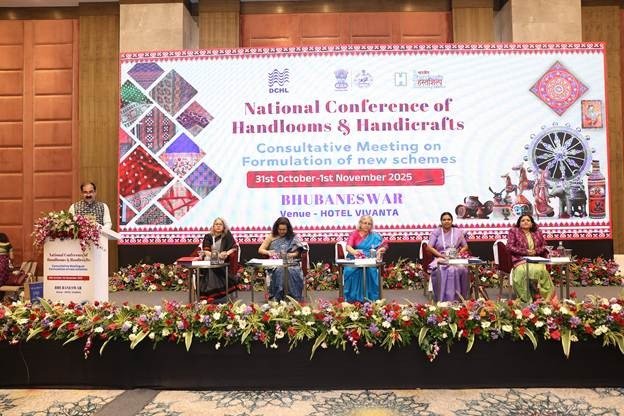
Bhubaneswar: The National Conference on Handlooms and Handicrafts 2025 concluded in Bhubaneswar on Saturday, reaffirming the Government’s commitment to reimagining India’s handmade sector as a key pillar of Viksit Bharat 2047. Organized by the Offices of the Development Commissioners (Handlooms and Handicrafts), Ministry of Textiles, the two-day event brought together senior officials, policymakers, and experts to shape a unified roadmap for the growth of India’s handloom and handicraft industries.
Balancing tradition with modern tools

Chairing the second day’s sessions, Neelam Shami Rao, Secretary, Ministry of Textiles, emphasized the importance of balancing traditional craftsmanship with modern technologies to enhance productivity and reduce drudgery. She urged premier institutions like NIFT and IIHT to proactively forecast design and colour trends to stay ahead of global markets.
Calling for seamless inter-state coordination to ensure the free movement of raw materials, she said, “We must safeguard the very ecosystem we are nurturing. Whether handloom or handicraft, these are not peripheral industries—they are the premium products of the future.”
Sustained coordination and periodic reviews

The Secretary announced that such conferences will be held every six months to ensure continuous dialogue between the Centre and States, promote cross-learning of best practices, and review progress in both sectors. She reiterated that a resilient, inclusive, and innovation-driven handmade economy requires sustained collaboration and periodic assessment aligned with the goals of Viksit Bharat 2047.
Odisha’s commitment to sustainable handicrafts
Anu Garg, Additional Chief Secretary and Development Commissioner (Odisha), highlighted the cultural and ecological value of handlooms, citing Kotpad and Dongria shawls as sustainable models. She stressed the need for **artisan recognition through name-tagging, youth-oriented skill development, and market-driven design training. Garg also announced plans to establish a Sustainability Cell and promote eco-textiles such as Katha Silk to boost green growth in the sector.

Blueprint for the National Traditional Textile Mission
Dr. M Beena, Development Commissioner (Handlooms), presented the framework for the National Traditional Textile Mission (2026–31) — a mission-mode initiative aligned with Viksit Bharat 2047. The blueprint emphasizes cooperative federalism, women-led development, cluster infrastructure, universal financial support for artisans, and innovation hubs for GI-linked branding.
Governance reforms and digital integration
Amrit Raj, Development Commissioner (Handicrafts), outlined proposed governance reforms under the Mission, advocating for a three-tier National-State-District model to ensure decentralized and outcome-based implementation. She emphasized the need for digital governance systems and PMU-led impact monitoring to enhance accountability and transparency in policy execution.
Showcasing Odisha’s rich craft heritage
The conference was inaugurated on October 31 by Manoj Ahuja, Chief Secretary, Government of Odisha, in the presence of senior officials from the Ministry of Textiles. A Theme Pavilion at Taj Vivanta, Bhubaneswar, showcased Odisha’s diverse handloom and handicraft heritage, while delegates also visited Kala Bhoomi, Boyanika, and Utkalika showrooms to experience the region’s living traditions.
Shared national vision
Over two days of deliberations, the conference reaffirmed a shared national vision to create a cohesive, inclusive, and technology-enabled ecosystem for artisans and weavers—balancing tradition with innovation and aligning with the developmental aspirations of Viksit Bharat 2047.