

1 Key Hearing: Mamata Banerjee Challenges Voter List Revision in Supreme Court
By Doruvu Paul Jagan Babu: Assistant Chief Editor

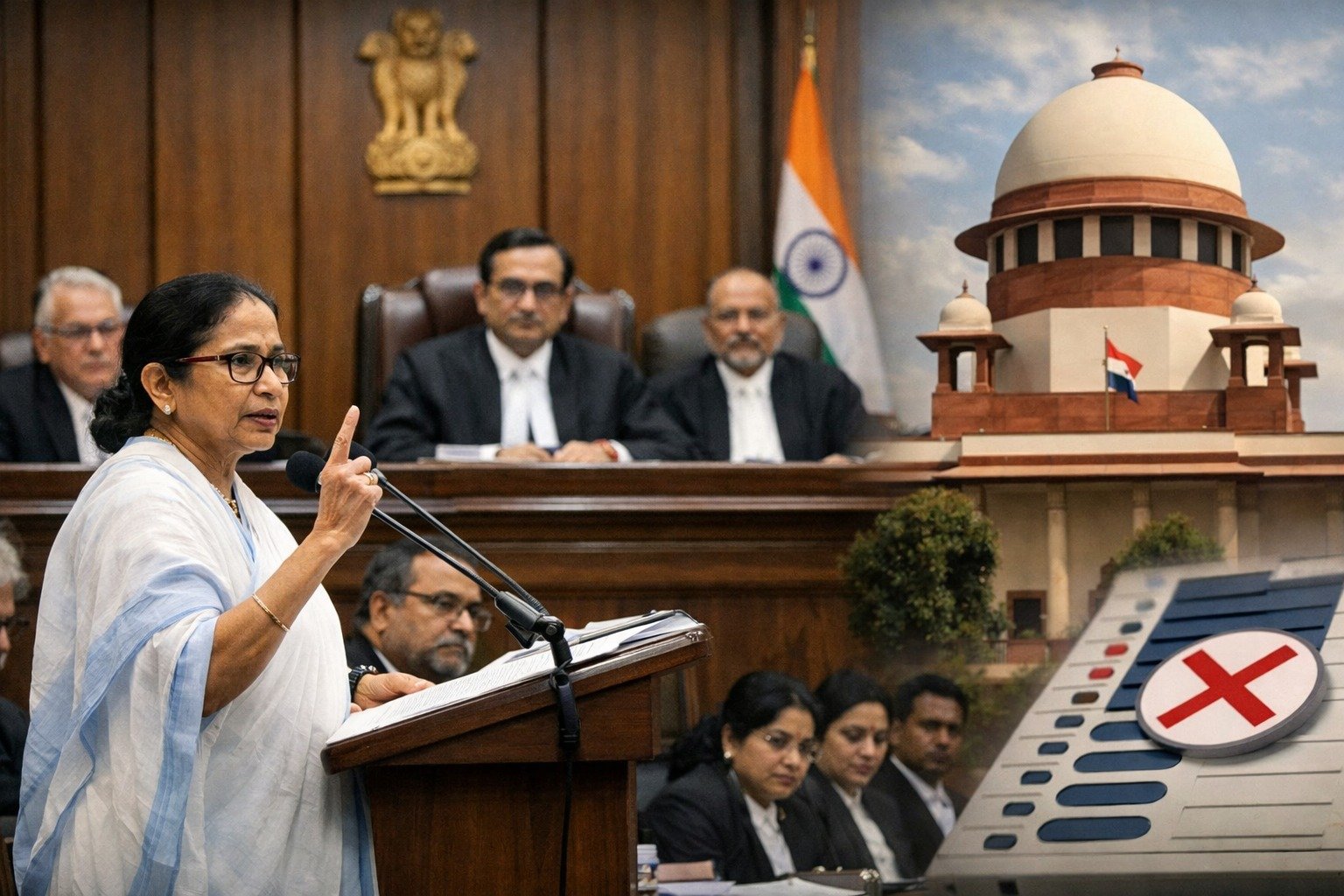
In an unprecedented moment in India’s judicial history, West Bengal Chief Minister Mamata Banerjee personally advanced forceful constitutional arguments before a Supreme Court bench headed by the Chief Justice of India, challenging the Special Intensive Revision (SIR) of the voter list and triggering a wider debate on electoral integrity and institutional accountability.
A rare moment in Supreme Court history Mamata Banerjee
It is exceedingly rare for a serving Chief Minister to directly engage in arguments before the Supreme Court. Mamata Banerjee’s intervention, supported by a coordinated and prepared legal team, marked a significant departure from convention, instantly elevating the hearing into a historic judicial event. Legal observers note that such direct political participation at the highest constitutional forum underscores the gravity of the issue under consideration.

The core of the argument: Voter list integrity
At the heart of the proceedings lies the Special Intensive Revision (SIR) of electoral rolls, a process that has raised concerns over transparency, inclusiveness, and potential disenfranchisement. Banerjee’s submissions reportedly raised sharp constitutional questions on procedural fairness, democratic safeguards, and the rights of voters, particularly in politically sensitive regions.
Election Commission under renewed scrutiny

The Election Commission of India (ECI), already facing criticism in recent years over its perceived neutrality and decision-making, now finds itself under intensified judicial and public scrutiny. Analysts point out that the Court’s engagement with multiple petitions challenging the SIR indicates that the issue extends beyond partisan politics into the domain of constitutional governance.
Anticipation of counter-arguments
Attention now turns to the ECI’s response. Legal experts suggest that the Commission will be required to robustly justify the rationale, timing, and methodology of the SIR exercise. The strength and clarity of these counter-arguments could significantly influence the Court’s final assessment.

Implications of an imminent verdict
With arguments nearing completion, a judgment is expected in the coming days, likely based on constitutional merit and judicial consensus. Whatever the outcome, the verdict is expected to have far-reaching implications for electoral processes, federal dynamics, and the role of constitutional authorities in safeguarding democracy.
A defining constitutional moment
Intellectuals, senior advocates, and political analysts widely describe this episode as a defining moment in India’s democratic journey. Beyond the immediate legal outcome, the case has reopened fundamental questions about institutional trust, electoral reforms, and the evolving relationship between elected governments and constitutional bodies.
In that sense, the hearing is not merely about voter list revisions—it has become a broader test of democratic resilience and constitutional accountability in contemporary India.