

Kremlin Claims Full Control of Luhansk as Information Strategy Intensifies in Eastern Ukraine
By Samir Singh 'Bharat': Editor In Chief

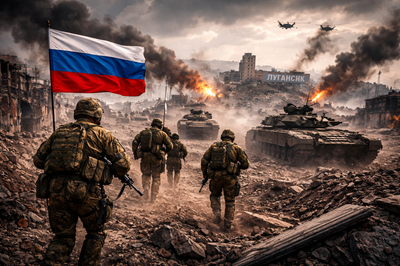
WAR-REPORT : Ukraine The Russian Ministry of Defense (MoD) has once again asserted that Russian forces have achieved full control over Luhansk Oblast, marking the third such declaration since the beginning of Russia’s full-scale invasion of Ukraine. This latest claim, announced on April 1, has drawn significant attention not only because of its timing but also due to the broader strategic narrative it appears to support. Despite these repeated announcements, available evidence indicates that Russian forces have controlled the overwhelming majority—but not the entirety—of the region since late 2022.
Ground Reality: Ukraine Still Holds Key Areas
Independent assessments suggest that Russian forces currently control approximately 99.84 percent of Luhansk Oblast. However, Ukrainian forces continue to hold limited positions in specific settlements, including Nadiya and Novoyehorivka, both located east of Borova. These small but strategically relevant pockets of resistance highlight the discrepancy between official Russian statements and the actual situation on the ground.

This is not the first time Russian officials have declared complete control over Luhansk Oblast. In July 2022, then Defense Minister Sergei Shoigu announced that Russian forces had fully captured the region. Similar claims were repeated in June 2025 by Leonid Pasechnik, the head of the self-proclaimed Luhansk People’s Republic. Later, in October 2025, Russian President Vladimir Putin stated that Ukrainian forces remained in control of only 0.13 percent of the oblast. These recurring assertions have established a pattern of overstating territorial gains, raising questions about the motivations behind such declarations.
The reality is that Russian forces have maintained control over most of Luhansk Oblast since the autumn of 2022. This followed the stabilization of the frontline after Ukraine’s successful counteroffensive in the Kharkiv region. Since then, the front in Luhansk has seen relatively limited movement, with only minor territorial adjustments occurring over time. Against this backdrop, recent claims of complete السيطرة appear to exaggerate minimal changes in order to create the impression of renewed momentum.
Analysts widely interpret these claims as part of a broader information strategy employed by the Kremlin. By portraying incremental or negligible advances as major victories, Russian authorities may be attempting to shape perceptions both domestically and internationally. This strategy appears designed to project strength, maintain morale, and influence ongoing diplomatic and military dynamics.

More importantly, the narrative surrounding Luhansk Oblast seems to be closely linked to Russia’s broader objectives in eastern Ukraine, particularly in Donetsk Oblast. The Kremlin’s repeated emphasis on territorial control in Luhansk may serve as a precursor to increased pressure on Ukraine regarding Donetsk. By creating a perception that Russian forces are rapidly consolidating their hold in one region, Moscow may aim to suggest that similar outcomes in neighboring areas are inevitable.
This messaging aligns with a wider campaign that appears intended to create a sense of urgency among Ukraine and its international partners. The goal of such a campaign may be to push Ukraine toward making territorial concessions that would otherwise be considered unacceptable. By framing the situation as one in which Ukrainian defenses are on the verge of collapse, the Kremlin may seek to influence decision-making in Kyiv and among Western governments.
Recent statements from Ukrainian leadership provide additional context for this dynamic. On March 31, Ukrainian President Volodymyr Zelensky indicated that Russia had issued a demand for Ukrainian forces to withdraw from the remaining parts of Donetsk Oblast within a two-month timeframe, effectively setting a deadline for late May 2026. Zelensky suggested that this demand is part of a broader effort by the Kremlin to create the impression that Russian forces are on the brink of capturing the entire Donbas region.

According to Zelensky, the underlying message from Moscow is that failure to comply with these demands could result in even harsher conditions in the future. This approach appears to combine military pressure with psychological and diplomatic tactics, aiming to force Ukraine into a difficult position where it must choose between continued resistance and potential territorial losses.
Russian officials have reinforced this narrative through their public statements. Kremlin spokesperson Dmitry Peskov responded to questions about the alleged deadline by stating that Zelensky should make a decision immediately, emphasizing urgency. Similarly, members of the Russian State Duma have echoed this sentiment, suggesting that Ukraine should have already withdrawn from contested areas. These coordinated messages contribute to a consistent narrative designed to increase pressure on Ukrainian leadership.
Some Russian lawmakers have gone further, indicating that future demands could extend beyond Donetsk Oblast. Statements have suggested that Russia might also seek Ukrainian withdrawal from Zaporizhia and Kherson regions, as well as the cession of major cities such as Odesa, Mykolaiv, Dnipro, and Kharkiv. While such claims may appear ambitious, they are consistent with earlier rhetoric from Russian officials who have frequently described certain Ukrainian cities as historically or culturally Russian.
However, many analysts argue that these claims do not align with current battlefield realities. The idea that Russian forces could easily seize the remainder of Donetsk Oblast—or advance significantly into other regions—faces substantial practical challenges. Ukrainian defenses remain robust, particularly in heavily fortified urban areas known collectively as the “Fortress Belt” in Donetsk. These positions have been prepared over several years and are designed to withstand prolonged assaults.
Russian military leadership has previously set ambitious timelines for capturing these fortified areas but has repeatedly failed to meet those objectives. The complexity of urban warfare, combined with determined Ukrainian resistance, has limited the pace of Russian advances. In many cases, progress has been measured in small increments rather than sweeping gains.
Developments in 2026 have further complicated Russia’s military plans. Ukrainian forces have demonstrated an ability to not only defend key positions but also to conduct effective counterattacks. These actions have disrupted Russian preparations for a large-scale spring and summer offensive aimed at breaking through the Fortress Belt. As a result, Russian timelines have reportedly been extended, reflecting the challenges faced on the ground.
President Zelensky noted on April 1 that Russian forces had once again failed to achieve their operational goals in Donetsk Oblast, leading to further delays in their offensive plans. This acknowledgment underscores the gap between official Russian narratives and the realities of the conflict.
Additionally, despite having controlled most of Luhansk Oblast for an extended period, Russian forces have not been able to leverage this advantage to launch successful offensives toward key Ukrainian cities such as Slovyansk or Izyum. These cities remain important strategic targets, yet attempts to advance from eastern positions have not yielded decisive results.
Another notable trend is the apparent slowdown in Russian advances since the beginning of 2026. While Russian forces continue to engage in offensive operations, the rate of territorial gains has decreased. At the same time, Ukrainian forces have shown resilience and adaptability, successfully contesting the initiative along various sections of the frontline. In some areas, Ukrainian counteroffensives have even regained limited territory, further complicating Russia’s operational picture.
This evolving situation suggests that the conflict has entered a phase characterized by attrition and incremental changes rather than rapid breakthroughs. In such an environment, information warfare becomes an increasingly important tool for shaping perceptions and influencing outcomes.
The Kremlin’s repeated claims regarding Luhansk Oblast can therefore be seen as part of a broader effort to control the narrative of the war. By emphasizing success and downplaying challenges, Russian authorities aim to maintain domestic support and project confidence internationally. At the same time, these narratives may be intended to influence negotiations by creating the impression that Ukraine’s position is weakening.
For Ukraine and its allies, understanding and responding to this information strategy is a critical aspect of the broader conflict. Accurate assessments of battlefield conditions are essential for making informed decisions about military strategy, diplomatic engagement, and resource allocation.
Our Media Opinion is , the Russian Ministry of Defense’s latest claim of full control over Luhansk Oblast reflects a continuation of a long-standing pattern of overstated territorial achievements. While Russian forces do control the vast majority of the region, the presence of remaining Ukrainian positions highlights the gap between official statements and on-the-ground realities. More broadly, these claims appear to be part of a coordinated effort to shape perceptions, increase pressure on Ukraine, and influence the trajectory of the conflict. As the war continues, the interplay between military operations and information campaigns will remain a defining feature of the struggle for control and influence in eastern Ukraine.