

Iran Adopts Sustained Low-Volume Missile Strategy Against Israel
By Samir Singh 'Bharat': Editor In Chief

WAR-REPORT : Iran appears to be recalibrating its missile strategy against Israel, shifting from large-scale, high-intensity barrages to a pattern of smaller, more frequent launches spread throughout the day. This evolving approach, observed over the past week, suggests a deliberate effort to maximize psychological pressure on Israeli civilians while operating within the constraints imposed by sustained military degradation of Iran’s missile infrastructure.
Rather than attempting to overwhelm Israeli air defenses with massive, coordinated salvos—as it has done in previous escalations—Iran is now launching between five and eleven missile barrages daily. According to official statements, each barrage typically consists of a single missile or a very limited number of projectiles. This shift reflects not only tactical adaptation but also the broader strategic realities facing Iran as it contends with the cumulative effects of sustained strikes by United States and Israeli forces.

A Strategy of Persistent Pressure
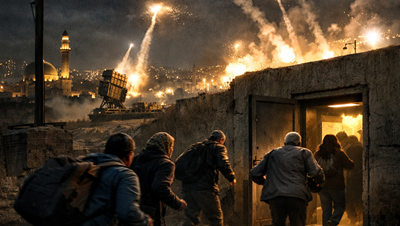
The defining feature of Iran’s current approach is its emphasis on persistence rather than scale. By distributing missile launches across the day, Iran is effectively maintaining a near-constant state of alert within Israel. Ballistic missiles launched from Iranian territory take approximately ten minutes to reach Israeli airspace, leaving little time for response once detected. However, by spacing out launches—often with several hours between them—Iran ensures that Israeli early warning systems are repeatedly activated.
This pattern forces Israeli civilians to seek shelter multiple times per day, disrupting daily life and creating a sustained atmosphere of tension and uncertainty. Even if each individual strike poses limited physical damage due to Israel’s advanced missile defense systems, the cumulative psychological effect can be significant.
The repeated activation of air raid sirens, emergency alerts, and shelter protocols places a continuous burden on civilian populations. Schools, workplaces, transportation systems, and public services must frequently pause operations, contributing to economic and social disruption. Over time, such conditions can erode public morale and create pressure on political leadership.

Psychological Warfare and Civilian Impact
Iran’s apparent focus on psychological effects aligns with broader principles of asymmetric warfare. When direct military parity is unattainable, adversaries often seek to exploit vulnerabilities in the opponent’s civilian infrastructure and societal resilience.
In this case, the objective is not necessarily to inflict maximum physical destruction with each strike, but rather to impose a constant sense of threat. The unpredictability of launch timing—combined with the inevitability of repeated alerts—creates a rhythm of disruption that can be difficult for civilians to adapt to.
This approach also leverages the visibility of missile threats in modern media environments. Each alert, interception, or impact is rapidly disseminated through news outlets and social media platforms, amplifying the perceived intensity of the conflict. Even when damage is minimal, the perception of ongoing danger can have far-reaching effects.

Constraints on Iranian Capabilities
While the current strategy may offer certain advantages in terms of psychological impact, it is widely viewed as suboptimal from a purely military perspective. Iran has historically relied on large-scale missile and drone attacks designed to saturate and overwhelm enemy defenses.
For example, during escalations in April and October 2024, Iran launched hundreds of ballistic and cruise missiles, along with one-way attack drones, in coordinated strike packages targeting Israel. These operations were intended to exploit the limitations of missile defense systems by presenting a volume of threats that could not be intercepted in full.
The shift away from such large-scale operations suggests that Iran’s capacity to conduct them has been significantly reduced. Continuous strikes by U.S. and Israeli forces have targeted critical components of Iran’s missile infrastructure, including launchers, storage facilities, and hardened bases.
Degradation of Missile Stockpiles
Recent intelligence assessments indicate that Iran’s missile arsenal has been substantially diminished. According to sources familiar with U.S. intelligence, approximately one-third of Iran’s missile stockpile has been destroyed outright, while another third has been damaged, degraded, or rendered inaccessible—potentially buried under debris from strikes on fortified storage sites.
This level of attrition represents a major constraint on Iran’s ability to sustain high-intensity operations. With a reduced inventory of operational missiles, Iran must carefully manage its remaining resources, balancing immediate operational needs against long-term strategic considerations.
The use of smaller, dispersed salvos may therefore reflect a necessity rather than a preference. By limiting the number of missiles used in each launch, Iran can extend the duration of its campaign, maintaining pressure over time without exhausting its remaining stockpile too quickly.
Loss of Launch Infrastructure
In addition to stockpile reductions, Iran has also suffered significant losses in its missile launch infrastructure. Israeli defense assessments indicate that approximately 330 of Iran’s 470 missile launchers have been destroyed or rendered inoperable.
This loss severely constrains Iran’s ability to coordinate large-scale launches. Even if sufficient missiles were available, the absence of operational launch platforms would limit the number of projectiles that could be deployed simultaneously.
The reduced launcher inventory also increases the vulnerability of remaining assets. With fewer launchers available, each one becomes more valuable and, consequently, a higher-priority target for Israeli airstrikes. This dynamic further incentivizes Iran to adopt a more cautious deployment strategy.
Adaptive Launch Tactics
Iran’s current approach may also be influenced by a desire to protect its remaining launch capabilities. By deploying only a small number of launchers at any given time, Iran reduces the risk of detection and destruction by Israeli surveillance and strike systems.
This tactic is supported by recent operational patterns. In one documented instance, footage surfaced of a missile launch from the Yazd Missile Base. Within hours, the base was reportedly targeted by follow-on strikes, suggesting that Israeli forces are actively monitoring Iranian launch activity and responding rapidly to emerging threats.
Such responsiveness indicates a high level of situational awareness and operational readiness on the part of Israeli and allied forces. It also underscores the risks associated with concentrated launch operations, which could expose multiple assets simultaneously.
Airspace Surveillance and Rapid Response
The ability of combined U.S. and Israeli forces to detect and strike missile launch sites shortly after activation highlights a broader trend: persistent surveillance of Iranian airspace. Advanced reconnaissance capabilities, including satellite imagery, drones, and electronic intelligence, enable continuous monitoring of potential launch locations.
This surveillance network allows for rapid targeting of launchers, storage facilities, and support infrastructure as soon as they are identified. The result is a dynamic battlefield in which Iranian forces must operate under constant threat of detection and attack.
In such an environment, the use of dispersed, low-volume launches becomes a logical adaptation. By minimizing the visibility and duration of each launch event, Iran can reduce the likelihood of immediate retaliation, even if it cannot eliminate the risk entirely.
Strategic Trade-Offs
Iran’s current missile strategy reflects a series of trade-offs between effectiveness, sustainability, and survivability. Large-scale barrages offer the potential for greater immediate impact but require significant resources and expose launch infrastructure to heightened risk. Smaller, distributed launches are less likely to overwhelm defenses but can be sustained over longer periods and are more difficult to counter preemptively.
The choice between these approaches is shaped by the evolving balance of capabilities. As Iran’s ability to conduct large-scale operations has been degraded, the relative advantages of a low-volume, high-frequency strategy have increased.
However, this approach is not without limitations. The physical damage inflicted by small salvos is inherently limited, particularly when faced with advanced missile defense systems such as those deployed by Israel. As a result, the primary impact of these operations is psychological rather than material.
Implications for Israeli Defense
For Israel, the shift in Iranian tactics presents a different set of challenges. While missile defense systems are designed to intercept incoming threats, the need to respond to frequent, low-volume launches places sustained pressure on both technical systems and human operators.
Each alert requires coordination between detection systems, command centers, and interceptor units. Over time, this can lead to fatigue and increased operational strain. Additionally, the repeated disruption of civilian life carries economic and social costs that extend beyond the immediate military domain.
At the same time, Israel’s ability to intercept a high proportion of incoming missiles and to conduct rapid retaliatory strikes against launch sites demonstrates the resilience and effectiveness of its defense posture.
Our Media Opinion
Iran’s adoption of a sustained, low-volume missile strategy against Israel represents a significant evolution in its approach to the conflict. Driven by the degradation of its missile stockpile and launch infrastructure, this strategy prioritizes persistence and psychological impact over scale and immediate destructive power.
While effective in maintaining constant pressure on Israeli civilians, the approach also highlights the constraints under which Iran is operating. The loss of missiles and launchers, combined with the threat of continuous surveillance and rapid retaliation, has forced a shift toward more cautious and adaptive tactics.
As the conflict continues, the interplay between Iranian adaptation and Israeli countermeasures will shape the trajectory of hostilities. Whether Iran can sustain its current approach over the long term—and whether it can achieve its strategic objectives through psychological pressure alone—remains an open question.
What is clear, however, is that the nature of modern conflict is increasingly defined not only by physical destruction but also by the ability to influence perception, morale, and resilience. In this context, Iran’s current missile campaign serves as a compelling example of how warfare continues to evolve in response to changing capabilities and constraints.