


New Delhi:- An IndiGo flight from Delhi to Srinagar faced a critical situation on May 21 when it encountered a sudden hailstorm mid-flight. The severe weather prompted the pilot to seek emergency clearance to enter Pakistani airspace, a request that was denied by both Indian and Pakistani authorities.
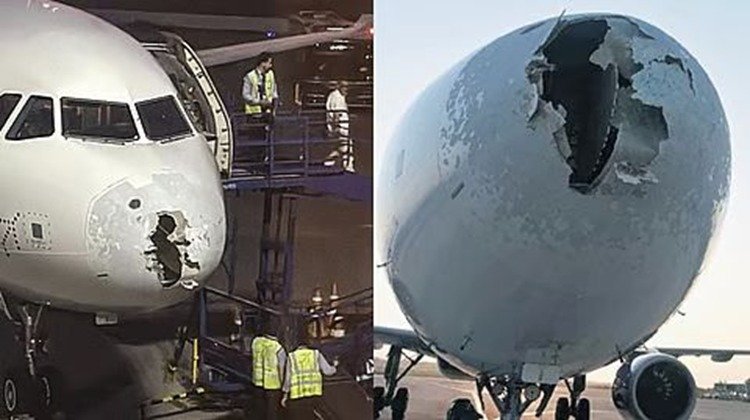
Flight 6E-2142, an Airbus A321 carrying 227 passengers, departed Delhi at 5:13 PM. Approximately 45 minutes into the journey, the aircraft was struck by a hailstorm and experienced a bird strike, leading to extreme turbulence and visible damage to the plane’s nose cone. Passengers described the ordeal as a “near-death experience,” with overhead compartments opening and luggage scattering throughout the cabin.

In an effort to navigate out of the hazardous weather, the pilot requested permission from the Indian Air Force (IAF) to enter Pakistani airspace. Upon denial, the pilot then contacted Lahore Air Traffic Control (ATC) for emergency clearance, which was also refused.
With no alternative routes available, the pilot declared an emergency with Srinagar ATC and executed rapid descent maneuvers to stabilize the aircraft. Despite the challenges, the flight crew successfully landed the plane at Srinagar Airport at 6:30 PM. All passengers and crew members were unharmed.
The Directorate General of Civil Aviation (DGCA) has initiated an investigation into the incident, focusing on the sequence of events and the decisions made by both Indian and Pakistani authorities.

This incident underscores the complexities of international airspace regulations and the challenges pilots face during unforeseen emergencies. While there have been instances where aircraft from India and Pakistan have entered each other’s airspace due to bad weather, such deviations are typically coordinated between respective ATCs.
IndiGo has confirmed that the aircraft involved has been grounded for inspection and maintenance. The airline commended the professionalism of the flight crew in ensuring the safety of all onboard during the emergency.
As aviation authorities continue their investigation, this event highlights the critical importance of international cooperation and flexibility in air traffic management, especially during emergencies.