

Houthis have entered the Iran war but have not joined Iran’s regional economic warfare campaign
By Samir Singh 'Bharat': Editor In Chief

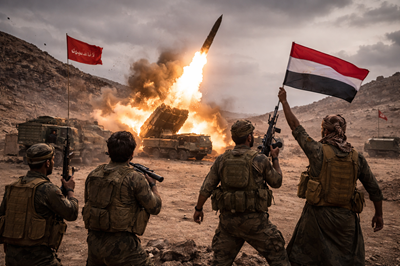
WAR-REPORT : The involvement of Yemen’s Houthi movement in the ongoing conflict linked to Iran marks a notable yet carefully measured development in the broader regional security landscape. While the group has initiated limited military actions against Israel, it has refrained from expanding its operations into a wider economic warfare campaign. This restrained posture suggests a deliberate strategy aimed at balancing ideological alignment with Iran and its allies while safeguarding the Houthis’ own political, economic, and domestic interests.
Since late March, the Houthis have conducted a series of attacks targeting southern Israel, marking their first direct engagement in the conflict. These operations included ballistic missile launches on March 27 and April 1, as well as a drone attack on March 28. All of these attempts were intercepted by Israeli air defense systems, resulting in no reported casualties or significant damage. Despite their limited tactical impact, these attacks carry strategic significance, signaling the Houthis’ entry into the conflict and their willingness to contribute to the broader axis aligned with Iran.

However, the nature and scale of these operations indicate that the Houthis are pursuing a calculated approach rather than an all-out escalation. Their actions appear designed to send political and strategic messages rather than to achieve immediate military gains. In particular, the Houthis likely aim to exert pressure on the United States and its allies, encouraging them to make concessions in ongoing or future negotiations with Iran. At the same time, the group seeks to deter further military escalation against Iran and the network of allied organizations often referred to as the “Axis of Resistance.”
Evidence suggests that the Houthis are closely coordinating their activities with Iran. Statements from Iranian media and affiliated organizations have pointed to a broader strategic alignment. For instance, the Islamic Revolutionary Guard Corps (IRGC)-linked Tasnim News Agency warned on March 25 of the emergence of a “new front” in the Bab el Mandeb Strait, a critical maritime chokepoint at the southern entrance to the Red Sea near Yemen. This warning preceded the Houthis’ initial attack by only a few days, indicating a degree of synchronization in messaging and planning.
Further reports have indicated that IRGC personnel arrived in Yemen shortly before the first Houthi strike on March 28. While the exact nature of their involvement remains unclear, their presence suggests that Iran may be providing advisory, logistical, or intelligence support to the Houthis. The Houthis themselves have acknowledged coordination with Iran and with Lebanese Hezbollah, particularly in relation to the April 1 attack. This acknowledgment reinforces the perception of a coordinated regional strategy involving multiple actors aligned with Iran.

Despite this coordination, the Houthis have deliberately avoided targeting Gulf energy infrastructure or disrupting shipping in the Red Sea—actions that would represent a significant escalation and could have far-reaching global consequences. This restraint is notable given the group’s past activities, including attacks on Saudi oil facilities and threats to maritime traffic in the region. The decision to refrain from such actions reflects a careful assessment of risks and priorities.
One of the primary factors influencing this restraint is the Houthis’ relationship with Saudi Arabia. After years of conflict, the two sides reached a United Nations-brokered ceasefire in 2022, which has provided a degree of stability and opened the door to ongoing negotiations. This arrangement includes significant financial support from Saudi Arabia, which reportedly spends billions of dollars annually to cover the salaries of Yemeni civil servants, including those in Houthi-controlled areas.
This financial arrangement is critical to maintaining stability in regions under Houthi control. The Yemeni economy has been severely weakened by years of conflict, sanctions, and internal divisions. As a result, the regular payment of public-sector salaries plays a vital role in sustaining livelihoods and preventing social unrest. Any disruption to this flow of funds could have immediate and destabilizing effects.

The Houthis are therefore reluctant to take actions that could jeopardize their relationship with Saudi Arabia. An expanded military campaign targeting Gulf energy infrastructure or international shipping would likely provoke a strong response from Saudi Arabia and its allies, potentially leading to the collapse of the ceasefire. Such an outcome would not only reignite large-scale conflict but also cut off the financial support that the Houthis currently rely on.
Reports have suggested that economic considerations have already influenced the timing of the Houthis’ entry into the conflict. According to a Yemeni journalist cited by Israeli media, delays in salary payments from Saudi Arabia may have contributed to the group’s cautious approach. This highlights the extent to which economic dependencies shape the Houthis’ strategic decisions.
In addition to preserving the ceasefire, the Houthis are also seeking to secure further economic concessions from Saudi Arabia as part of ongoing and future negotiations. These demands reportedly include financial reparations for the damage caused during the conflict, as well as investment in reconstruction efforts in Yemen. The Houthis have also called for the Saudi-backed Republic of Yemen Government (ROYG) to assume responsibility for paying all public-sector salaries in Houthi-controlled areas.
These demands reflect the broader economic challenges facing the Houthis and the territories under their control. Years of conflict have left infrastructure damaged, services disrupted, and economic activity severely constrained. Addressing these challenges requires substantial financial resources, which the Houthis are unlikely to generate internally. As a result, they are seeking external support as part of a negotiated settlement.
The interplay between military action and economic considerations is a defining feature of the Houthis’ current strategy. On one hand, the group is demonstrating its capability and willingness to participate in regional conflicts alongside Iran and its allies. On the other hand, it is carefully calibrating its actions to avoid undermining its own domestic stability and economic position.
This balancing act is evident in the limited scope of the Houthis’ recent attacks. By targeting Israel directly, the group aligns itself with the broader objectives of the Axis of Resistance and reinforces its ideological credentials. At the same time, by avoiding actions that would disrupt global trade or provoke regional escalation, it minimizes the risk of retaliation and preserves its strategic flexibility.
The Bab el Mandeb Strait remains a key point of concern in this context. As one of the world’s most important maritime chokepoints, it is a critical route for global التجارة and energy supplies. Any disruption in this area would have significant economic and geopolitical implications. The warning issued by the IRGC-affiliated media suggests that this region could become a focal point in the future, but the Houthis’ current restraint indicates that such escalation is not imminent.
The broader regional implications of the Houthis’ actions are complex. Their involvement adds another layer to an already multifaceted conflict, involving multiple state and non-state actors with overlapping interests and objectives. While their current approach is restrained, it nonetheless contributes to the overall tension and uncertainty in the region.
For the United States and its allies, the Houthis’ actions present both challenges and opportunities. On one hand, the attacks on Israel and the potential for further escalation require continued vigilance and preparedness. On the other hand, the Houthis’ restraint and their reliance on economic arrangements with Saudi Arabia create potential avenues for diplomatic engagement and de-escalation.
The situation also underscores the importance of regional diplomacy and conflict resolution efforts. The ceasefire between the Houthis and Saudi Arabia has provided a foundation for stability, but it remains fragile and dependent on continued cooperation. Strengthening this arrangement and addressing underlying economic and political issues will be critical for maintaining peace.
Our Media Opinion, the Houthis’ entry into the Iran-linked conflict represents a carefully calibrated move rather than a full-scale escalation. Their limited attacks on Israel signal alignment with Iran and its allies, while their avoidance of broader economic warfare reflects a pragmatic assessment of risks and priorities. By balancing military engagement with economic considerations, the Houthis are seeking to maximize their strategic leverage while minimizing potential costs.
As the situation continues to evolve, the Houthis’ actions will remain a key factor in shaping regional dynamics. Their ability to maintain this delicate balance will depend on a range of factors, including developments in the conflict, the state of their relationship with Saudi Arabia, and the broader geopolitical environment. Ultimately, their strategy highlights the complex interplay between military objectives, economic realities, and political considerations in one of the world’s most volatile regions.