


7 Powerful AI Breakthroughs From CSF’s EdTech Dialogue That Could Transform India’s Education
By Samir Singh 'Bharat': Editor In Chief

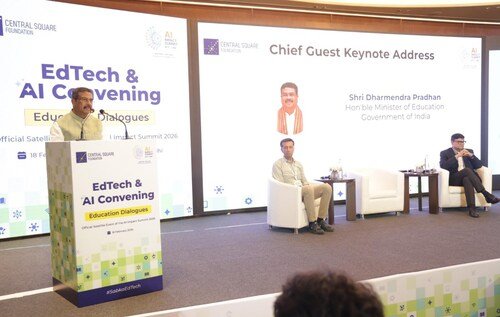
NEW DELHI: Central Square Foundation (CSF) convened a high-level EdTech and AI Convening – Education Dialogues in the national capital as a satellite event of the India AI Impact Summit, bringing together senior policymakers, philanthropists, education experts, and leading global and Indian EdTech innovators. The dialogue focused on how emerging technologies—particularly Artificial Intelligence—can be harnessed to transform India’s learning ecosystem and ensure equitable access to quality education at scale.
Delivering the keynote address, Chief Guest Dharmendra Pradhan, Hon’ble Union Minister for Education, outlined a forward-looking roadmap aligned with India’s ambition of becoming a Viksit Bharat by 2047. He emphasised that the integration of technology and AI into education systems will be essential to empower teachers, improve learning outcomes, and prepare India’s youth for the evolving future of work.

Speaking at the launch of the Bharat Survey for EdTech 2025 (BaSE) Report, Pradhan highlighted how digital transformation has become a defining feature of India’s development journey under the leadership of Narendra Modi. He noted that the rapid adoption of digital tools—from smartphones to AI-enabled platforms—demonstrates India’s growing technological readiness.
“Our commitment is clear—technology must connect to every aspect of life and become embedded in everyday living so that it delivers opportunity, employment, and empowerment,” Pradhan said. He pointed out that digital access has expanded significantly across the country, with rising internet penetration and growing preparedness for AI adoption. Anchoring these advancements in education, he added, transforms technology from a mere infrastructure upgrade into a powerful equaliser that democratises learning and encourages broad participation.
Technology’s Transformative Impact on School Education CSF
The event was also attended by Sanjay Kumar, Secretary, Department of School Education and Literacy, Ministry of Education. In his address, Kumar underlined the transformative impact of foundational learning initiatives such as NIPUN Bharat Mission in classrooms nationwide.

He cited improvements in reading confidence and number sense among early-grade learners as indicators of the programme’s success and called for deeper technological integration across its implementation layers. According to Kumar, embedding digital tools into policy design, monitoring frameworks, and classroom pedagogy will be essential to sustain and accelerate recent learning gains.
He further noted that the Bharat Survey for EdTech (BaSE) 2025 marks a significant milestone in strengthening evidence-based policymaking in school education. By providing a comprehensive, pan-India view of how digital tools are accessed and utilised—particularly in underserved regions—the survey offers critical insights into adoption gaps, infrastructure constraints, and last-mile capacity needs.
Such data-driven understanding, Kumar explained, can help align policy frameworks with ground realities and guide targeted interventions that improve resource allocation, strengthen monitoring systems, and ensure that investments in educational technology translate into measurable learning outcomes.


A Rare Inflection Point for India’s Education Ecosystem
Ashish Dhawan, Founder-Chairperson of Central Square Foundation, described the current moment as a “rare inflection point” for India’s education system. He observed that the convergence of strong digital infrastructure, a growing evidence base on effective interventions, and the rapid advancement of AI presents a unique opportunity to reimagine how learning is delivered and supported.
However, Dhawan cautioned that innovation must remain pedagogically grounded and equity-focused. Without intentional design that prioritises inclusion, he argued, technological advancements risk widening existing learning disparities rather than bridging them.
Echoing this sentiment, Shaveta Sharma-Kukreja, Chief Executive Officer and Managing Director of CSF, highlighted how technology has steadily reshaped the education ecosystem over the past decade—from teacher training methods to system-level approaches to scaling.
With the emergence of AI-driven tools, she noted, stakeholders must balance optimism with responsibility. The findings of the BaSE 2025 survey provide valuable ground-level insights into how students, teachers, and families from low-income households are accessing and using technology in real-world contexts. These insights, she said, can inform collaborative efforts among governments, civil society, innovators, and philanthropies to ensure digital tools genuinely serve every learner.
A Global Moment for AI in Education
The convening opened with reflections on the global rise of AI in education systems. As AI-enabled platforms begin to enter classrooms worldwide, they offer new possibilities for personalised learning pathways, teacher support, and system-level efficiency.
Benjamin Piper, Director of Global Education at the Gates Foundation, underscored that realising AI’s potential will require rigorous evidence, equity-oriented design, and context-sensitive implementation—particularly in low-resource settings.
Participants also examined pioneering AI-led EdTech innovations from India and abroad, showcasing how digital tools are being creatively deployed to enhance classroom instruction and student engagement across diverse socio-economic environments.CSF
Building an Evidence Base for AI Integration
As AI tools proliferate in classrooms, leaders stressed the importance of data-driven research to guide their effective adoption. Reinforcing this emphasis, Amitabh Kant launched the second edition of the Bharat Survey for EdTech (BaSE).CSF
Conducted across 10 states, the large-scale national survey reached over 12,500 households and 2,500 teachers from government and affordable private schools. It examined patterns of access to and use of technology for teaching and learning among parents, teachers, and students from low-income backgrounds.
A new focus area in the BaSE 2025 edition explored awareness and usage of AI tools in educational settings. Findings indicate that India’s digital transition is accelerating, with nearly 90 percent of surveyed households owning at least one smartphone and approximately 63 percent of children already using technology to support their learning.
In his plenary address, Kant emphasised that access to devices is no longer the primary bottleneck in India’s education technology landscape. The central challenge now lies in determining whether increased digital access is translating into improved learning outcomes.
“If India aspires to become a Viksit Bharat by 2047,” he noted, “that ambition cannot be realised without meaningful improvements in educational attainment.”CSF
From Pilot Projects to Scalable Impact
Michael Kremer, Nobel Laureate and Director of the Development Innovation Lab at the University of Chicago, highlighted the need for measurable evidence of efficacy in AI-driven educational interventions.
He argued that innovations must be evaluated based on their tangible impact on learning outcomes, rather than their novelty or technological sophistication. Moving from promising pilot programmes to large-scale implementation, participants agreed, will require enabling policy environments, robust infrastructure, and strong public-private partnerships.
Laying the Foundations for Responsible AI
The convening also featured discussions on India’s efforts to establish frameworks for the responsible and equitable deployment of AI in education. Leaders from government, academia, and the innovation ecosystem outlined a vision for democratising AI through education-first digital public infrastructure.
This agenda is being advanced through initiatives under the IndiaAI Mission, which focuses on expanding compute capacity, developing safe language models, and creating high-quality datasets for public use.
Bodhan AI, a Centre of Excellence in AI for Education, was highlighted as a key platform for translating digital infrastructure into system-ready solutions that can be responsibly adopted across public education systems.
In a fireside chat on responsible AI, B. Ravindran, Board Member at Bodhan AI and faculty at Indian Institute of Technology Madras, emphasised the importance of understanding on-ground realities before designing AI interventions.CSF
Building AI Literacy for the Global South
The convening also spotlighted AI Samarth, an initiative launched by Central Square Foundation in 2024 with support from Google.org. The programme aims to build AI literacy among students, teachers, and parents from underserved communities, enabling them to meaningfully participate in the digital transformation.
Maggie Johnson, Global Head of Google.org, stressed the importance of community-led design in developing scalable technological solutions. She noted that solutions for the Global South must account for constraints such as outdated devices and limited infrastructure, underscoring the need to prioritise scalability from the earliest stages of development.CSF
As India accelerates its journey toward becoming a knowledge-driven economy, the Education Dialogues highlighted that responsible AI integration—guided by evidence, equity, and collaboration—will be critical to ensuring that technology enhances learning outcomes and prepares future generations for an increasingly digital world.CSF