


CAG report exposes corruption in Delhi’s old liquor policy, validates AAP’s claims
By Doruvu Paul Jagan Babu: Assistant Chief Editor

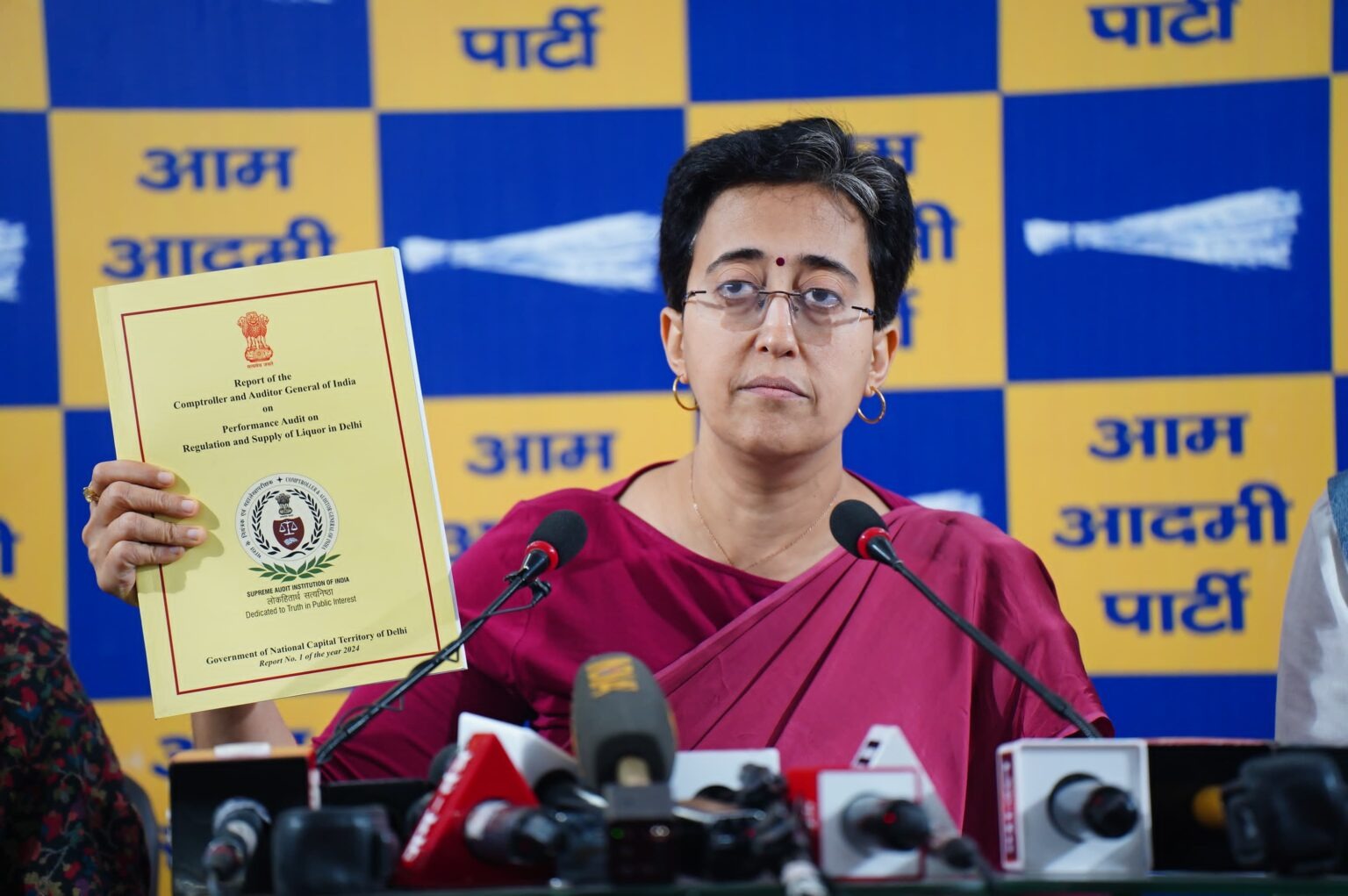
Delhi: The Comptroller and Auditor General (CAG) report on Delhi’s excise policy, presented in the Assembly on Tuesday, has confirmed large-scale corruption under the old liquor policy, validating the Aam Aadmi Party’s (AAP) long-standing allegations. The report highlights how liquor sales were underreported by 28%, while unchecked smuggling from Uttar Pradesh and Haryana drained Delhi’s revenue.
Corruption in liquor sales confirmed

Former Delhi Chief Minister and Leader of Opposition Atishi, alongside senior AAP leaders Priyanka Kakkar and Jasmine Shah, stated that the report justifies AAP’s decision to overhaul the flawed policy. She explained that the report, covering the period from 2017 to 2021, detailed systemic corruption, including the manipulation of liquor sales data and black marketing.
Atishi cited the report, which states that excise revenues were manipulated as liquor vendors underreported sales by 28%, siphoning off unaccounted revenue. “Chapter 5, Page 44 of the report clearly mentions that excise calculations were falsified to allow liquor vendors to pocket profits,” she said.
Black marketing and smuggling drained Delhi’s revenue

The CAG report highlights how liquor smuggling from Uttar Pradesh and Haryana thrived under the old policy, contributing to revenue losses. According to Atishi, Page 59 of the report explicitly mentions that black marketing was rampant, further confirming AAP’s accusations.
The report also debunks the claim that liquor contractors operated on a mere 5% profit margin. Instead, Chapter 6, Page 58 reveals that vendors manipulated cost-price calculations to make excessive profits.


AAP’s new excise policy was designed for transparency
Atishi emphasized that the eighth chapter of the CAG report acknowledges the AAP government’s efforts to introduce a transparent excise policy in 2021. The new policy aimed to curb black market sales and boost Delhi’s revenue.
She pointed out the success of a similar policy in Punjab, where excise revenue jumped from Rs 6,158 crores in 2021-22 to Rs 8,841 crores in 2022. The projected revenue for 2024-25 stands at Rs 10,146 crores, marking a 65% increase.
Policy obstruction led to revenue loss
The CAG report estimates that had AAP’s new excise policy been properly implemented, Delhi’s excise revenue could have increased from Rs 4,108 crores to Rs 8,911 crores in a single year. However, the revenue fell short by Rs 2,000 crores, raising questions about why the policy was obstructed.
Atishi accused three key entities of derailing the policy: the BJP-appointed Lieutenant Governor, who allegedly created administrative hurdles; the Central Bureau of Investigation (CBI), which filed an FIR before the policy’s completion; and the Enforcement Directorate (ED), which initiated an investigation prematurely.
Demand for investigation into policy obstruction
Atishi has called for an investigation into the role of the Lieutenant Governor, the CBI, and the ED in blocking the implementation of the new excise policy. She asserted that an FIR should be registered to determine who was responsible for the Rs 2,000-crore revenue loss suffered by Delhi.
“The CAG report proves that the old excise policy was corrupt, and the new policy was deliberately obstructed. The people of Delhi deserve answers,” she said.