

Akiveedu Tensions: AP Christian Leaders Urge CM Chandrababu Naidu to Prevent ‘Another Karamchedu’1
By Doruvu Paul Jagan Babu: Assistant Chief Editor

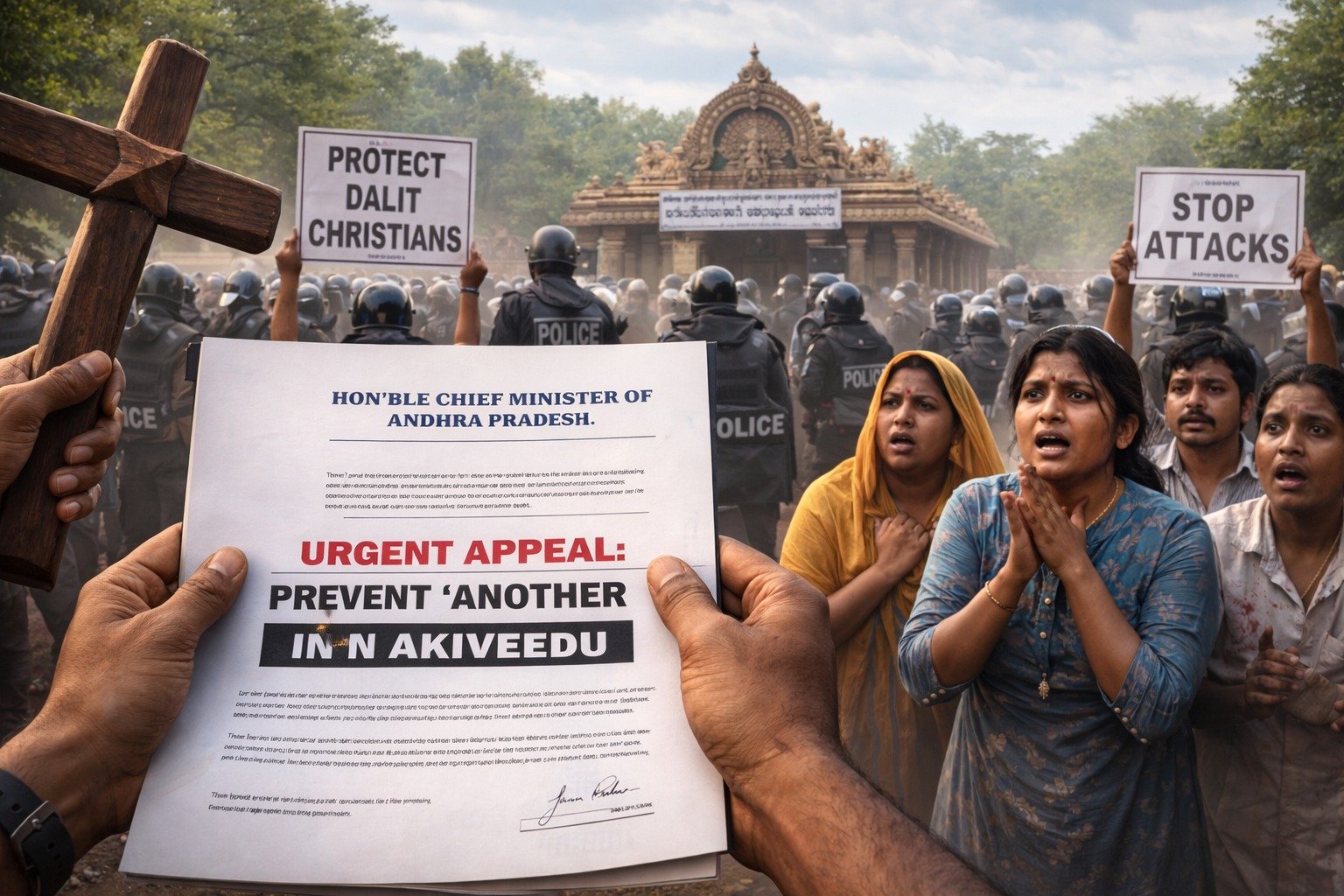
Andhra Pradesh: Amid rising tensions in Akiveedu of West Godavari district, the Andhra Pradesh Christian Leaders Forum (APCLF) has written an open letter to Chief Minister Nara Chandrababu Naidu, expressing deep concern over recent clashes and alleged targeting of Dalit Christians, and urging immediate intervention to ensure peace and protection.
Clashes in Akiveedu trigger concern
The concerns stem from incidents reported on March 27, 2026, coinciding with Sri Rama Navami, in Peddapeta village of Akiveedu (Undi constituency). According to APCLF, tensions arose over alleged attempts to convert a local Dalit deity shrine—Gonthemma temple—into a Rama temple, leading to clashes reportedly involving stone-pelting and violence during a visit by Raghurama Krishna Raju.

Police action and arrests
Reports indicate that police registered cases against around 58 individuals, imposed prohibitory orders under Section 144, and temporarily closed the temple. The forum alleged that many of those detained or placed under house arrest were Christians, raising concerns of targeted action.
Fear among Dalit Christians

APCLF stated that the developments have triggered widespread fear among Dalit Christians, with many families reportedly feeling unsafe. The forum drew parallels to the Karamchedu massacre, describing it as an unhealed historical wound that continues to influence community sentiments.
Concerns over religious freedom and social harmony
The letter also highlighted apprehensions over statements attributed to Raghurama Krishna Raju regarding the demolition of “unauthorized churches” in his constituency. According to APCLF, such remarks have intensified anxiety among Christian communities, particularly in rural and marginalized areas where places of worship were built through community efforts.

Allegations of misinformation and social media campaigns
The forum alleged that protests by local Dalits seeking to protect their traditional place of worship were being misrepresented on social media, contributing to heightened tensions and fear of further unrest.
Key demands to the government
In its appeal, APCLF urged the state government to deploy additional police forces in Akiveedu, conduct an impartial inquiry into the incident, and ensure protection for Dalit Christian families. It also called for measures to curb hate campaigns on social media and for the formation of peace committees involving affected communities.
Call for immediate intervention
The forum emphasized that failure to address the issue could undermine public trust and potentially escalate into a larger law-and-order concern. It urged the Chief Minister to uphold constitutional values, ensure equality, and take proactive steps to maintain communal harmony across the state.
Appeal for peace and justice
Signed by APCLF Chairman Oliver Roy, the letter concluded with an appeal for safeguarding the dignity, rights, and security of Dalits and minorities, expressing hope that the state leadership would act decisively to prevent further tensions and preserve social harmony.
APCLF to seek meeting with AP CM
Speaking to WAR-TIMES, APCLF Chairman Oliver Roy stated that the organization is committed to upholding the dignity of every Christian and ensuring the constitutional right to freely profess one’s faith. He appealed for the protection of the dignity, rights, and security of Dalits, Christians, and other minorities, expressing hope that the state leadership would take decisive steps to prevent further tensions and maintain social harmony. He further announced that APCLF would soon seek an appointment with the Andhra Pradesh Chief Minister to present their concerns, affirming that the organization would take all necessary steps to safeguard the community’s right to live with equal human dignity.
Our Media Opinion
The situation in Akiveedu is being framed as a local clash, but that’s a shallow reading. What’s unfolding is a stress test of governance, law enforcement neutrality, and public trust. When any community—especially a vulnerable one—starts feeling selectively targeted, the problem is no longer just law and order; it becomes a legitimacy issue for the administration.
The most dangerous element here isn’t the initial trigger—it’s the narrative spiral that follows. Allegations of shrine conversion, counter-allegations, arrests, and social media amplification create a feedback loop where facts get buried and emotions take over. Once that happens, control shifts from institutions to mob perception. That’s how small incidents escalate into long-term fault lines.
The police response raises hard questions. If enforcement appears uneven—even if unintentionally—it fuels grievance. Detentions, Section 144, and temple closure may be standard protocol, but perception of bias can undo the intent of neutrality. The administration cannot afford ambiguity here. Transparency isn’t optional—it’s the only way to contain escalation.
Invoking historical trauma like Karamchedu is not random—it signals deep-seated insecurity and memory of injustice. Ignoring that context would be a mistake. But at the same time, using such comparisons without restraint risks inflaming the situation further. Both state and community leaders need to act responsibly, not rhetorically.
The government now has two choices: react late or act decisively. Decisive action means independent inquiry, visible protection for all communities, and strict control over misinformation. Anything less will prolong instability.
This is not about one village or one incident. It’s about whether institutions can maintain fairness under pressure. If they fail, the cost won’t be local—it will spread, politically and socially.