


AI and Human Well-Being in 2025: How Health and Education Are Being Quietly Transformed
By Samir Singh 'Bharat': Editor In Chief

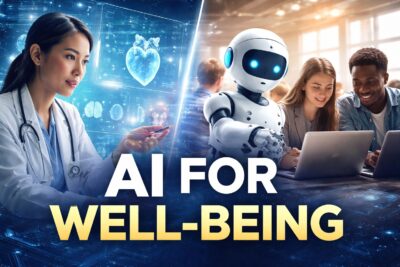
By October 2025, artificial intelligence is no longer framed as a future disruptor—it has become an embedded layer in everyday systems that directly influence how people live, learn, and manage their well-being. What makes this shift significant is not the existence of AI itself, but the way it has begun to operate quietly in the background, shaping outcomes in healthcare and education without always being visible to the people relying on it.
From Hype to Reality: AI’s Measured Impact on Human Well-Being
The conversation around AI has matured over the past year. Earlier narratives focused on extreme possibilities—either utopian breakthroughs or catastrophic risks. By late 2025, a more grounded reality has emerged. AI is neither saving the world nor destroying it. Instead, it is steadily improving certain aspects of human well-being while simultaneously exposing the weaknesses of the systems it operates within.

In healthcare, the most tangible impact of AI has been seen in diagnostics and patient monitoring. Hospitals and diagnostic centers across multiple countries have integrated AI systems into imaging workflows, particularly in radiology and pathology. These systems assist in identifying abnormalities in scans—often flagging potential issues earlier than traditional processes would allow. The practical result is not that AI replaces doctors, but that it reduces the margin of error and speeds up decision-making in time-sensitive situations.
What has become clearer by late 2025 is that AI’s effectiveness in healthcare is closely tied to infrastructure. In well-equipped environments with standardized digital records, AI enhances clinical accuracy and efficiency. In less developed settings, however, inconsistent data and limited digital integration reduce its reliability. This gap highlights a critical reality: AI improves well-being most effectively where systems are already functioning at a basic level.
Alongside institutional use, AI has significantly expanded its presence in personal health management. The growth of wearable technology and AI-powered health platforms has accelerated through 2025, with millions of users relying on continuous tracking of sleep, heart rate, activity levels, and stress indicators. These tools analyze patterns over time and offer personalized recommendations, pushing healthcare toward a more preventive model.

This shift has had a measurable effect on user behavior. Individuals are becoming more aware of their daily habits and how those habits influence long-term health. Preventive guidance—such as sleep optimization, activity adjustments, and early warnings of irregularities—has contributed to a broader understanding of personal health.
However, by October 2025, concerns have also emerged around over-dependence on these systems. Continuous monitoring can lead to heightened anxiety, particularly when users lack the context to interpret data correctly. The presence of constant feedback does not automatically translate into better decisions. In some cases, it creates a cycle of overanalysis, where individuals respond more to data fluctuations than to actual symptoms.
Mental health has been another area where AI has expanded rapidly during 2025. AI-driven conversational tools have become widely accessible, offering immediate support for individuals dealing with stress, anxiety, or isolation. These systems are designed to simulate human-like interaction, providing responses that encourage reflection and emotional expression.

The appeal is clear. Traditional mental health services remain inaccessible or expensive for many people, and AI offers an alternative that is available at any time. For some users, this has reduced the barrier to seeking help and provided a form of emotional outlet.
At the same time, limitations have become increasingly apparent. AI systems, despite their sophistication, do not possess genuine emotional understanding. Their responses are generated based on patterns, not lived experience. By late 2025, experts have raised concerns about the long-term impact of relying on AI for emotional support, particularly the risk of forming attachments to systems that cannot provide true empathy or accountability.
In education, AI has reshaped learning environments in ways that are both visible and subtle. By October 2025, AI-powered tools are no longer optional additions; they are integrated into how students study, complete assignments, and engage with information. Adaptive learning platforms, in particular, have gained widespread use, allowing educational content to adjust in real time based on a student’s performance.
This level of personalization has improved accessibility for many learners. Students who previously struggled to keep pace in traditional classrooms can now receive targeted support, revisiting concepts until they are fully understood. The ability to break down complex subjects into manageable explanations has contributed to more inclusive learning experiences.
At the same time, the widespread availability of AI tools has changed how students approach problem-solving. Tasks that once required sustained effort can now be completed with minimal input. Essays can be generated, problems can be solved instantly, and explanations can be delivered on demand. This shift has raised concerns about the depth of learning and the development of critical thinking skills.
Educational institutions have begun to respond by adjusting assessment methods. By late 2025, there is a growing emphasis on practical application, project-based evaluation, and interactive learning rather than traditional written exams. These changes reflect an attempt to measure understanding rather than output, acknowledging that AI has fundamentally altered how information is accessed and produced.
Teachers, meanwhile, are navigating a changing role. AI has reduced the burden of administrative tasks such as grading and lesson planning, allowing educators to focus more on engagement and mentorship. This shift has the potential to improve the quality of education, but it also requires teachers to adapt to new technologies and teaching methods. The transition is ongoing, and its success varies widely depending on institutional support and training.
Beyond academics, AI has also influenced student well-being by altering the learning experience itself. For some students, immediate access to assistance reduces stress and increases confidence. For others, the expectation to use AI effectively introduces new forms of pressure. The presence of advanced tools does not eliminate competition; it changes its nature.
Across both healthcare and education, a consistent pattern has emerged by October 2025. AI enhances well-being most effectively when it is used as a support system rather than a replacement for human judgment. In medical contexts, it assists professionals but does not eliminate the need for expertise. In education, it supports learning but does not replace the cognitive effort required to understand complex ideas.
This distinction is critical. When AI is positioned as a substitute rather than a supplement, the risks increase. Over-reliance can lead to reduced skill development, weakened decision-making, and a loss of accountability. These outcomes are not caused by the technology itself, but by how it is used.
The broader challenge lies in aligning technological capability with human behavior. By late 2025, it is evident that AI systems are advancing faster than the frameworks designed to guide them. Questions around data privacy, ethical use, and long-term impact remain only partially addressed. In both healthcare and education, these issues directly influence how AI affects well-being.
What has become clear is that AI is not a universal solution. It does not automatically improve outcomes, nor does it guarantee progress. Its impact depends on context—on the quality of the systems it operates within and the choices made by those who use it.
The narrative surrounding AI and well-being is therefore shifting. Instead of focusing on potential, attention is turning toward practical outcomes. Where AI is integrated thoughtfully, it is contributing to earlier diagnoses, more personalized learning, and greater access to essential services. Where it is adopted without sufficient understanding or oversight, it introduces new challenges that are often less visible but equally significant.
By October 2025, the role of AI in human well-being is no longer theoretical. It is measurable, observable, and increasingly influential. The question is no longer whether AI can improve health and education, but how it should be used to do so effectively.
The answer does not lie in the technology alone. It lies in the systems that deploy it and the people who rely on it.