

Iran–United States Negotiations Stall as Strategic Divide Deepens Over Strait of Hormuz
By Samir Singh 'Bharat': Editor In Chief
 war-times.com
Send an email
12 April 2026
war-times.com
Send an email
12 April 2026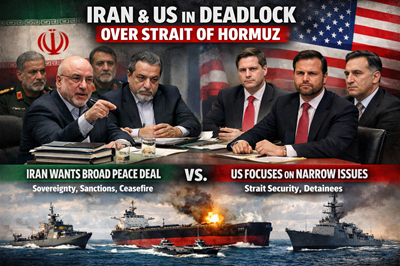
WAR-REPORT : The latest round of negotiations between Iran and the United States has exposed a widening strategic and ideological divide that now threatens to derail diplomatic progress altogether. Despite renewed efforts to de-escalate tensions amid ongoing regional instability, both sides appear locked in fundamentally incompatible visions for what the negotiations should achieve. This growing disconnect has culminated in what insiders have described as a “stalemate,” particularly over the critical issue of the Strait of Hormuz.
At the heart of the impasse lies a stark contrast in objectives. Iran is pursuing a sweeping, all-encompassing agreement designed to fundamentally reset its relationship with the United States and eliminate the long-standing threat of military confrontation. In contrast, the United States is advancing a far narrower agenda, focused primarily on managing the immediate crisis and reducing tensions in key flashpoints, especially maritime security in the Persian Gulf.
Diverging Strategic Visions
The American delegation, led by JD Vance, reflects Washington’s tactical approach. Accompanied by senior figures such as Steve Witkoff and Jared Kushner, the team has focused on limited, issue-specific negotiations. Their priorities reportedly include de-escalation mechanisms in the Strait of Hormuz and secondary humanitarian concerns such as detainee exchanges.
This approach suggests that the United States views the current talks as a crisis-management exercise rather than an opportunity for comprehensive diplomatic normalization. American policymakers appear wary of overextending commitments or engaging in broader concessions that could reshape the geopolitical balance in the region.
Iran, however, is approaching the negotiations from an entirely different perspective. The Iranian leadership has framed the talks as a rare opportunity to secure a long-term strategic settlement with the United States—one that addresses not only immediate tensions but also decades of economic sanctions, military threats, and political hostility.

Iran’s Expansive Demands
Iran’s negotiating position includes a wide array of demands that extend far beyond the immediate scope of the current conflict. These include recognition of its sovereignty claims over the Strait of Hormuz, financial compensation for war-related damages, the release of billions of dollars in frozen assets, and a comprehensive regional ceasefire involving allied groups often referred to as the “Axis of Resistance.”
Such demands reflect Iran’s ambition to reshape not only its bilateral relationship with the United States but also the broader security architecture of the Middle East. However, they also create a significant imbalance in expectations, making compromise increasingly difficult.
According to individuals briefed on the negotiations who spoke to the Financial Times, the talks reached a critical deadlock on April 11, with the status of the Strait of Hormuz emerging as the principal sticking point. This narrow but strategically vital issue has come to symbolize the broader disconnect between the two sides.

The Strategic Importance of the Strait of Hormuz
The Strait of Hormuz is one of the world’s most critical maritime chokepoints, through which a significant portion of global oil supplies passes. Control and security of this waterway have long been a source of tension between Iran and the United States, as well as other global powers.
For the United States, ensuring free navigation through the strait is a non-negotiable priority tied to global economic stability and energy security. Any suggestion of Iranian sovereignty claims over the strait is viewed as unacceptable and potentially destabilizing.
Iran, on the other hand, considers the strait to be within its sphere of influence and sees recognition of its role there as a matter of national sovereignty and strategic necessity. This fundamental disagreement has made it exceedingly difficult to find common ground.
Composition of the Iranian Delegation
Complicating matters further is the composition of Iran’s unusually large and diverse delegation, which numbers at least 70 individuals. The team is jointly led by Mohammad Bagher Ghalibaf and Abbas Araghchi, signaling the high political stakes attached to the negotiations.
The delegation includes a broad mix of diplomats, parliamentarians, economic experts, and individuals affiliated with the Islamic Revolutionary Guard Corps (IRGC). This diverse composition underscores Iran’s intention to address a wide range of issues simultaneously, from security and military concerns to economic sanctions and financial systems.
Notably, the inclusion of Abdolnaser Hemmati highlights the importance Iran places on economic negotiations. Tehran is seeking not only the lifting of sanctions but also access to frozen assets and the development of alternative financial mechanisms to bypass Western restrictions.
Signals of Internal Divisions
While the size and diversity of the Iranian delegation demonstrate the breadth of its ambitions, they also reveal underlying internal tensions within the Iranian political system. Reports suggest that significant infighting occurred among various factions prior to the negotiations.
In particular, disagreements reportedly emerged between Ghalibaf and Araghchi on one side and Ahmad Vahidi on the other. The dispute centered on Vahidi’s attempt to include Mohammad Bagher Zolghadr in the delegation despite his limited diplomatic experience.
The involvement of figures such as Ali Akbar Ahmadian further illustrates the overlapping roles of political, military, and security actors within Iran’s negotiating framework. This complexity suggests that the delegation is not only negotiating with external counterparts but also managing internal power dynamics.
Such internal divisions may hinder Iran’s ability to present a cohesive negotiating position, potentially weakening its leverage at a critical moment.
A Negotiation Built for Deadlock
The current state of negotiations reflects a deeper structural problem: the absence of a shared framework or mutual understanding of the talks’ purpose. While the United States seeks incremental progress on specific issues, Iran is pushing for a comprehensive settlement that addresses long-standing grievances.
This mismatch in expectations creates a situation in which even minor disagreements can escalate into major obstacles. The dispute over the Strait of Hormuz exemplifies this dynamic, as both sides attach vastly different meanings and priorities to the issue.
Moreover, the lack of trust between the two countries continues to cast a long shadow over the negotiations. Decades of hostility, broken agreements, and conflicting regional interests have created an environment in which compromise is viewed with suspicion by both sides.
Broader Regional Implications
The outcome of these negotiations will have far-reaching implications for the Middle East and beyond. A successful agreement could reduce tensions in one of the world’s most volatile regions, improve global energy security, and open the door to broader diplomatic engagement.
Conversely, a failure to reach an agreement could exacerbate existing conflicts, increase the risk of military escalation, and further destabilize the global economy. The stakes are particularly high given the strategic importance of the Strait of Hormuz and its role in global oil supply chains.
Additionally, the involvement of regional actors aligned with Iran adds another layer of complexity. Tehran’s demand for a region-wide ceasefire involving its allied groups underscores its desire to reshape the regional security landscape, a goal that is unlikely to be fully accepted by the United States and its partners.
The Road Ahead
As negotiations remain deadlocked, the prospects for a breakthrough appear uncertain. Both sides face significant domestic and international pressures that limit their flexibility. For the United States, maintaining a firm stance on maritime security and regional stability is paramount. For Iran, achieving meaningful economic relief and strategic recognition is equally critical.
Moving forward, any progress will likely depend on the ability of both parties to narrow their differences and establish a more realistic set of objectives. Confidence-building measures, such as limited agreements on humanitarian issues or maritime safety, could serve as a starting point.
However, without a fundamental shift in approach—particularly regarding the scope and ambition of the negotiations—the risk of continued stalemate remains high.
Our Media Opinion
The ongoing negotiations between Iran and the United States illustrate the challenges of bridging deeply entrenched geopolitical divides. With both sides pursuing fundamentally different goals, the talks have become a microcosm of the broader tensions that define their relationship.
The deadlock over the Strait of Hormuz is not merely a technical disagreement but a reflection of competing visions for regional order and international engagement. Until these underlying differences are addressed, the path to a lasting agreement will remain fraught with obstacles.
In the absence of compromise, the current stalemate may well persist, leaving the region—and the world—on edge as two of its most consequential adversaries struggle to find common ground.
war-times.com
Send an email
12 April 2026