

Kremlin Declares Easter Ceasefire as Fighting Continues to Shape Battlefield
By Samir Singh 'Bharat': Editor In Chief

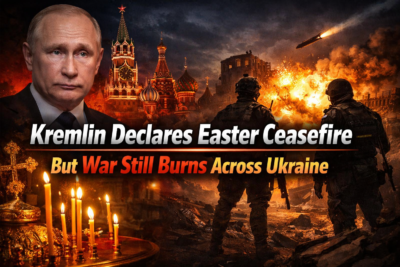
WAR-REPORT : The Kremlin has announced a unilateral, short-term ceasefire across the Ukrainian theater to coincide with the Orthodox Easter holiday, a move that has drawn cautious responses from Kyiv while raising broader questions about Moscow’s strategic intentions. The decree, signed by Vladimir Putin on April 10, orders a temporary halt to combat operations beginning at 1600 Moscow time on April 11, 2026, and lasting until the end of April 12. While presented as a humanitarian gesture tied to a major religious observance, the ceasefire unfolds against a backdrop of continued military maneuvering and limited tactical progress on the battlefield.
According to the Kremlin, the directive instructs Defense Minister Andrey Belousov and Chief of the General Staff Valery Gerasimov to suspend combat operations “in all directions.” The language of the decree suggests an expectation—though not a guarantee—that Ukraine will reciprocate. Moscow stated that it “assumes” Kyiv will follow its example, framing the ceasefire as both a symbolic and practical opportunity for a pause in hostilities during one of the most significant holidays in the Orthodox Christian calendar.
However, the announcement appears to have been made without prior coordination with either Ukraine or international partners. Kremlin spokesperson Dmitry Peskov confirmed on April 9 that no discussions had taken place with the United States or Ukraine regarding the proposed truce. He also dismissed suggestions that the ceasefire might signal a broader resumption of peace negotiations, reinforcing the perception that the move is limited in scope and duration.
Ukraine’s Measured Response
Ukrainian President Volodymyr Zelensky responded cautiously to the announcement, indicating that Ukraine had already proposed a ceasefire during the Easter period and would “act accordingly.” His statement reflects a willingness to observe the pause while simultaneously leaving room for skepticism about Russia’s intentions. Zelensky also noted that Moscow could choose to extend the ceasefire, subtly shifting the burden of responsibility back onto the Kremlin.
The Ukrainian leadership’s reaction underscores a broader pattern seen throughout the conflict: temporary ceasefires are often met with caution due to past instances where such pauses were either violated or used to reposition forces. While Kyiv has not rejected the ceasefire outright, it remains wary of any initiative that lacks transparency or mutual agreement.

Peskov later acknowledged that the Kremlin had taken note of Zelensky’s response, but offered no additional details regarding potential follow-up measures or mechanisms to ensure compliance. This absence of clarity has contributed to uncertainty over how the ceasefire will be implemented on the ground.
Battlefield Realities Undermine Ceasefire Narrative
Even as the ceasefire announcement captures headlines, developments on the battlefield suggest that both sides remain deeply engaged in active operations. In southern Ukraine, Russian forces continue to prioritize offensive actions in the Hulyaipole direction, despite facing persistent Ukrainian counterattacks in adjacent areas.
Military analyst Kostyantyn Mashovets reported on April 10 that the Russian command appears to be focusing its efforts on advancing west of Hulyaipole, an area under the operational control of the 5th Combined Arms Army (CAA) of the Eastern Military District. This prioritization comes at the expense of defensive stabilization in other sectors, particularly the Oleksandrivka direction, where Ukrainian forces have been mounting counteroffensives.

Mashovets noted that Russian commanders have assessed the Ukrainian counterattacks near Oleksandrivka as insufficiently threatening to warrant a shift in strategic priorities. These counterattacks, however, pose a potential risk to the operational rear of Russian units pushing toward Orikhiv, highlighting a calculated gamble by Moscow to maintain offensive momentum rather than reinforce vulnerable positions.
Limited Gains Despite Reinforcements
Despite the concentration of resources in the Hulyaipole sector, Russian forces have struggled to achieve significant territorial gains. Reports indicate that advances in the area have been minimal in recent days, with Ukrainian forces not only holding their ground but in some cases regaining lost territory.
This lack of progress is particularly notable given the reinforcements deployed to support the offensive. Elements of the 40th Naval Infantry Brigade from the Pacific Fleet, the 39th Separate Motorized Rifle Brigade of the 68th Army Corps, and the 38th Separate Motorized Rifle Brigade of the 35th CAA have all been directed to the area. The influx of these units suggests a concerted effort to break through Ukrainian defenses, yet the results have fallen short of expectations.
In contrast, the Russian response to Ukrainian counterattacks in the Oleksandrivka direction has been more limited. Reinforcements in this sector have included elements of the 120th Naval Infantry Division and the 69th Separate Covering Brigade, but these deployments appear insufficient to fully stabilize the front line.
Mashovets reported that units from the 120th Naval Infantry Regiment have been leading counterattacks toward Oleksandrohrad and Sichneve, as well as conducting defensive operations near Voskresnka. However, these efforts have not yielded significant gains, and Ukrainian forces continue to press their advantage in the broader Pryluly-Varvarivka-Oleksandrivka area.
Strategic Implications
The divergence between Russia’s declared ceasefire and its ongoing military priorities highlights the complexity of the current phase of the war. While the Easter truce may provide a temporary reduction in violence in some areas, it does not appear to signal a broader de-escalation of the conflict.
Instead, the ceasefire may serve multiple purposes for Moscow. On one level, it allows the Kremlin to project an image of restraint and humanitarian concern, particularly in the context of a religious holiday. On another level, it could provide an opportunity for Russian forces to regroup, resupply, or reposition without formally acknowledging such intentions.
For Ukraine, the challenge lies in balancing the potential benefits of a temporary pause with the risks associated with reduced vigilance. Any ceasefire, especially one declared unilaterally, carries the possibility of exploitation by the opposing side. As a result, Ukrainian forces are likely to remain on high alert even as they signal their willingness to observe the truce.
The Broader Diplomatic Context
The absence of coordination with the United States and other international actors further complicates the situation. Without a multilateral framework or monitoring mechanism, the ceasefire lacks the safeguards typically associated with negotiated truces. This raises questions about accountability and enforcement, particularly in a conflict where trust between the parties is minimal.
Moreover, Peskov’s dismissal of any link between the ceasefire and renewed negotiations suggests that the move is not intended as a stepping stone toward a broader peace process. Instead, it appears to be a limited, symbolic gesture with uncertain practical impact.
Our Media Opinion
The Kremlin’s Easter ceasefire represents a notable, albeit limited, development in the ongoing war in Ukraine. While it offers a brief window for a potential pause in hostilities, its unilateral nature and the استمرار of active military operations on the ground underscore the challenges of achieving meaningful de-escalation.
As both sides navigate the complexities of the battlefield and the diplomatic arena, the ceasefire serves as a reminder of the gap between symbolic gestures and substantive progress. Whether it leads to a temporary reduction in violence or becomes another episode in the cycle of contested truces will depend largely on actions taken in the hours and days ahead.