

Russian Forces Intensify Drone Campaign Against Civilians
By Samir Singh 'Bharat': Editor In Chief

WAR-REPORT : Russian forces have continued to escalate their use of drone warfare in southern Ukraine, increasingly targeting civilians and civilian infrastructure in what analysts describe as a deliberate and systematic strategy. Recent incidents in Dnipropetrovsk Oblast highlight a troubling pattern in which civilian harm appears not incidental, but intentional—raising serious legal, ethical, and strategic concerns about the conduct of the war.
Russian FPV Drone Attacks Kill and Injure Civilians in Nikopol
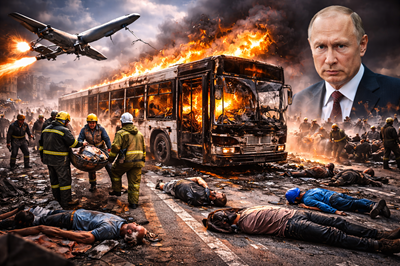
On April 7, the head of the Dnipropetrovsk Oblast Military Administration, Oleksandr Hanzha, reported that Russian forces carried out a first-person view (FPV) drone strike against a city bus in the town of Nikopol. The attack resulted in the deaths of at least four civilians and injured at least 24 others. Later the same day, another drone strike targeted a civilian bus in the Chervonohryhorivka Hromada, located east of Nikopol, injuring at least five additional civilians. These attacks are part of a broader pattern of strikes that have repeatedly hit civilian targets across the region.
Such incidents are not isolated. Since the beginning of Russia’s full-scale invasion in February 2022, Dnipropetrovsk Oblast has experienced consistent attacks on non-military targets. One of the most recent examples occurred on April 4, when a drone strike hit a market in Nikopol, killing five civilians and injuring 28 others. These repeated strikes on clearly civilian locations have drawn widespread condemnation and have reinforced concerns that civilians are being deliberately targeted.
Military analysts and observers have increasingly described these tactics as “human safari,” a term used to characterize the deliberate use of FPV drones to locate and strike individual civilians or civilian groups. Unlike traditional aerial bombardment, FPV drones allow operators to guide munitions with precision in real time, making it possible to specifically identify and target non-combatants. This capability transforms drones into tools not only of battlefield engagement but also of psychological warfare.
The use of such tactics suggests a shift in operational doctrine. Russian forces appear to be integrating civilian targeting into their broader battlefield air interdiction (BAI) strategy. Traditionally, BAI focuses on disrupting enemy military logistics, supply lines, and infrastructure to weaken combat capabilities. However, in this context, the application of BAI has expanded beyond military objectives to include the targeting of civilian roads, transportation systems, and public spaces.

By striking civilian vehicles, markets, and infrastructure in areas near the front lines, Russian forces are effectively attempting to deny access to critical routes and disrupt daily life. This approach not only hampers logistical movement but also instills fear among the civilian population, creating a climate of insecurity and instability. The cumulative effect is both tactical and psychological, aimed at undermining resilience and forcing displacement.
The deliberate targeting of civilians as part of military operations constitutes a violation of international humanitarian law. The laws of armed conflict clearly prohibit attacks on civilian populations and require combatants to distinguish between military and civilian targets. The intentional use of violence against civilians as a method of warfare is widely recognized as a war crime and has been the subject of increasing scrutiny by international organizations and legal bodies.
While the situation in southern Ukraine continues to deteriorate, broader regional tensions are also escalating. The Kremlin has recently issued warnings to the Baltic states, signaling a potential expansion of its confrontational posture beyond Ukraine. On April 7, Russian Ministry of Foreign Affairs spokesperson Maria Zakharova accused Baltic nations of allowing Ukrainian drones to operate within their airspace and warned of unspecified “retaliatory measures” if such activities continue.

These statements were echoed by members of the Russian State Duma, who accused the Baltic states of being complicit in Ukrainian military operations. Some officials went further, suggesting that Russia could take direct action against any drones operating in Baltic airspace and even consider imposing “blockades” against these countries. Although these claims remain unverified, they indicate a growing willingness by Russian officials to escalate rhetoric and potentially justify future actions.
The implications of such statements are significant. By framing the Baltic states as participants in the conflict, Russia may be attempting to create a pretext for extending military operations into new areas. This raises concerns about the stability of the broader region, particularly given that the Baltic states are members of NATO. Any escalation involving these countries could have far-reaching consequences for international security.
Amid these developments, Ukraine has continued to signal its willingness to pursue de-escalation through diplomatic means. President Volodymyr Zelensky has reiterated proposals for temporary ceasefires, including a pause in hostilities during the Easter holiday period and a moratorium on strikes targeting energy infrastructure. On April 6, Zelensky stated that Ukraine is prepared to halt attacks on Russian energy facilities if Russia agrees to do the same.
Zelensky’s proposals reflect an effort to reduce the humanitarian impact of the conflict and create conditions for further negotiations. The suggested ceasefire during the Orthodox Easter period, observed on April 12, is intended as a confidence-building measure that could pave the way for broader agreements. Additionally, the focus on energy infrastructure highlights the importance of protecting critical systems that affect millions of civilians.
According to Zelensky, the United States has already conveyed Ukraine’s proposals to Russia and is working with Kyiv to formalize security guarantees that would accompany any agreement. These guarantees could include mechanisms to monitor compliance and ensure that both sides adhere to the terms of the ceasefire. However, the success of such efforts depends largely on Russia’s willingness to engage constructively.
To date, Russian officials have shown little inclination to accept these proposals. Previous ceasefire offers, including those focused on humanitarian corridors and infrastructure protection, have been rejected or ignored. The continued use of aggressive tactics, including drone strikes on civilian targets, suggests that Russia may be prioritizing military objectives over diplomatic engagement.
This divergence in approaches underscores the challenges facing efforts to resolve the conflict. While Ukraine has demonstrated a willingness to explore compromises and reduce hostilities, Russia’s actions indicate a different strategic calculus. The persistence of attacks on civilians, combined with escalating rhetoric toward other countries, points to a broader pattern of confrontation.
The humanitarian consequences of the conflict remain severe. Civilians in affected regions face constant threats to their safety, limited access to essential services, and ongoing displacement. The targeting of public spaces and infrastructure exacerbates these challenges, making it increasingly difficult for communities to function and recover.
International responses to these developments have emphasized the need for accountability and adherence to the rules of war. Calls for investigations into alleged war crimes have intensified, with various organizations documenting incidents and gathering evidence. Ensuring accountability for violations of international law will be a critical component of any long-term resolution.
In conclusion, the continued use of drone strikes against civilian targets in southern Ukraine represents a deeply concerning evolution in the conflict. These actions not only violate established norms of warfare but also contribute to a cycle of violence that undermines prospects for peace. At the same time, rising tensions with the Baltic states and the rejection of ceasefire proposals highlight the broader risks of escalation.
As the situation unfolds, the international community faces the challenge of addressing both the immediate humanitarian crisis and the underlying dynamics driving the conflict. Diplomatic efforts, while difficult, remain essential to preventing further escalation and achieving a sustainable resolution. The path forward will require a combination of pressure, negotiation, and a renewed commitment to the principles of international law and human dignity.