


Governance Crisis in India? RPC Chief Meda Srinivas Calls for Police, Judiciary Reforms
By Doruvu Paul Jagan Babu: Assistant Chief Editor

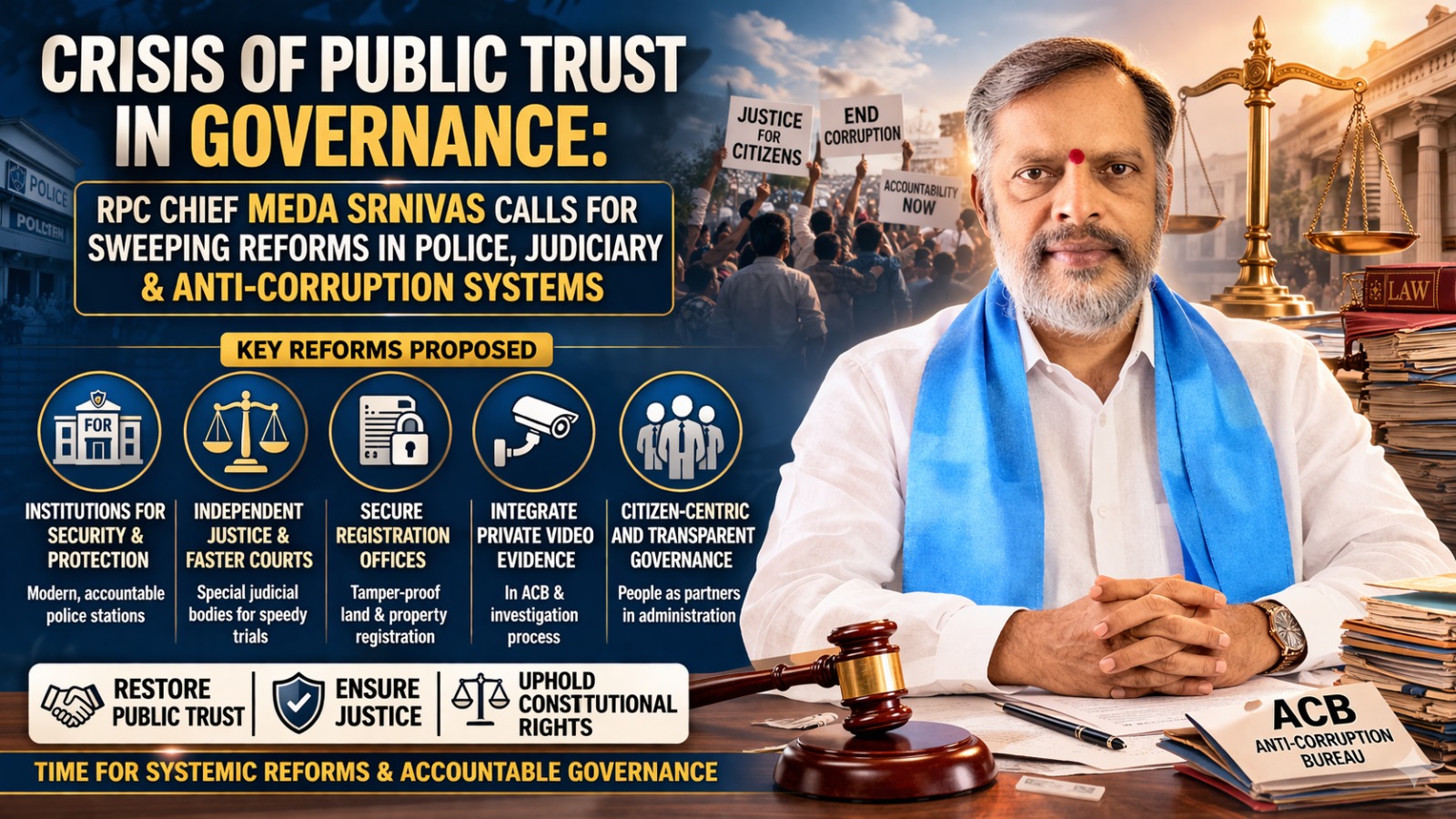
Amid growing public distrust in governance and institutional accountability, Rashtriya Praja Congress (RPC) Founder-President Meda Srinivas has called for comprehensive structural reforms across the police, judicial, revenue, and anti-corruption systems, warning that systemic failures are eroding citizens’ faith in justice, transparency, and rule of law.
Demand for structural overhaul in governance systems
Addressing pressing concerns over governance failures, Meda Srinivas emphasized the urgent need to establish dedicated institutions focused on public safety, justice delivery, and secure administrative processes. He proposed creating specialized centers akin to police stations for protection, independent judicial mechanisms for faster justice, and highly secure registration systems to safeguard property rights.
Police system under political influence
Srinivas expressed concern that the police system, once known for discipline and integrity, is increasingly influenced by political forces. He alleged that law enforcement agencies are failing to uphold law and order, leaving victims hesitant to approach police stations while emboldening offenders. He stressed that political interference has weakened the autonomy and effectiveness of policing.

To address this, he suggested separating FIR registration from criminal investigation by assigning investigations to an independent specialized department, thereby ensuring professionalism and accountability.
Judicial delays and erosion of faith in justice
Highlighting inefficiencies in the judicial system, Srinivas pointed to delays, flawed investigations, and lack of witness protection as major obstacles to justice delivery. He noted that prolonged trials and frequent acquittals due to weak evidence are diminishing public confidence.

He recommended the establishment of special judicial bodies with statutory backing to ensure faster trials and reliable outcomes, particularly in complex cases.
Revenue and registration departments under scrutiny
Srinivas raised serious concerns over corruption and irregularities in revenue and registration departments, particularly in land-related matters. He alleged that forged documents are often granted legal validity, leaving rightful property owners entangled in prolonged disputes with little hope for resolution.
He proposed integrating all land-related departments—including revenue, municipal, and registration authorities—to ensure real-time verification and protection of property ownership during registration itself.
Anti-Corruption Bureau faces public criticism
The functioning of the Anti-Corruption Bureau (ACB) also came under sharp criticism. Srinivas noted that despite public complaint mechanisms, corruption continues unabated across government offices. He alleged that delays in action and lack of accountability have rendered the system ineffective.
To strengthen anti-corruption efforts, he advocated for making the ACB an independent body, separate from the police, and incorporating digital, audio, and video evidence submitted by citizens into official procedures. He also suggested incentivizing whistleblowers to encourage public participation in combating corruption.
Call for citizen-centric governance
Srinivas underscored the need for governments to restore public trust by ensuring transparency, accountability, and citizen participation. He warned that the current administrative framework is pushing victims toward frustration and despair, and in extreme cases, even self-harm.
He concluded by urging authorities to undertake a comprehensive review of governance systems and implement reforms that prioritize justice, efficiency, and public confidence.
A growing trust deficit
The observations reflect a broader concern over declining public trust in institutions meant to uphold justice and governance. Experts note that without systemic reforms, the gap between citizens and state institutions may continue to widen, posing long-term challenges to democratic stability and social order.