

Ukraine’s Expanding Long-Range Strike Campaign Targets Russian Oil 2026
By Samir Singh 'Bharat': Editor In Chief
 war-times.com
Send an email
7 April 2026
war-times.com
Send an email
7 April 2026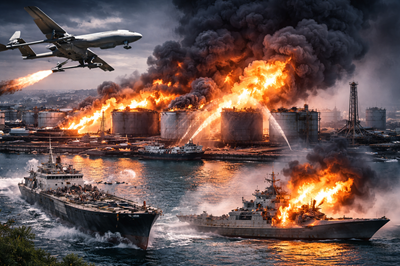
WAR-REPORT : Ukraine has significantly intensified its long-range strike campaign against Russian energy infrastructure, marking a new phase in the conflict characterized by strategic precision and economic targeting. These operations, focused particularly on oil export facilities and naval assets, are increasingly exposing vulnerabilities in Russia’s air defense systems while simultaneously inflicting tangible damage on its energy sector—one of the most critical pillars of its wartime economy.
A notable example of this campaign occurred overnight between April 5 and April 6, when Ukrainian forces launched a coordinated strike on the Sheskharis oil terminal near the port of Novorossiysk in Krasnodar Krai. According to the Ukrainian General Staff, the attack resulted in a significant fire at the facility, disrupting operations at one of Russia’s key oil export hubs. This claim was supported by geolocated footage released on April 6, which showed large fires burning at oil tanker berths within the port.
The Russian Ministry of Defense later acknowledged that Ukrainian forces had indeed struck oil terminals in Novorossiysk, confirming the scale and effectiveness of the operation. Additional insights from industry sources, cited by international media, indicated that the fires had spread across the main pier operated by Transneft, Russia’s state-controlled pipeline and petroleum transportation company. The damage reportedly affected multiple tanker berths, potentially disrupting the loading and export of crude oil.
Satellite-based monitoring systems further corroborated these developments. Data from NASA’s Fire Information for Resource Management System (FIRMS) detected heat anomalies at the Sheskharis oil terminal beginning on April 5, providing independent confirmation of the fires and their intensity. This convergence of military, visual, and satellite evidence underscores the credibility of the reports and highlights the growing sophistication of Ukraine’s strike capabilities.
In addition to targeting energy infrastructure, Ukrainian forces have also expanded their operations to include high-value naval assets. Ukrainian Unmanned Systems Forces Commander Major Robert “Magyar” Brovdi reported that Ukrainian drones struck the Admiral Makarov, a Russian Admiral Grigorovich-class frigate, in the port of Novorossiysk during the same overnight operation. Geolocated footage appears to show drones impacting the vessel, suggesting that Ukraine is increasingly capable of conducting precision strikes against maritime targets within Russian-controlled ports.

These developments point to a broader strategic objective: to degrade Russia’s ability to sustain its war effort by targeting critical nodes in its logistics and energy networks. Oil exports represent a major source of revenue for Russia, and disruptions to this sector can have cascading effects on its economy and military operations. By focusing on infrastructure such as terminals, pipelines, and storage facilities, Ukraine is attempting to impose economic costs that extend beyond the battlefield.
At the same time, these strikes are placing significant pressure on Russia’s air defense systems. Russian military bloggers, including those with links to the Kremlin, have openly criticized the effectiveness of current defenses in the face of persistent Ukrainian drone and missile attacks. One prominent commentator noted that the frequency and scale of Ukrainian strikes are “stretching” Russia’s surface-to-air missile systems to their limits, leading to accelerated depletion of ammunition stocks.
The issue of missile supply has emerged as a critical constraint. According to these sources, Russia is unable to produce large quantities of air defense missiles—such as those used in Pantsir systems—at a rate sufficient to meet current operational demands. This has raised concerns about the sustainability of Russia’s defensive posture, particularly as Ukraine continues to refine and expand its strike capabilities.

The criticism extends beyond production capacity to include tactical and operational shortcomings. Some Russian analysts have argued that the country’s air defense strategy needs to evolve in response to the changing nature of the threat. They have pointed to Ukraine’s use of mobile fire groups, interceptor drones, and acoustic reconnaissance systems as examples of innovative approaches that could be adapted to improve Russian defenses.
The strain on air defense systems is further compounded by the need to protect a wide range of targets across a vast geographic area. From oil terminals and industrial facilities to military bases and urban centers, Russia must allocate its limited resources across multiple priorities. This dispersion reduces the effectiveness of defenses in any given location and creates opportunities for Ukrainian forces to exploit gaps.
The impact of Ukrainian strikes is not limited to immediate physical damage. The resources required to repair infrastructure, restore operations, and reinforce defenses represent a significant burden on Russia’s economy and military logistics. Frequent attacks also disrupt planning and operations, forcing Russian authorities to divert attention and resources away from other priorities.
Another notable aspect of Ukraine’s campaign is its use of daytime drone strikes. These operations challenge traditional assumptions about air defense, which are often optimized for nighttime or low-visibility conditions. By conducting strikes during daylight hours, Ukraine is further stretching Russian defenses and increasing the likelihood of successful engagements.
The systematic nature of these attacks suggests a well-coordinated strategy aimed at achieving cumulative effects over time. Rather than relying on isolated high-impact strikes, Ukraine appears to be pursuing a sustained campaign that gradually erodes Russia’s capabilities. This approach aligns with broader principles of asymmetric warfare, in which a less resource-rich actor seeks to offset disadvantages through innovation and targeted operations.
The vulnerability of Russian naval assets has also come into sharper focus. Warships stationed at ports such as Novorossiysk are increasingly within range of Ukrainian drones, raising questions about their security. The reported strike on the Admiral Makarov highlights the risks faced by these vessels and underscores the need for enhanced protective measures.
While Ukraine’s offensive capabilities are expanding, Russia is facing growing challenges in maintaining its manpower levels. Reports indicate that the Russian military is struggling to recruit sufficient numbers of contract soldiers to replace losses on the front lines. According to data released by Ukraine’s “I Want to Live” initiative, the Russian Ministry of Defense has fallen short of its recruitment targets for 2026.
To meet its annual goal of 409,000 contract soldiers, Russia would need to recruit approximately 1,100 to 1,150 individuals per day. However, during the first three months of the year, the average daily recruitment rate was reportedly around 940 soldiers. This shortfall suggests that Russia may face difficulties sustaining its current level of operations over the long term.
The recruitment challenges are compounded by the demographic and socio-economic profile of new recruits. Reports indicate that a significant proportion of contract soldiers—around 24 percent—are under criminal investigation or have prior convictions. Additionally, nearly 40 percent of these individuals are reported to be in debt. These factors raise questions about the quality, motivation, and long-term reliability of the personnel being recruited.
To address these challenges, the Russian Ministry of Defense is reportedly focusing its recruitment efforts on specific regions, including the Central and Volga federal districts. There are also indications that recruitment is continuing in occupied areas of Ukraine, which may reflect efforts to supplement domestic recruitment with local sources.
The combination of manpower shortages and material constraints presents a complex challenge for the Russian military. While it continues to maintain significant capabilities, the cumulative effects of sustained Ukrainian pressure are becoming increasingly apparent. The need to defend critical infrastructure, replenish depleted resources, and recruit new personnel is placing strain on multiple aspects of the system.
From a strategic perspective, Ukraine’s campaign represents an effort to shift the balance of the conflict by targeting vulnerabilities that extend beyond the front lines. By focusing on economic and logistical nodes, Ukraine is seeking to impose costs that are difficult for Russia to absorb. This approach also has the potential to influence international perceptions and support, as it demonstrates Ukraine’s ability to conduct effective operations against a larger adversary.
At the same time, the escalation of long-range strikes carries risks. It may prompt retaliatory actions by Russia, potentially leading to further intensification of the conflict. The targeting of infrastructure also raises broader questions about economic stability and the potential impact on global markets, particularly in the energy sector.
In conclusion, Ukraine’s expanding long-range strike campaign against Russian oil infrastructure marks a significant evolution in the conflict. By exploiting weaknesses in air defense systems and targeting critical economic assets, Ukraine is achieving strategic effects that extend beyond immediate battlefield outcomes. However, the long-term implications of this approach will depend on a range of factors, including Russia’s ability to adapt, the sustainability of Ukraine’s operations, and the broader geopolitical context. As the conflict continues, the interplay between military innovation, economic pressure, and resource constraints will remain central to its trajectory.
war-times.com
Send an email
7 April 2026