

7 Stark Signs Russia’s Internet Crackdown Is a Strategic Power Shift Amid Prolonged War
By Samir Singh 'Bharat': Editor In Chief
 war-times.com
Send an email
26 February 2026
war-times.com
Send an email
26 February 2026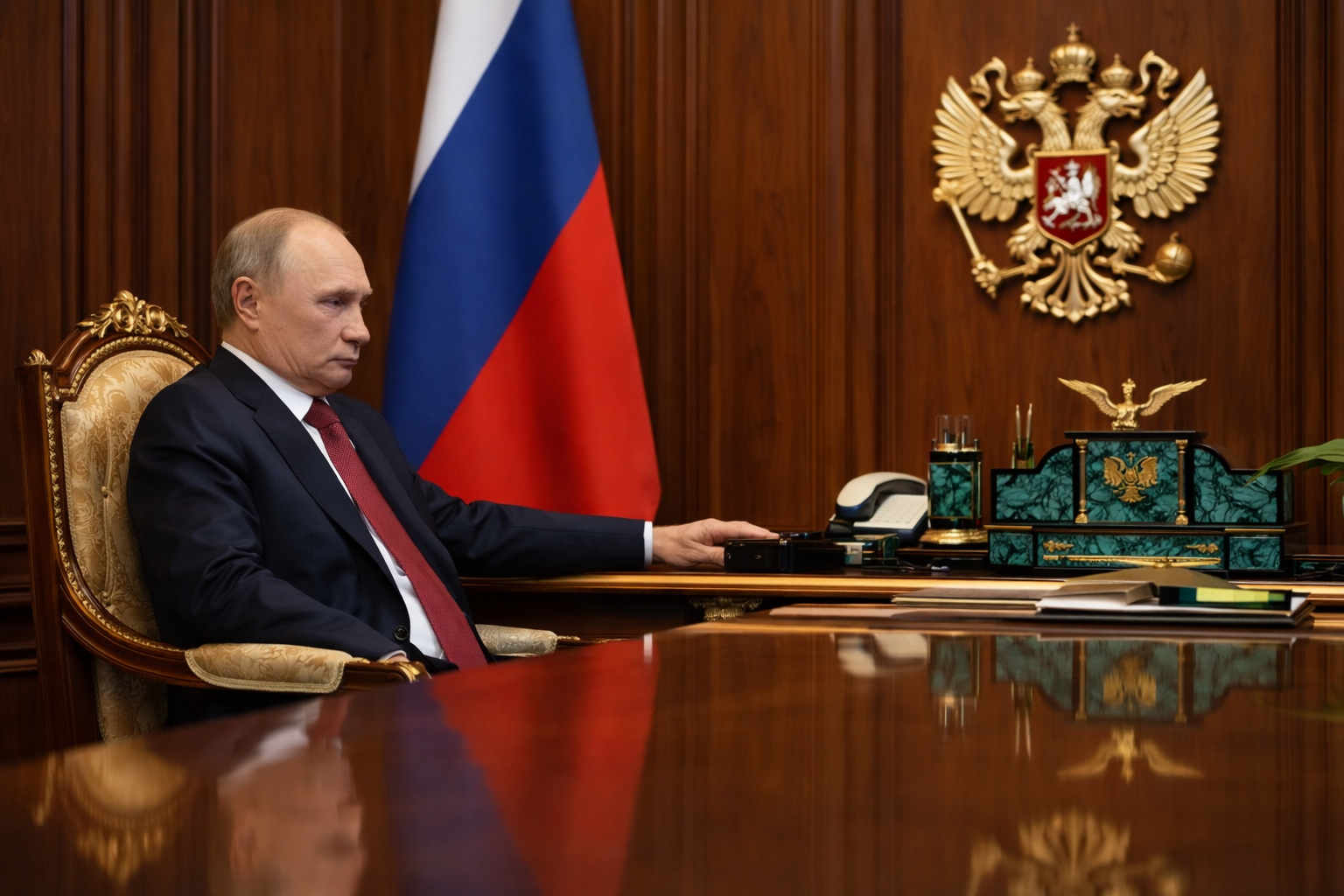
WAR-REPORT : The Kremlin significantly intensified its campaign to dismantle the open internet in Russia throughout 2025 and into 2026, moving decisively to consolidate control over online narratives, suppress anti-war and anti-regime voices, and prepare Russian society for a protracted conflict in Ukraine and the possibility of broader confrontation with NATO. The expansion of censorship, surveillance, and digital restrictions marks a critical phase in the evolution of Russia’s information policy—one shaped by lessons learned from earlier failures and growing anxiety within the leadership about regime stability.
This latest wave of restrictions reflects mounting pressures on President Vladimir Putin as Russia enters the fifth year of its full-scale war in Ukraine. What began as a strategy to control information during wartime has evolved into a systemic effort to restructure Russia’s digital environment into a tightly managed, state-dominated space reminiscent of Soviet-era controls—albeit powered by modern surveillance technologies.
Learning from Early Missteps
The Kremlin’s tightening grip on the internet did not begin in 2025. It traces back at least to late 2022, when Moscow recognized that it had failed to secure informational dominance ahead of the February 2022 invasion of Ukraine. In the months leading up to the invasion, Russia maintained a partially open internet ecosystem, allowing independent journalists, bloggers, and civil society actors to circulate information freely across global platforms.
When Russian forces entered Ukraine, alternative reporting, battlefield footage, and casualty accounts quickly flooded online channels. Domestic criticism—though constrained—spread faster than the Kremlin anticipated. The situation intensified in September 2022 when the government announced a “partial mobilization.” The declaration sparked widespread anxiety, protests in multiple cities, and a mass exodus of military-age men. Much of the public reaction unfolded online, underscoring how digital networks could amplify dissent and expose policy miscalculations.
From that moment forward, Russian authorities began systematically recalibrating their approach. What had been reactive censorship evolved into a proactive campaign to redesign the digital sphere itself.

Dismantling Pro-War Civil Criticism
One of the less visible but significant elements of the campaign has been the dismantling of pro-war civil groups that criticized the conduct—not the premise—of the war. Certain nationalist bloggers and volunteer networks, often referred to as “milbloggers,” initially supported the invasion but became vocal critics of military leadership, corruption, and logistical failures.
Rather than tolerate internal criticism from ostensibly loyal constituencies, the Kremlin moved to neutralize these voices. Through legal pressure, arrests, intimidation, and co-optation, authorities either silenced or integrated influential figures into state-controlled structures. The objective was not merely to suppress anti-war activists but to eliminate all unsanctioned narratives—whether oppositional or ultra-nationalist—that might challenge centralized messaging.
This signaled a broader shift: the Kremlin no longer distinguished between hostile and inconvenient speech. Any discourse outside official channels risked being labeled destabilizing.


Building Physical and Cyber Control
The escalation in 2025 involved not only legal measures but also infrastructure changes. Authorities expanded efforts to isolate the Russian segment of the internet from the global web, enhancing capabilities for traffic rerouting, deep packet inspection, and platform blocking. Independent outlets and foreign-based platforms faced heightened throttling or outright bans.
In parallel, the state strengthened domestic alternatives to global services—search engines, social media networks, messaging apps, and video platforms that operate under Russian jurisdiction. These platforms comply with data localization laws and cooperate with security agencies.
The Kremlin’s long-term objective appears to be the creation of a “sovereign internet” system capable of functioning independently from global networks. This structure would allow authorities to sever external connections during crises while maintaining domestic connectivity under state supervision.
Such measures align with warnings issued in recent years by organizations including the Institute for the Study of War, which has argued that Moscow aims to construct a digital architecture that fuses surveillance, censorship, and propaganda into a unified control system.
Waning Confidence Behind the Escalation
The renewed intensity of censorship suggests that Putin may not feel as secure domestically as the Kremlin’s public messaging implies. As Russia entered the fifth year of its war, the cumulative effects of battlefield losses, economic strain, and demographic pressures began to converge.
Putin faces a triad of competing imperatives: sustaining military operations in Ukraine, preserving economic stability amid Western sanctions, and preventing widespread societal discontent. Balancing these demands was challenging even in the early stages of the conflict; by 2025, it became markedly more difficult.
Military recruitment rates reportedly declined as casualties mounted and public enthusiasm waned. Maintaining offensive operations required increased financial incentives and expanded recruitment campaigns, raising defense expenditures significantly. At the same time, labor shortages—exacerbated by mobilization and emigration—strained key sectors of the economy.
For ordinary Russians, inflationary pressures and reduced purchasing power made the war’s economic costs increasingly tangible. As the burden shifted from abstract geopolitical narratives to household budgets, dissatisfaction risked becoming more widespread.
Economic Tradeoffs and Public Sacrifice
In response to mounting fiscal pressure, the Kremlin began making decisions that directly affected citizens’ livelihoods. For the first time in November 2025, authorities reportedly tapped into portions of Russia’s gold reserves to stabilize finances. The government also increased the value-added tax (VAT) on a range of consumer goods, effectively transferring part of the war’s financial burden onto the broader population.
Simultaneously, stricter regulations were introduced regarding veterans’ benefits and compensation frameworks. While framed as administrative adjustments, such measures signaled tightening fiscal constraints.
These economic tradeoffs marked a turning point. For years, the Kremlin sought to insulate much of the population from the immediate costs of the war. By 2025, insulation was no longer fully feasible. The leadership appeared to anticipate that unpopular economic decisions could spark renewed criticism—especially in digital spaces where grievances can spread rapidly.
The intensification of internet controls coincided with these fiscal measures, suggesting a defensive motivation: to preempt backlash rather than demonstrate confidence.
Preparing the Information Space for a Long War
The Kremlin’s actions indicate preparation not only for ongoing conflict in Ukraine but also for the possibility of confrontation with NATO. Official rhetoric increasingly frames the war as part of a broader struggle against Western powers, portraying sanctions and military aid to Ukraine as existential threats to Russian sovereignty.
To sustain public support for such a narrative over an extended period, authorities require a tightly managed information ecosystem. Open debate, independent fact-checking, or viral dissent could undermine mobilization efforts and weaken resolve.
The internet, once a space for pluralistic expression in Russia’s major cities, is being transformed into a tool of mobilization and surveillance. Algorithms favor state-approved content, and online discourse is monitored for signs of “discrediting” the armed forces or spreading “false information.”
Digital Surveillance and the New Police State
Beyond censorship, the Kremlin is weaponizing digital infrastructure to expand surveillance capabilities. Integration of biometric systems, facial recognition in urban centers, and mandatory SIM card registrations strengthens the state’s ability to track individuals’ movements and communications.
This emerging model has prompted comparisons to Soviet-era practices, though updated with twenty-first-century technology. Instead of relying solely on informants and paper files, modern systems leverage data analytics and artificial intelligence to flag dissent in real time.
The result is not merely the suppression of visible protest but the cultivation of self-censorship. When citizens assume that their online behavior is monitored, they may refrain from expressing controversial opinions altogether.
The Calculus of Vulnerability
The scale and timing of the crackdown suggest it stems from perceived vulnerability rather than triumph. If the Kremlin were confident in unwavering public support, such extensive measures might be unnecessary.
Instead, the leadership appears to calculate that the intersection of military attrition, economic hardship, and prolonged uncertainty increases the risk of instability. By consolidating digital control, authorities seek to eliminate or minimize platforms where dissatisfaction could coalesce into organized opposition.
The strategy is preventive: neutralize the channels of dissent before grievances crystallize into coordinated movements.
Long-Term Implications
The transformation of Russia’s internet landscape has profound implications for its society and global relationships. Domestically, it narrows the space for civic engagement, independent journalism, and political pluralism. Generational divides may widen as younger Russians—accustomed to global connectivity—encounter increasing restrictions.
Internationally, the shift contributes to the fragmentation of the global internet into nationalized segments governed by divergent rules and values. Russia’s model could inspire similar approaches in other states seeking to assert digital sovereignty and control.
For Putin, the challenge remains balancing coercion with stability. Excessive repression can deter open protest but may also breed quiet resentment. Economic pressures and demographic shifts will continue to test the regime’s resilience.
As Russia moves deeper into a prolonged conflict, the Kremlin’s campaign to dismantle the open internet stands as a central pillar of its domestic strategy. What began as reactive censorship following mobilization backlash has evolved into a comprehensive restructuring of the digital sphere.
Facing difficult decisions about military recruitment, economic sustainability, and public sacrifice, Putin appears determined to secure the informational battlefield at home as tightly as the one abroad. The intensified controls of 2025 and 2026 reflect not merely authoritarian reflex but strategic calculation in a moment of mounting strain.
Whether this digital consolidation will ensure long-term regime stability remains uncertain. What is clear, however, is that Russia’s internet—once relatively open by regional standards—is being reshaped into a controlled domain designed to serve the demands of war, governance, and political survival.
war-times.com
Send an email
26 February 2026