

Philippines and India Hold First Joint Naval Patrol Amid Rising South China Sea Tensions
Samir Kr. Singh: Editor-in-Chief

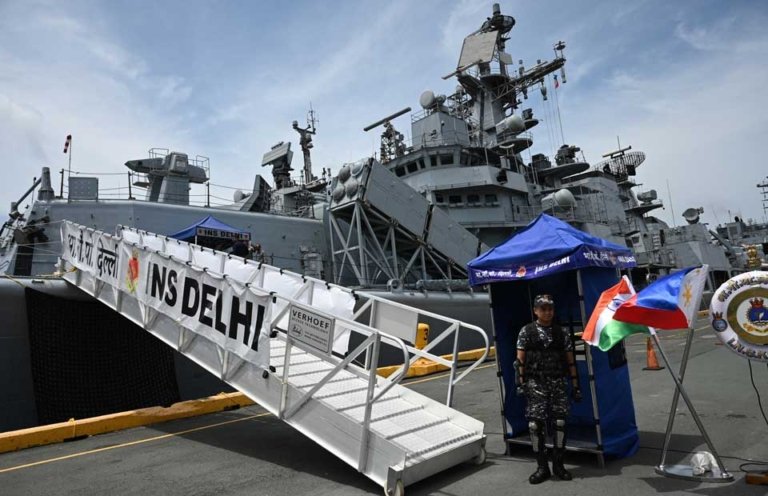
New Delhi : The Philippines and India conducted their first-ever joint naval patrol in the South China Sea on August 3–4, operating within the Philippine Exclusive Economic Zone (EEZ) east of Luzon. The “maritime cooperative activity” involved two Philippine missile frigates, an Indian missile destroyer, an Indian anti-submarine corvette, an Indian fleet tanker, and several aircraft.
The patrol featured combat drills, including surface warfare, anti-air warfare, and anti-submarine exercises. It concluded just as Philippine President Ferdinand Marcos Jr. began his state visit to India (August 4–8), during which the two countries signed several defense cooperation agreements and pledged to hold more bilateral and multilateral naval drills in the future.
China reacted swiftly. The PLA Southern Theater Command launched a “routine patrol,” shadowing the Philippine and Indian vessels. PLA spokesperson Tian Junli accused Manila of “co-opting foreign countries to disrupt the situation in the South China Sea.” The Chinese Ministry of Foreign Affairs also reiterated that disputes should be resolved only between the parties directly involved, with no “third party” interference.
Collision Near Scarborough Shoal Highlights Growing Risks
Tensions escalated further on August 11, when China Coast Guard (CCG) and PLA Navy ships attempted to block a Philippine resupply mission near Scarborough Shoal. The maneuver resulted in a collision between a PLA destroyer and a CCG vessel.

Video footage released by Manila showed the PLA destroyer Guilin cutting in front of CCG ship 3104, which was chasing a Philippine Coast Guard (PCG) vessel. The collision caused serious damage to the CCG ship. Despite the clash, the PCG confirmed that the resupply mission was completed successfully, and the Philippines even offered medical aid to the injured Chinese crew.

China, however, denied responsibility. MFA spokesperson Lin Jian accused the Philippines of “deliberate provocations,” claiming that multiple Philippine coast guard and fishing vessels had intruded into Chinese waters. The CCG defended its operation as “professional, legitimate, and legal,” and accused Manila of disguising supply missions as fishing activities.

The incident marks a significant escalation. In previous years, confrontations at Scarborough Shoal were largely managed by the CCG, while PLA Navy vessels usually kept to the perimeter. The direct involvement of a PLA destroyer in blocking maneuvers suggests a shift in China’s approach, though analysts note that the PLA’s limited experience in close-quarters interception may have contributed to the accident.
South Korea Postpones US Joint Drills Amid Inter-Korean Concerns
Meanwhile, in Northeast Asia, South Korea announced the postponement of 20 out of 40 planned field training exercises (FTXs) under the Ulchi Freedom Shield (UFS), its largest annual drill with the United States. The exercise involves more than 18,000 troops from both nations and combines command post simulations with field operations against potential North Korean threats.
While the Joint Chiefs of Staff (JCS) cited an “extreme heatwave” as the reason for postponement during an August 7 press briefing, other officials suggested a political motive. The Unification Ministry indicated that the decision was likely influenced by Minister Chung Dong-Young’s July 28 recommendation to President Lee Jae-myung to reduce the scale of the drills. Since taking office on July 25, Chung has pushed for policies aimed at easing inter-Korean tensions and fostering a more peaceful atmosphere on the peninsula.