


Government asserts legal powers to curb fake news and misinformation
By Doruvu Paul Jagan Babu: Assistant Chief Editor

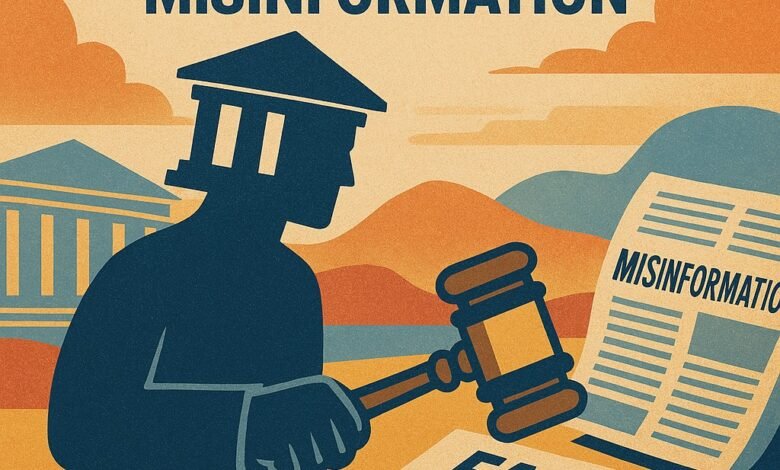
New Delhi: Union Minister of State for Information and Broadcasting, Dr. L Murugan, informed the Lok Sabha on Wednesday that the government has both a constitutional responsibility and a legal framework in place to counter fake news and misinformation across print, television, digital, and OTT platforms.
Legal measures across media sectors*

The minister outlined the regulatory provisions governing different media formats to prevent the dissemination of misleading or false information.
Print media regulations
Newspapers are bound by the “Norms of Journalistic Conduct” established by the Press Council of India (PCI). Under Section 14 of the PCI Act, violations such as publishing fake, defamatory, or misleading news are investigated, and punitive actions like warnings, admonishments, or censure may be taken against erring newspapers, editors, or journalists.

Television programme code
Television channels must comply with the Programme Code under the Cable Television Networks (Regulation) Act, 1995. This includes a prohibition on content that is obscene, defamatory, deliberately false, or misleading. The 2021 amendment to the Cable Television Network Rules introduced a three-tier grievance redressal system to handle public complaints.
Digital news and current affairs
Digital news publishers are subject to the Information Technology (Intermediary Guidelines and Digital Media Ethics Code) Rules, 2021. These rules include a Code of Ethics to ensure accountability in online content related to news and current affairs.
Fact check mechanism for government-related news
A Fact Check Unit (FCU) under the Press Information Bureau (PIB) was established in November 2019 to verify and counter fake news related to the Central Government. Verified corrections are shared through PIB’s official social media handles.
Blocking powers under IT act
Invoking Section 69A of the Information Technology Act, 2000, the government can block access to websites, social media accounts, and posts that threaten India’s sovereignty, security, public order, or national integrity.
OTT platforms: Ethics code and advisory
The Information Technology Rules, 2021, also cover Over-the-Top (OTT) content platforms.
Part III of these rules mandates age-based self-classification and prohibits the hosting of content that violates Indian laws.
OTT platforms must restrict access to inappropriate content for minors using effective parental control mechanisms.
Section 79(3)(b) of the IT Act, 2000, empowers the government to instruct intermediaries to remove or disable access to unlawful content.
To ensure compliance, the Ministry issued an advisory on February 19, 2025, directing OTT platforms and their self-regulatory bodies to strictly adhere to Indian laws and the IT Rules. As of now, 43 OTT platforms have been blocked following consultations with concerned ministries.