

Syrian Democratic Forces Agree to Ceasefire, Cede Territory to Government
By Samir Singh 'Bharat': Chief Editor


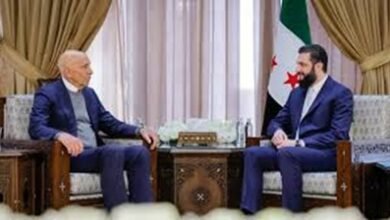
WAR-REPORT : The US-backed, Kurdish-led Syrian Democratic Forces (SDF) agreed to a ceasefire with the Syrian government on January 18, marking a major political and military setback for the SDF. The agreement effectively represents a capitulation after sustained government military operations and widespread tribal uprisings forced the SDF to withdraw from nearly half of its territory, particularly from predominantly Arab areas.
Under the terms of the ceasefire, the Syrian government immediately assumes control of Deir ez Zor and Raqqa provinces, while Hasakah Province will be gradually integrated into the Syrian state. The government will also take over responsibility for ISIS detention facilities and the al-Hol internally displaced persons (IDP) camp, which houses tens of thousands of people, including many suspected ISIS supporters.


A central provision of the agreement requires the SDF to dissolve its forces as an independent military entity. SDF fighters will instead be integrated individually into the Syrian Ministry of Defense, a condition long rejected by SDF leadership due to concerns that it would leave Kurdish-majority areas without an autonomous defense force. An exception was made for Kobani, where local residents will form a city-based security force.
The ceasefire marks the collapse of years of SDF resistance to Damascus’ demands and constitutes a significant defeat for more pragmatic SDF leaders, including SDF commander Mazloum Abdi and civilian leader Ilham Ahmed. Both figures had previously supported negotiated settlements, including earlier ceasefires in Aleppo, but were repeatedly overruled by hardline factions within the SDF leadership aligned with the Kurdistan Workers’ Party (PKK).

Clashing Visions for Syria’s Political Future
Since the fall of the Assad regime, the Syrian government and the SDF have advanced sharply different visions for the country’s future. President Ahmed al-Shara’s government seeks to establish a centralized, unitary state, largely replicating the administrative structure of the former Assad system, though now dominated by Syria’s Sunni Arab majority.
While the government publicly endorses decentralization, it has largely referenced Law 107, an Assad-era framework that grants limited administrative and economic authority to local councils but places them under the authority of centrally appointed governors. In practice, this system historically concentrated power at the provincial level while restricting genuine local autonomy.


For Syria’s Kurdish population, long subjected to political repression under the Assad regime and fearful of renewed violence from figures now holding power in Damascus, these assurances offered little comfort. As a result, the SDF pushed for a federal, decentralized political system that would preserve its existing governance model in northeastern Syria. While this model formally emphasized local representation, many leadership positions would likely have remained in the hands of SDF-affiliated officials.
Damascus rejected the SDF proposal as a veiled attempt at separatism, while the SDF viewed the emerging government as authoritarian in nature. These positions proved irreconcilable without either significant ideological compromise or coercion.
Hardliners and the Road to Confrontation
Hardline elements on both sides ultimately undermined prospects for compromise. In October 2025, senior SDF officials had verbally agreed to integrate three divisions and several independent battalions into the Syrian army. However, the SDF later reversed course and introduced additional demands.
According to US officials, internal divisions within the SDF repeatedly weakened the authority of Mazloum Abdi. PKK-aligned leaders within the SDF coalition reportedly blocked agreements unless all factions consented, frequently introducing new conditions or ordering SDF units to continue fighting even after Abdi had committed to ceasefires, including those in Aleppo.
On the government side, senior officials increasingly viewed military action as a viable alternative if negotiations failed. While Damascus signaled openness to continued talks beyond the official integration deadline at the end of 2025, it ultimately concluded that force would yield faster and more decisive results than prolonged negotiations.
The Syrian government also coordinated closely with Turkey, which has long advocated for decisive action against the SDF. Ankara has consistently pressed Damascus to use military pressure to dismantle the SDF, viewing it as inseparable from PKK influence.
The January 18 ceasefire reflects the culmination of these dynamics—internal fractures within the SDF, mounting military pressure, and regional alignment against Kurdish autonomy—bringing an end to the SDF’s experiment in self-rule across much of northeastern Syria.